In the world of mineral processing, construction materials, and chemical production, grinding mills are the backbone of powder-making operations. Two machines stand out for their widespread use: the traditional Raymond mill and the modern vertical mill (also called vertical roller mill or VRM). While both crush and grind materials into fine powder, their design, capabilities, and ideal uses are vastly different. This guide breaks down their key differences in simple terms—so you can make an informed choice for your project, whether you’re a small business owner or a large-scale industrial operator.
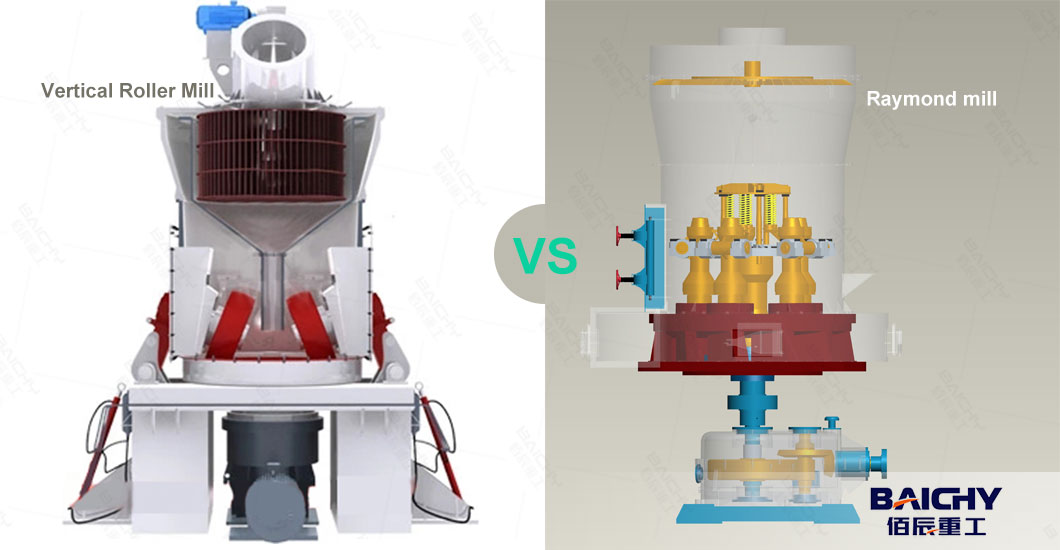
What Are Raymond Mills and Vertical Mills?
Raymond Mill: The Trusted Traditional Powder Grinding Mill
A Raymond mill (or pendulum roller mill) is a time-tested closed-circuit grinding machine. It operates on a simple principle: centrifugal force spins grinding rollers around a fixed ring, creating line contact to crush materials .
Its core structure includes grinding rollers, a fixed grinding ring, a spider frame, and scraper blades. Here’s how it works:
1.Raw materials (20-30mm) enter the grinding chamber.
2.Scrapers lift materials between the rotating rollers and fixed ring.
3.Rollers crush the material into powder.
4.Airflow carries fine particles to a classifier— qualified powder is collected, while coarse particles fall back for re-grinding .
Raymond mills are known for their mature technology, easy operation, and flexibility—perfect for small to medium-scale production.
Vertical Mill: The Integrated Modern Powder Mill
A vertical mill (VRM) is a state-of-the-art machine that combines grinding, drying, classifying, and conveying in one compact unit . It uses "material bed grinding": a rotating table spreads materials into a thin layer, and hydraulic rollers press down to crush them (surface contact for efficient grinding) .
Key components include a rotating grinding table, hydraulic pressure system, high-efficiency classifier, and hot air drying system. Its workflow is seamless:
1.Materials enter the center of the rotating table.
2.Centrifugal force moves materials outward to form a uniform bed.
3.Hydraulic rollers crush the material while hot air dries it (ideal for high-moisture feed).
4.The classifier sorts particles—ultra-fine powder is collected, and coarse particles rejoin the bed .
Vertical mills excel at large-scale, continuous production with low energy use.
7 Key Differences Between Raymond Mill and Vertical Mill
| No |
Comparison |
Raymond Mill |
Vertical Mill (VRM) |
| 1 |
Grinding Performance |
Fineness: 80-600 mesh; Handles moisture ≤6-8%; Capacity: 1-15 t/h |
Fineness: 80-3000+ mesh (ultra-fine powder); Handles moisture up to 15-20%; Capacity: 10-200+ t/h |
| 2 |
Energy Efficiency |
Higher consumption (friction-based grinding); Needs separate dryer for wet materials |
Saves 15-30% energy (material bed grinding); Integrated hot air system boosts thermal efficiency |
| 3 |
Structure & Design |
Simple: Spring-loaded rollers + fixed ring; Line contact; Single function (only grinding) |
Complex: Hydraulic rollers + rotating table; Surface contact; 4-in-1 integration (grind/dry/classify/convey) |
| 4 |
Cost |
Low initial investment (150,000-200,000); High maintenance frequency (wear parts last 2,000-2,500 hours) |
Higher initial investment (300,000-400,000+); Low maintenance frequency (wear parts last 8,000-12,000 hours) |
| 5 |
Automation |
Basic electrical control; Relies on manual operation |
PLC/DCS integrated control; Supports remote monitoring and one-click start/stop |
| 6 |
Footprint & Eco-Friendliness |
Medium space requirement; Higher noise; Needs extra dust removal |
Compact (60% smaller footprint); Low noise; Built-in dust collector (emissions ≤15mg/m³) |
| 7 |
Material Suitability |
Low-hardness (Mohs ≤7), low-moisture non-metallic minerals (calcite, talc, gypsum) |
High-hardness/special materials (slag, cement clinker, graphite for new energy); High-moisture feed |
Best Applications for Each Mill
When to Choose a Raymond Mill
•You’re a small/medium enterprise with a limited budget.
•Your material has low moisture (≤6%) and doesn’t require ultra-fine powder.
•You need flexible production (frequent material changes) or quick startup (e.g., putty powder, paint fillers) .
•Your capacity needs are ≤15 t/h (e.g., small-scale limestone or coal grinding) .
When to Choose a Vertical Mill
•You’re a large enterprise with high production demands (≥10 t/h).
•Your material is high-moisture (>8%) or requires ultra-fine powder (e.g., lithium battery anode materials) .
•You prioritize long-term savings (lower energy and maintenance costs) .
•You need an eco-friendly, automated system (e.g., cement plants, power plant desulfurization, large-scale slag processing) .
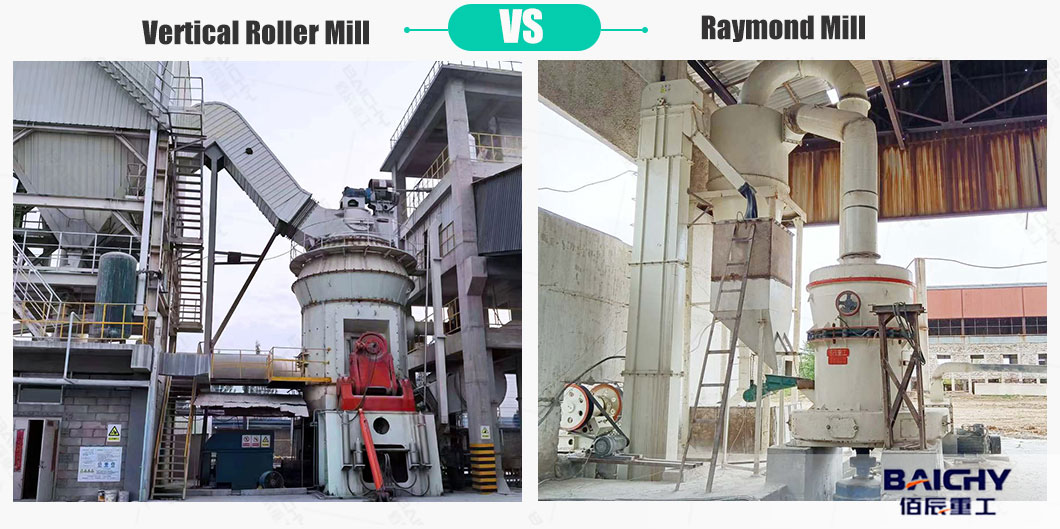
Pros and Cons at a Glance
Raymond Mill
✅ Pros: Low upfront cost; Easy to operate and maintain; Mature, reliable technology; Flexible for small-batch production .
❌ Cons: High energy use; Poor moisture handling; Prone to clogging; Limited ultra-fine capacity .
Vertical Mill
✅ Pros: Energy-efficient (saves 15-30% power); Integrates multiple functions; Handles high moisture and hard materials; Uniform product quality; Eco-friendly .
❌ Cons: High initial investment; Requires professional maintenance; Complex operation (needs skilled staff) .
How to Choose the Right Mill for Your Project
1.Assess Your Budget: Pick a Raymond mill if you need quick ROI with low upfront costs; Choose a vertical mill if you can invest more for long-term savings .
2.Analyze Your Material: Raymond mill for dry, low-hardness minerals; Vertical mill for wet, hard, or special materials .
3.Define Production Needs: Small-scale (≤15 t/h) → Raymond mill; Large-scale/continuous (≥10 t/h) → Vertical mill .
4.Check Eco & Automation Requirements: Vertical mill is better for strict environmental rules and automation; Raymond mill works for basic setups .
Raymond mills and vertical mills aren’t "better" than each other—they’re designed for different needs. The Raymond mill is a cost-effective, flexible choice for small to medium-scale, dry material processing. The vertical mill is a high-performance, integrated solution for large-scale, demanding projects that require energy efficiency and moisture resistance . By matching your project’s specific needs (material, capacity, budget, and eco goals) to each machine’s strengths, you’ll optimize production efficiency and profitability. For personalized advice, consult a grinding equipment expert with your material specs and production targets!




 2026-09-28





 86-15093113821
 86-15093113821