The domestic animal feed industry, particularly the poultry sector, requires highly specific grades of Calcium Carbonate (CaCO3) to ensure bird health and egg quality. Producing these grades from raw Crystalline Calcite requires a sophisticated, integrated turnkey solution. Whether you are starting with a Phase 1 investment of 3–5 Tons Per Hour (TPH) or scaling to a Phase 2 capacity of 8–10 TPH, understanding the technical requirements from boulder crushing to micronized classification is essential.
1. Raw Material Specifications: The Foundation of Purity
To meet the "Feed Grade" standard, the raw material must be high-purity Crystalline Calcite with a minimum of 98% (CaCO3) content. Calcite typically features a Mohs hardness of 3, making it highly suitable for industrial grinding without excessive wear on machinery.
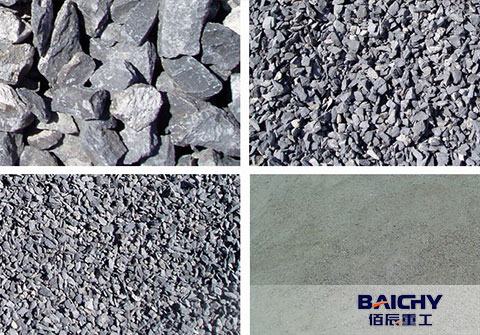
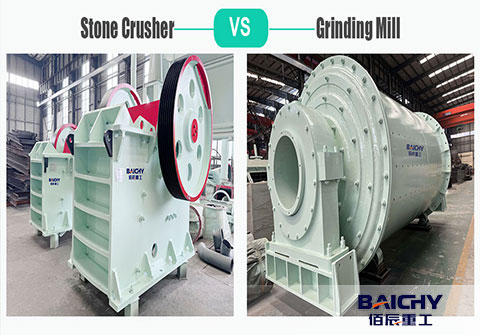
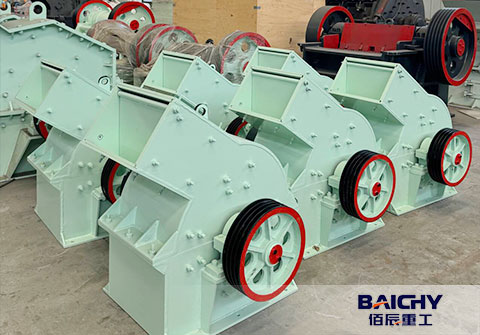
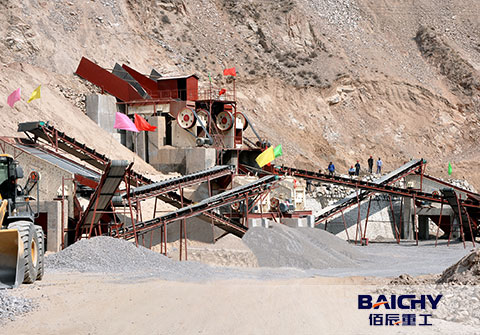
The process begins with raw 200mm to 300mm boulders. To prepare this material for the grinding mill, a primary crushing system is required. Utilizing a heavy-duty Jaw Crusher or Hammer Crusher, these large boulders are reduced to an optimal mill-feeding size of below 35mm. This initial size reduction ensures a stable throughput and prevents mechanical overload in the secondary grinding phase.
2. Scalable Production: Phase 1 and Phase 2 Strategies
For investors adopting a phased entry into the mineral processing market, the plant must be designed for scalability:
Option A (Phase 1): Focuses on a 3–5 TPH capacity. This scale is ideal for domestic market entry, allowing producers to establish off-take agreements with local broiler and layer farms.
Option B (Phase 2): Involves scaling to an 8–10 TPH capacity. This full-scale industrial solution is designed for high-volume supply to national feed premix manufacturers, utilizing larger grinding units or parallel production lines to maximize operational efficiency.
3. Technical Analysis: The Integrated Processing Flow (From Boulders to Precision Grades)
The integrated turnkey solution for calcite processing is engineered to manage a high reduction ratio, transforming 200mm–300mm boulders into either micronized powder or coarse grits through a precise three-stage mechanical sequence.
Stage 1: Primary Crushing and Feed Size Optimization
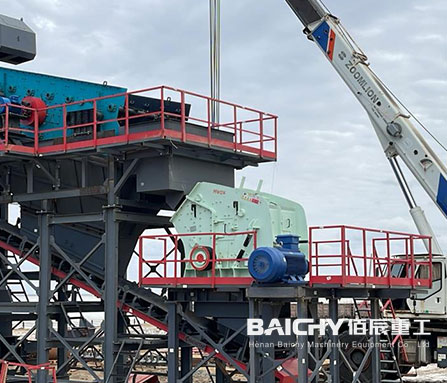
The process initiates at the Primary Crushing Station, where raw crystalline calcite boulders are reduced in size to ensure mill compatibility. A high-torque PE Jaw Crusher is utilized to pulverize the 300mm boulders into uniform fragments of under 35mm. This specific reduction ratio is critical; feeding material larger than 35mm directly into a grinding mill would lead to excessive vibration and mechanical failure. By optimizing the primary crush size, the plant maintains a stable throughput—whether in the 3–5 TPH (Phase 1) or 8–10 TPH (Phase 2) configuration.
Stage 2: Metered Feeding and Pressure Grinding
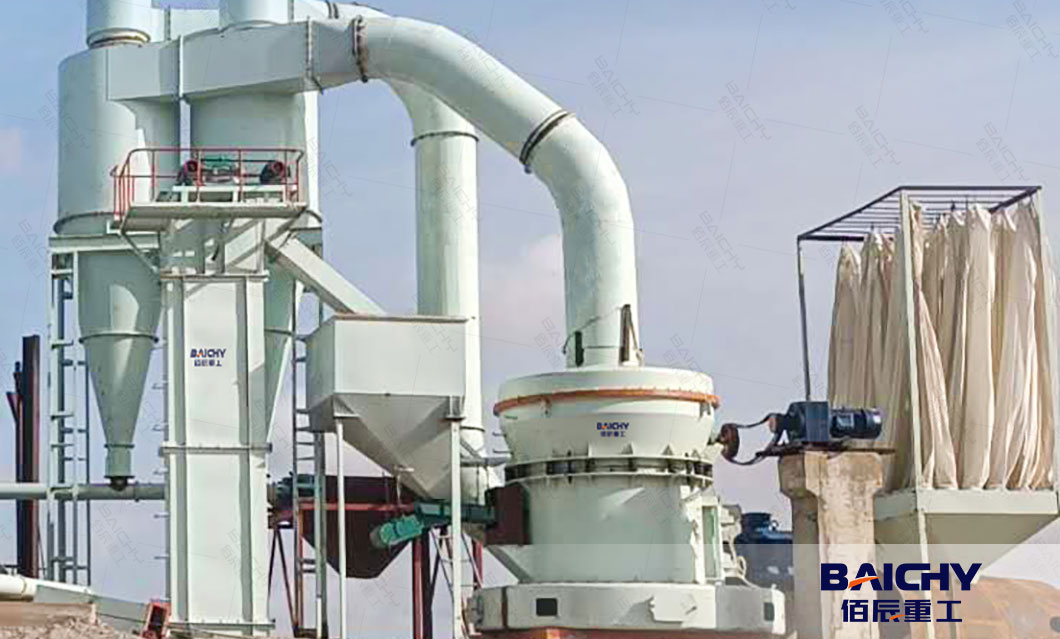
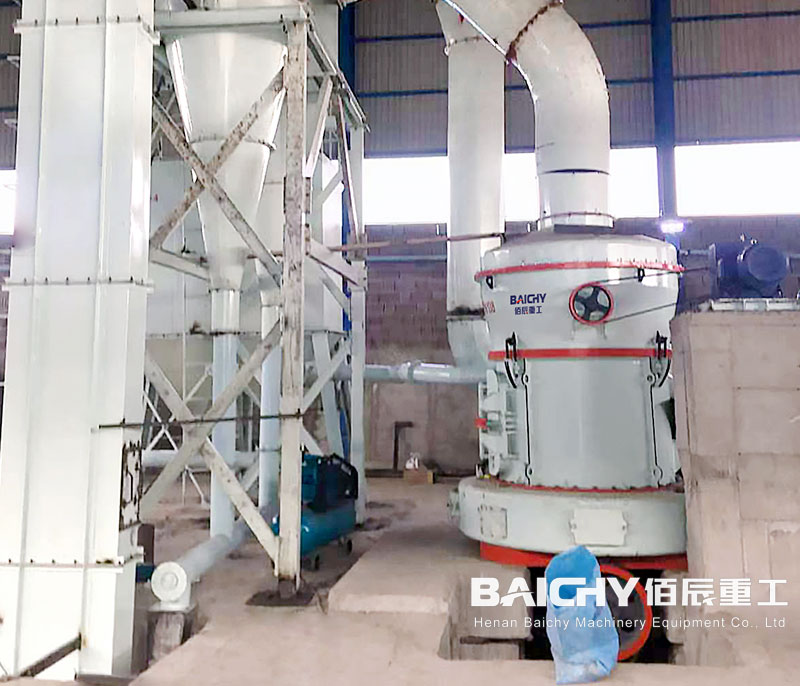
The crushed calcite is conveyed via a Bucket Elevator into a raw material hopper, which feeds the Raymond Grinding Mill through an automated vibrating feeder. For Mohs 3 Calcite, the mill employs a "pressure-grinding" principle where multi-layer rollers press against a stationary grinding ring. This method is highly efficient for crystalline structures, ensuring the 98% CaCO3 purity is preserved. The system is designed to handle the material's brittleness, minimizing the production of unwanted "over-fines" when the objective is to produce coarse grits.
Stage 3: VFD-Controlled Intelligent Classification (The Switching Logic)
The plant's versatility is centered on the High-Precision Air Classifier equipped with Variable Frequency Drive (VFD) technology. This system allows for the instantaneous adjustment of the "cut point" (the particle size that is allowed to pass) by varying the rotational speed (RPM) of the classifier wheel:
● Producing Broiler Grade (300 Mesh / D97): To achieve ultra-fine micronization, the VFD increases the motor frequency, raising the classifier's RPM. This creates a high centrifugal force that allows only the 300-mesh particles to pass into the cyclone collector, while coarser particles are rejected and returned to the mill for regrinding.
● Producing Layer Grade (1mm–3mm / 10–18 Mesh): To produce coarse grits for eggshell formation, the operator lowers the VFD frequency. This reduces the centrifugal resistance, allowing larger 1mm–3mm particles to exit the system as finished products.
Stage 4: Automated Collection and Environmental Filtration
The final products—whether powder or grits—are captured by a high-efficiency Cyclone Collector. To ensure the facility meets domestic environmental standards and prevents the loss of valuable CaCO3
fines, a Pulse Bag Dust Collector is integrated into the air loop. This system maintains a negative pressure environment throughout the plant, achieving a 99.9% dust collection efficiency and ensuring the final product remains free from external contaminants.
4. Targeted Output Grades for Poultry Broilers and Layers
To satisfy off-take partners, the plant must produce three distinct grades of CaCO3 , each serving a specific biological function:
● Broiler Grade (Meat Sector): Requires an ultra-fine powder of 300 Mesh (D97 passing). This high surface area allows for rapid calcium absorption into the bloodstream, supporting the fast skeletal development required for meat-producing birds.
● Layer Grade (Egg Sector): Requires coarse grits of 1mm – 3mm (approx. 10–18 Mesh). These larger particles stay in the bird's gizzard longer, providing a "sustained calcium release" during the night when eggshells are being formed.
Standard Feed Grade: A 200 Mesh (D90) powder used for general feed premixes and mineral supplements.
5. Environmental and Quality Compliance
A full turnkey solution from Baichy Machinery ensures that 98% purity is maintained throughout the process. To comply with environmental regulations, the plant is equipped with a Pulse Bag Filter system, achieving 99.9% dust collection efficiency. Furthermore, the use of specialized grinding media ensures that no metallic impurities contaminate the high-purity calcite, keeping the calcium safe for animal consumption.
People Also Frequently Asked For - FAQ
1. Can one calcite grinding plant produce both powder and grits?
Yes. By utilizing a VFD-controlled classifier, you can adjust the air-flow and centrifugal speed to separate either ultra-fine 300 mesh powder for broilers or coarse 1–3mm grits for layers. This allows for maximum market versatility.
2, Why is 98% purity calcite preferred for poultry feed?
High-purity calcite (98% (CaCO3) ensures that birds receive maximum elemental calcium with minimal heavy metal or silica contamination. This leads to better bioavailability, resulting in stronger bones for broilers and thicker eggshells for layers.
3. What equipment is needed for a full turnkey calcite plant?
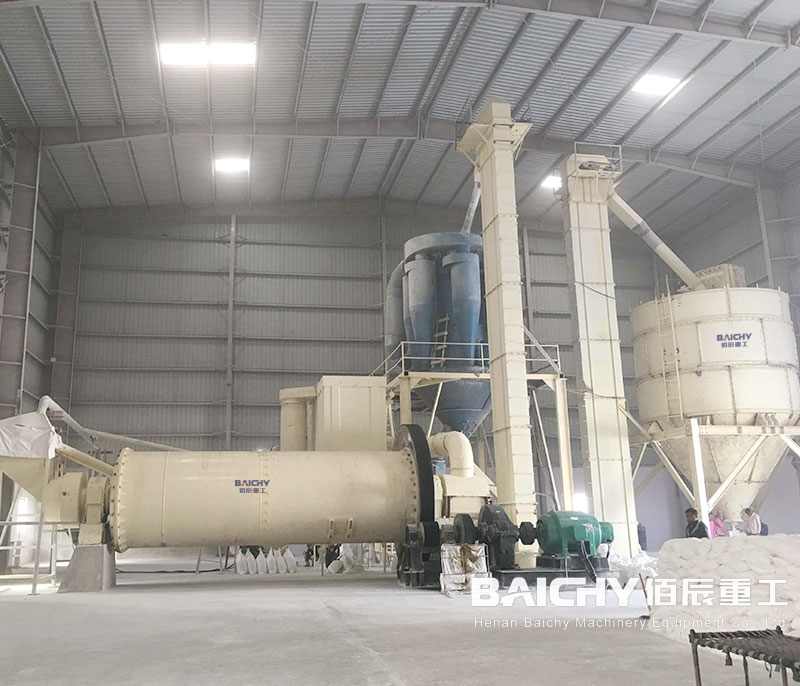
A complete integrated solution includes a Vibrating Feeder, a Jaw Crusher (for primary reduction), a Bucket Elevator, a Raw Material Hopper, a Grinding Mill, a VFD-controlled Classifier, and a Pulse Dust Collector.
4. What is the difference between Broiler and Layer calcium requirements?
Broilers need 300 mesh fine powder for rapid growth and bone strength. Layers need 1–3mm grits for slow, sustained calcium release, which is essential for consistent eggshell formation during the 24-hour laying cycle.




 2026-10-16





 86-15093113821
 86-15093113821