Setting up a stone crusher plant requires careful planning and a clear understanding of the equipment needed. Whether you are producing aggregates for road construction, concrete production, or railway ballast, a properly configured plant ensures efficient operation and consistent product quality.
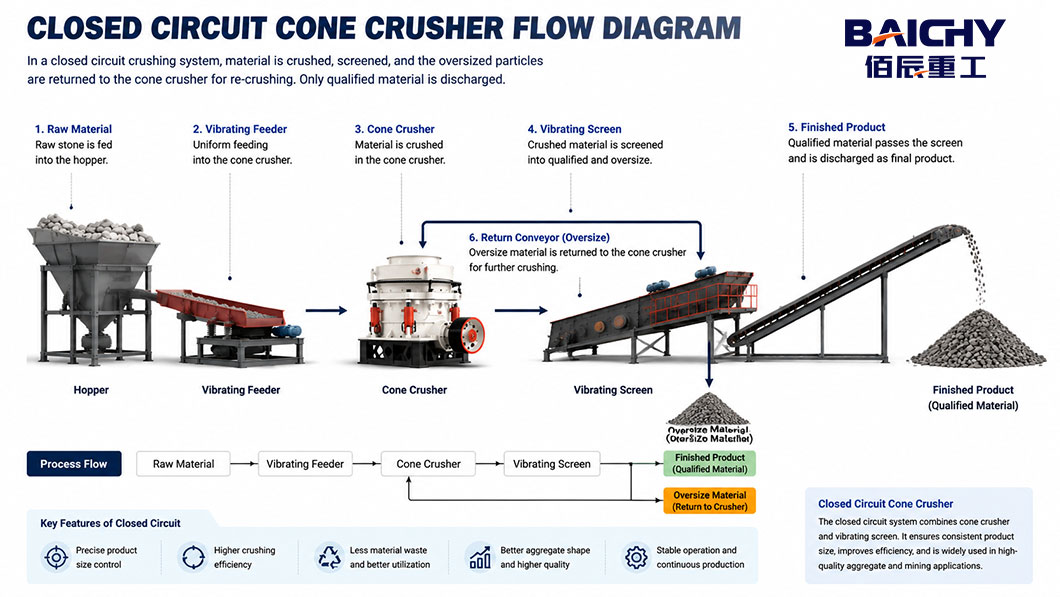
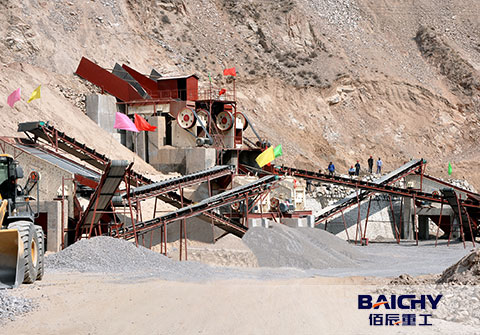
A complete stone crushing plant is a one-stop installation that incorporates different crushing stages—primary, secondary, and tertiary—along with screening and transport cycles to obtain the desired stone sizes . This guide breaks down every piece of equipment needed to build a functional, high-performance stone crusher plant, explaining what each component does and how they work together.
The Core Equipment Checklist
A stone crusher plant typically consists of the following essential components
| Equipment |
Primary Function |
| Vibrating Feeder |
Feeds raw material evenly to the primary crusher |
| Jaw Crusher |
Primary crushing of large stones |
| Secondary Crusher |
Further size reduction (cone, impact, or fine jaw) |
| Vibrating Screen |
Classifies crushed material by size |
| Belt Conveyor |
Transports material between stages |
| Control Panel |
Monitors and controls the entire system |
Optional equipment can be added depending on specific requirements.
1.Primary Crushing: Jaw Crusher
The jaw crusher is the workhorse of primary crushing. It handles large feed sizes—from 500 mm to over 1,000 mm depending on the model—and reduces them to a more manageable size for downstream processing.
Why jaw crushers are standard: Their simple, robust design handles the hardest rocks—granite, basalt, and river stones—and they require minimal maintenance compared to other primary crusher types.
2.Secondary and Tertiary Crushing: The Stage of Choice
After primary crushing, the material needs further size reduction. Here, several crusher types are available, and the right choice depends on your material and product requirements.
Option 1: Cone Crusher
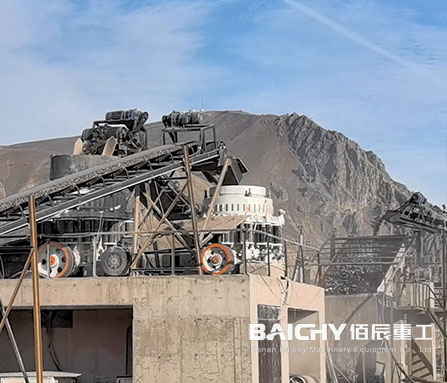
Cone crushers are the preferred choice for processing hard, abrasive materials like granite, basalt, and quartz . They use compression crushing to produce well-shaped, fine aggregates and are ideal for secondary and tertiary stages .
Advantages:
● Excellent for medium-hard to hard rock
● Lower wear costs compared to impact crushers in abrasive applications
● Produces cubical final products
Model DG200 and DG300 single-cylinder cone crushers are popular for their high crushing efficiency and moderate processing capacity .
Option 2: Impact Crusher
Impact crushers use high-speed blow bars to shatter rock. They are suitable for softer stones like limestone and are often chosen when producing aggregates for road construction .
Key advantage: High reduction ratio in a single pass. However, for highly abrasive materials, blow bar wear can be rapid.
Option 3: Fine Jaw Crusher (PEX Series)
For smaller plants or applications where a simple configuration is desired, a fine jaw crusher (such as PEX-250×1200) can perform secondary crushing at lower cost .
3.Screening System: Vibrating Screen
The vibrating screen separates crushed material into different size fractions, ensuring only the desired product goes to storage .
How it works: Material is fed onto a multi-deck screen (typically 2 to 4 decks) with progressively finer mesh sizes. Material that is too large for the top deck is discharged as oversize and returned to the crusher (closed-loop). Material passing through the final deck becomes the finished product.
Common models: 3YK-1854, 3YK-2160, and 4YK-2160 for medium to large plants .
4.Material Transport: Belt Conveyors
Belt conveyors connect every piece of equipment in the plant, transporting material from one stage to the next .
What they do:
● Transfer material from the feeder to the primary crusher
● Move crushed material from primary to secondary crusher
● Carry finished product from the screen to stockpiles
● Conveyor systems are typically customized to the plant layout, with lengths and configurations designed for efficient material flow .
5.Control System: Central Electric Control Panel
A centralized control panel allows operators to monitor and control every component of the plant from a single location .
Key functions:
● Start/stop all motors and equipment
● Monitor production capacity and equipment status
● Automate closed-circuit operations
6.Optional Equipment for Specialized Needs
Depending on your application, additional equipment may be added :
● Sand Making Machine (VSI)
Adds a tertiary crushing stage to produce manufactured sand for concrete and construction. Models like VSI5X7615 are commonly integrated into production lines .
● Sand Washing Machine
Removes impurities like clay and dust from sand and aggregates, essential when producing high-quality concrete sand .
● Dust Collection System
With increasing environmental regulations, dust collectors (bag filters or wet scrubbers) are often included to capture airborne particles and ensure compliance .
● Generator Set
For remote sites without grid power, a generator set supplies electrical power to the entire plant
Typical Stone Crusher Plant Configuration
A common hard rock crushing plant configuration is:
Vibrating Feeder → Jaw Crusher → Cone Crusher → Vibrating Screen → Belt Conveyor
For softer stones such as limestone, the configuration may be:
Vibrating Feeder → Jaw Crusher → Impact Crusher → Vibrating Screen → Belt Conveyor
For manufactured sand production:
Jaw Crusher → Cone Crusher → VSI Sand Maker → Vibrating Screen
The final design depends on the customer's specific requirements.
Baichy Stone Crusher Plant Solution
Baichy Machinery provides complete stone crusher plant solutions for quarry, mining, and construction industries.
Baichy supplies a wide range of crushing equipment, including:
● Jaw crushers
● Cone crushers
● Impact crushers
● Vibrating screens
● Sand making machines
● Belt conveyors
Based on different raw materials and production targets, Baichy engineers design customized crushing plants with suitable equipment combinations.
With professional plant design, equipment manufacturing, installation guidance, and after-sales service, Baichy helps customers build efficient and reliable aggregate production systems.
FAQ About Stone Crusher Plant Equipment
1. What is the most important equipment in a stone crusher plant?
The crusher is the core equipment, but the entire production line requires cooperation between feeders, crushers, screens, and conveyors to achieve stable production.
2. Which crusher is best for hard stone?
For hard rocks such as granite and basalt, jaw crushers are commonly used for primary crushing, while cone crushers are suitable for secondary crushing.
3. Can one crusher complete the whole stone crushing process?
In some small projects, one crusher may handle basic crushing. However, complete aggregate production usually requires multiple stages for better product quality and efficiency.
4. How many machines are needed for a stone crusher plant?
The number of machines depends on capacity, material type, and final product requirements. A complete plant may include several crushers, screens, feeders, and conveyors.




 2026-10-16





 86-15093113821
 86-15093113821