Vibration is a normal part of many industrial machines. In equipment such as vibrating screens, crushers, feeders, and conveyors, controlled vibration is necessary for operation. However, abnormal vibration can indicate problems such as imbalance, worn components, poor alignment, or structural issues.
Understanding different types of vibration helps operators identify potential problems earlier and improve equipment reliability.
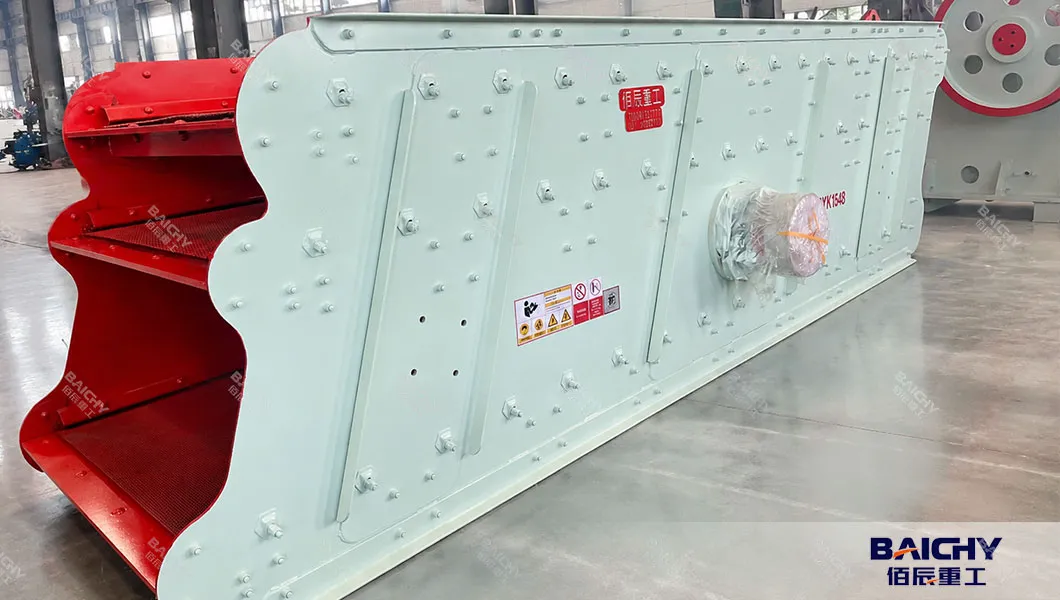
This article explains the four basic types of vibration and their practical applications in industrial machinery.
1. Free Vibration (Natural Vibration)
Free vibration occurs when an object is displaced from its original position and then released without continuous external force. The system will continue moving at its own natural frequency until the vibration energy is gradually reduced.
A simple example is a tuning fork after being struck. In industrial equipment, a similar effect can be observed when a machine structure or spring system continues to move briefly after the driving force stops.
Every mechanical structure has a natural frequency. During equipment design, engineers consider factors such as mass, stiffness, and operating speed to avoid operating conditions that may cause excessive vibration.
For vibrating screens and crushing equipment, correct structural design helps reduce the risk of fatigue caused by repeated stress.
2. Forced Vibration
Forced vibration is caused by a continuous external force acting on a mechanical system.
This is the working principle behind many types of mining equipment. For example, a vibrating screen uses an eccentric shaft or unbalanced motor to generate a controlled vibration force. This movement allows materials to separate according to particle size.
Controlled forced vibration improves screening efficiency and material flow.
However, forced vibration can also become a problem when it is caused by equipment faults. Common causes include:
● Unbalanced rotating parts
● Damaged bearings
● Misaligned shafts
● Loose fasteners
● Uneven wear of components
Unlike designed vibration, these conditions can increase maintenance costs and reduce equipment service life.
3. Damped Vibration
Damped vibration refers to vibration that gradually decreases because energy is absorbed or lost through resistance.
In real equipment, damping comes from several sources, including friction, rubber components, springs, and structural materials.
For example, vibration springs and rubber mounts used on crushing and screening equipment help absorb impact forces and reduce vibration transferred to the foundation.
Proper damping is important because excessive movement after shutdown or unstable operation may indicate problems with springs, mounts, or support structures.
Regular inspection of these components helps maintain stable machine performance.
4. Resonant Vibration (Resonance)
Resonance occurs when the operating vibration frequency becomes close to the natural frequency of a mechanical structure. When this happens, vibration amplitude can increase significantly.
In industrial equipment, resonance can create excessive stress on frames, supports, and connection points. Long-term operation under resonance conditions may lead to cracks, bolt loosening, or component failure.
For vibrating screens, crushers, and other rotating equipment, engineers avoid resonance by adjusting structural design, operating speed, and component selection.
Variable frequency drives (VFDs) can also help control motor speed during startup and shutdown, allowing equipment to pass through sensitive frequency ranges more smoothly.
How Vibration Management Improves Mining Equipment Performance
In mineral processing plants, vibration control directly affects production stability, maintenance requirements, and equipment availability.
Several factors influence vibration performance:
1. Accurate Dynamic Balancing
Rotating components such as eccentric shafts and counterweights must be properly balanced. Poor balance can create unnecessary vibration and accelerate bearing wear.
2. Strong Structural Design
Machine frames need sufficient strength and stiffness to withstand continuous operating loads. Proper design helps maintain stability during long-term operation.
3. Condition Monitoring
Monitoring vibration levels provides useful information about equipment condition. Changes in vibration patterns can help identify problems such as bearing damage, imbalance, or loose connections before major failures occur.
Why Vibration Matters in Crushing and Screening Plants
For quarry and mining operations, vibration is not simply a mechanical movement—it is part of the production process.
A vibrating screen depends on controlled vibration to separate materials efficiently. A crusher depends on stable operation to maintain capacity and product quality.
By understanding how different vibration types affect equipment behavior, operators can improve maintenance decisions, reduce unexpected downtime, and extend machine service life.
Free vibration, forced vibration, damped vibration, and resonance are four fundamental vibration types found in mechanical systems. In mining equipment, the goal is not to eliminate vibration completely but to control it. Proper design, correct installation, regular inspection, and condition monitoring help ensure vibrating screens, crushers, and other equipment operate safely and efficiently over time.




 2026-09-29





 86-15093113821
 86-15093113821