1. What Is a Wheeled Mobile Crushing Station?
A wheeled mobile crushing station is a portable crushing system mounted on a tire-based chassis. It integrates feeding equipment, crushers, vibrating screens, conveyor belts, and other supporting components into one or more mobile units. Unlike a traditional stationary crushing plant, which requires a fixed foundation and a permanent equipment layout, a wheeled mobile crushing station can be transported between job sites using a suitable towing vehicle. Its supporting legs or hydraulic stabilization system are deployed during operation to provide a stable working position.
Depending on the production requirements, a wheeled mobile crushing plant can be configured with jaw crushers, impact crushers, cone crushers, or screening equipment. Its main purpose is to bring crushing operations closer to the raw material source, reduce unnecessary material transportation, and simplify equipment relocation. For quarry operators, aggregate producers, road construction contractors, and mining companies, this equipment provides a practical option when production locations or project requirements change frequently.
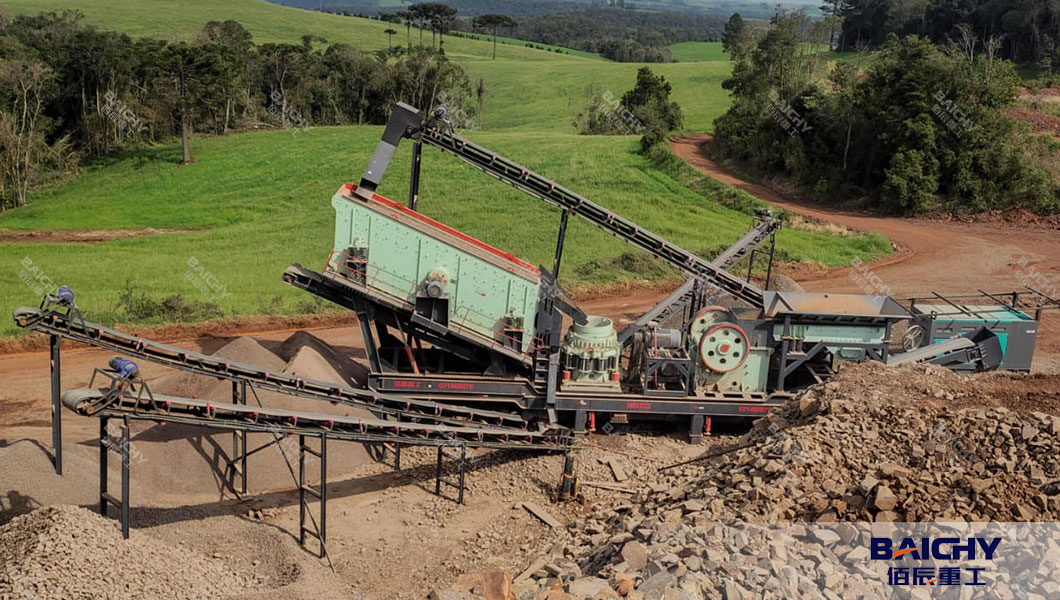
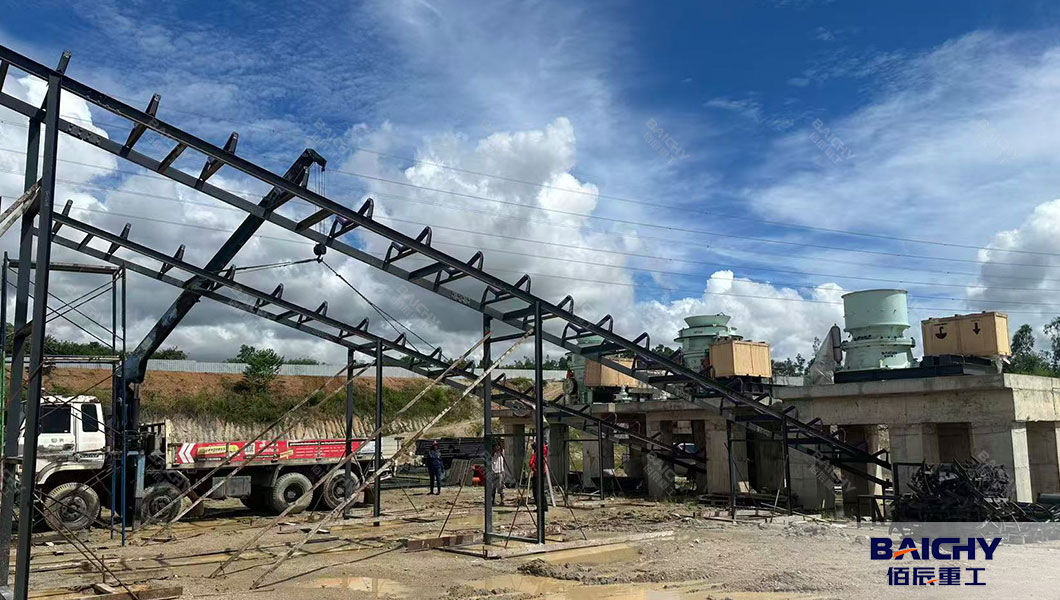
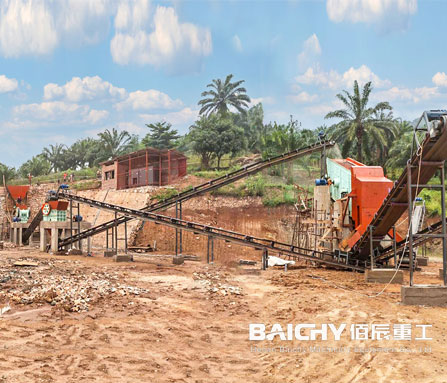
Baichy Wheeled Mobile Crushing Station In South Africa
2. What Equipment Can Be Integrated into a Wheeled Mobile Crushing Plant?
The configuration of a wheeled mobile crushing station depends on the raw material, feed size, required output, and final aggregate specifications.
A complete system usually consists of several functional units.
2.1 Hopper and Vibrating Feeder
The hopper receives raw materials from wheel loaders or excavators and provides a buffer for continuous feeding. A vibrating feeder controls the material flow into the primary crusher. Some configurations include a pre-screening grizzly section to separate fine materials before crushing. This arrangement helps prevent unnecessary crushing of undersized particles and reduces the load on the main crusher.
2.2 Jaw Crusher for Primary Crushing
A jaw crusher is commonly used as the primary crushing unit in a wheeled mobile crushing plant. It uses compressive force between a fixed jaw plate and a moving jaw plate to reduce large rocks into smaller particles. It is suitable for hard and abrasive materials such as granite, basalt, limestone, and river stone, depending on the crusher model and wear-part selection. A wheeled mobile jaw crusher is particularly useful when the raw material has a large feed size and requires primary size reduction.
2.3 Impact Crusher for Secondary Crushing
An impact crusher reduces material through impact force. It is commonly used for limestone, concrete, construction waste, and other materials suitable for impact crushing. Compared with compression crushing, an impact crusher can produce more cubical aggregate particles under appropriate operating conditions. For projects supplying commercial aggregates or road construction materials, a wheeled mobile impact crushing plant can combine crushing and screening to achieve the required product grading.
2.4 Cone Crusher for Hard Rock Crushing
For hard and abrasive materials such as granite and basalt, a cone crusher is often selected for secondary or tertiary crushing. It uses compression between the mantle and concave to reduce material size. A mobile cone crushing station is suitable for producing smaller, more uniform aggregates after primary crushing. The correct selection depends on material hardness, abrasiveness, feed size, and the required reduction ratio.
2.5 Vibrating Screen and Conveyor Belts
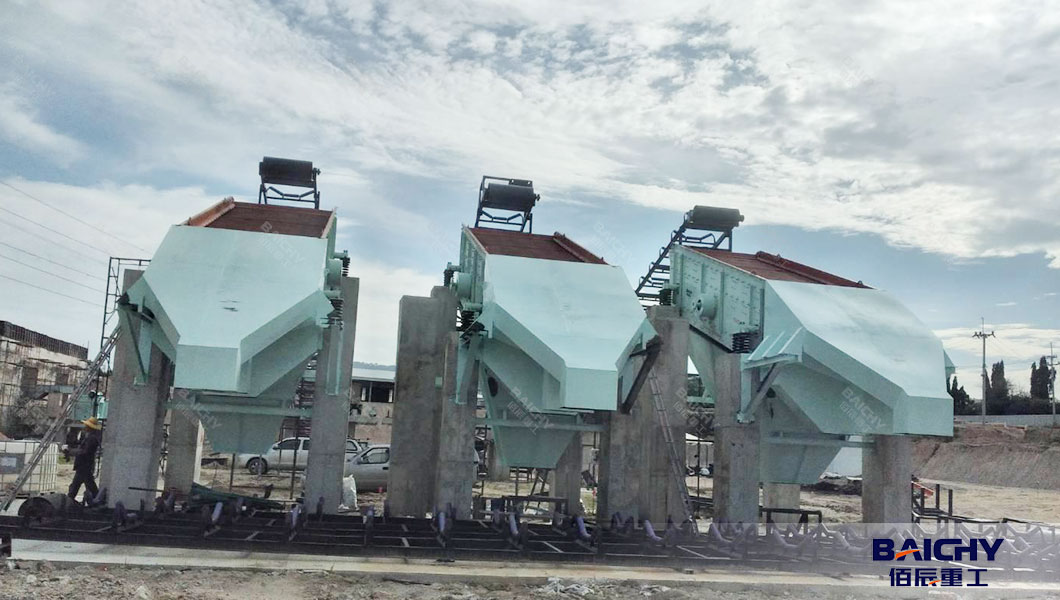
The vibrating screen separates crushed material into different particle-size fractions. Conveyor belts transport raw materials, intermediate products, and finished aggregates between equipment units. In a closed-circuit configuration, oversized particles can be returned to the crusher for further reduction. This helps control final product size and improves the utilization of the crushing system.
2.6 Mobile Chassis and Hydraulic Supporting System
The wheeled chassis supports the crushing equipment and allows the plant to be transported between working locations. Depending on the design, hydraulic cylinders may be used to raise, lower, or stabilize equipment sections during setup. Supporting legs provide stability during production, while the chassis and towing arrangement are designed for transportation.
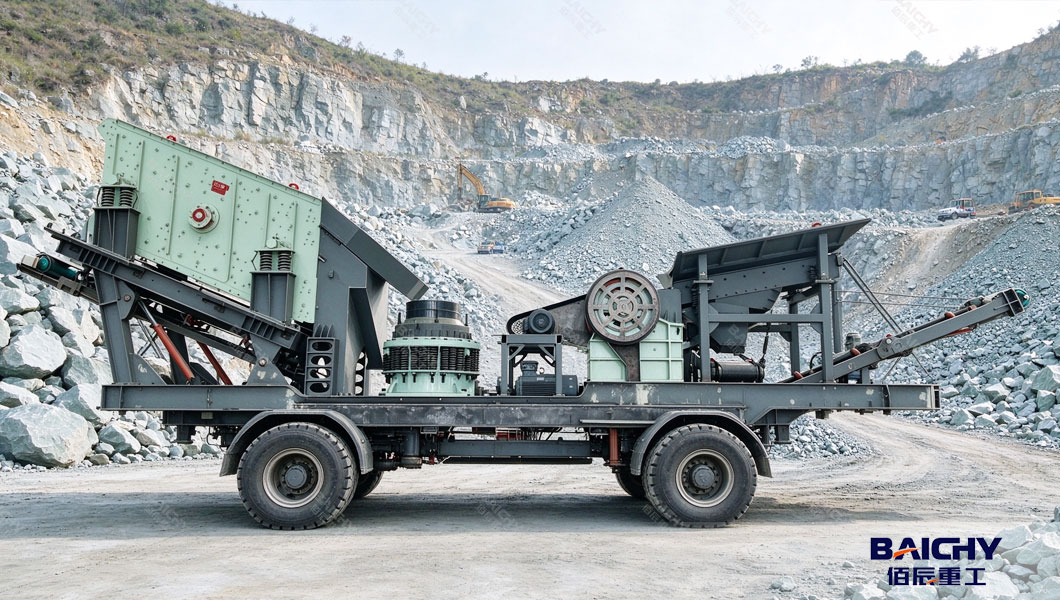
Mobile jaw + cone crusher with vibarting screen plant
3. What Are the Common Types of Wheeled Mobile Crushing Stations?
Different crushing applications require different equipment combinations. Selecting the correct crusher is more important than simply choosing a plant with a higher rated capacity.
| Mobile Crushing Station Type |
Main Configuration |
Typical Applications |
| Wheeled Mobile Jaw Crusher |
Hopper + Feeder + Jaw Crusher + Conveyor |
Primary crushing of granite, basalt, limestone and river stone |
| Wheeled Mobile Impact Crusher |
Hopper + Feeder + Impact Crusher + Conveyor |
Limestone crushing, concrete recycling and aggregate production |
| Wheeled Mobile Cone Crusher |
Feeder + Cone Crusher + Conveyor |
Secondary and tertiary crushing of hard rock |
| Wheeled Mobile Screening Plant |
Hopper + Feeder + Vibrating Screen + Conveyors |
Aggregate classification and material separation |
| Wheeled Mobile Jaw and Cone Plant |
Jaw Crusher + Cone Crusher + Screening System |
Multi-stage hard rock crushing |
| Wheeled Mobile Crushing and Screening Plant |
Crusher + Vibrating Screen + Return Conveyor |
Integrated aggregate production with closed-circuit crushing |
Single-Stage and Multi-Stage Configurations
A single-stage mobile crushing plant is suitable for projects that require a relatively simple crushing process. For example, a mobile jaw crusher may be used to reduce large limestone rocks into smaller material for further processing.
A multi-stage system combines primary, secondary, and sometimes tertiary crushing. It provides greater flexibility in controlling particle size and producing multiple aggregate specifications.
For example, a wheeled mobile jaw crusher can work together with a wheeled mobile cone crusher and a mobile screening plant to form a complete aggregate processing system.
The machines may operate as separate mobile units, with material transferred between them by conveyors.
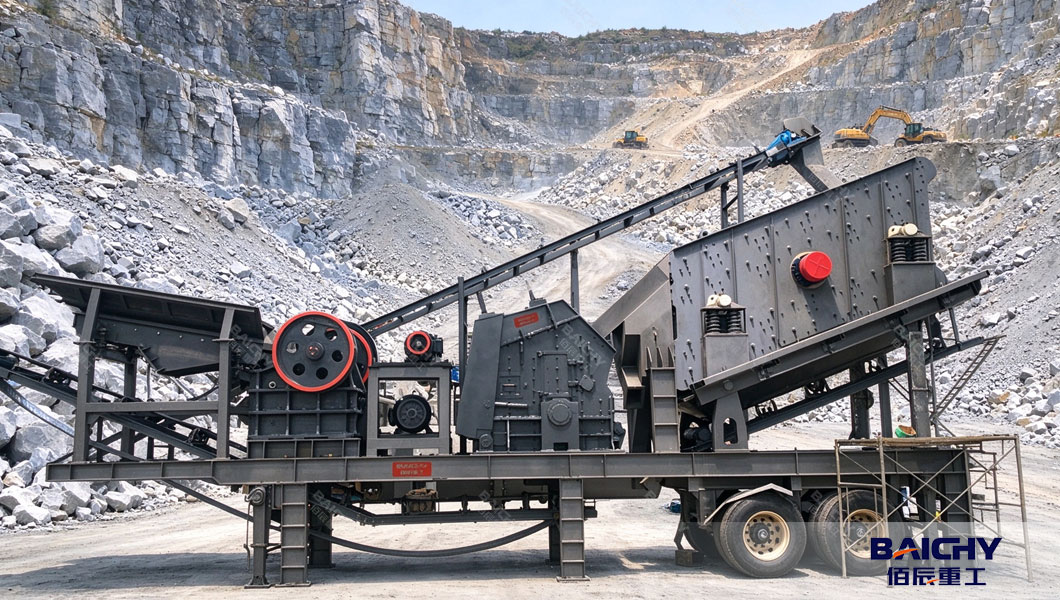
Mobile jaw + cone crusher with vibarting screen plant
4. What Are the Advantages of a Wheeled Mobile Crushing Station?
4.1 Easier Transportation Between Project Sites
The most obvious advantage is its tire-mounted chassis. Compared with stationary crushing equipment, a wheeled mobile crusher is easier to relocate when a project requires the plant to move between different working areas. It is particularly useful for contractors handling multiple short-term construction or quarrying projects. Transportation still depends on the overall dimensions, total weight, road regulations, and availability of a suitable towing vehicle.
4.2 Faster Site Deployment
A wheeled mobile crushing plant generally requires less permanent civil construction than a conventional stationary plant. After transportation, the operator positions the equipment, deploys the supporting legs, connects the required utilities, and completes the necessary checks before production. The actual installation time depends on the plant configuration, site preparation, and commissioning requirements.
4.3 Reduced Material Transportation Costs
A mobile crushing station can be positioned closer to the raw material source. This reduces the need to transport large quantities of unprocessed rocks to a distant fixed crushing facility. For quarry operators and construction contractors, reducing unnecessary material handling can improve overall production economics.
4.4 Flexible Equipment Combinations
A wheeled mobile crushing plant can integrate different crushers and screening units according to project requirements. Customers can select a jaw crusher for primary crushing, an impact crusher for aggregate shaping, or a cone crusher for hard rock applications. This flexibility allows the production line to match different materials and output requirements.
4.5 Suitable for Temporary and Multiple-Site Projects
For road construction, infrastructure development, and contract crushing, production locations may change as projects progress. A wheeled mobile crushing station provides a practical solution because the equipment can be transported to another site rather than rebuilding a permanent crushing plant.
5. What Information Should You Prepare Before Requesting a Quote?
To receive an accurate equipment recommendation and quotation, buyers should provide the following project information.
| Information Required |
Example |
Why It Matters |
| Raw Material |
Granite, limestone, basalt or concrete |
Determines crusher type and wear-part selection |
| Maximum Feed Size |
500 mm |
Determines crusher inlet requirements |
| Target Capacity |
100–200 TPH |
Determines equipment size and configuration |
| Finished Product Sizes |
0–5, 5–10, 10–20 mm |
Determines crushing stages and screen arrangement |
| Material Hardness |
Hard, medium or soft |
Affects crusher selection and production estimates |
| Moisture Content |
Dry or wet material |
Affects feeding and screening performance |
| Working Location |
Fixed quarry or multiple sites |
Determines chassis and transportation requirements |
| Power Supply |
Grid electricity or diesel |
Determines the power configuration |
Providing these details allows the manufacturer to evaluate the complete production process rather than recommending a crusher based on capacity alone.
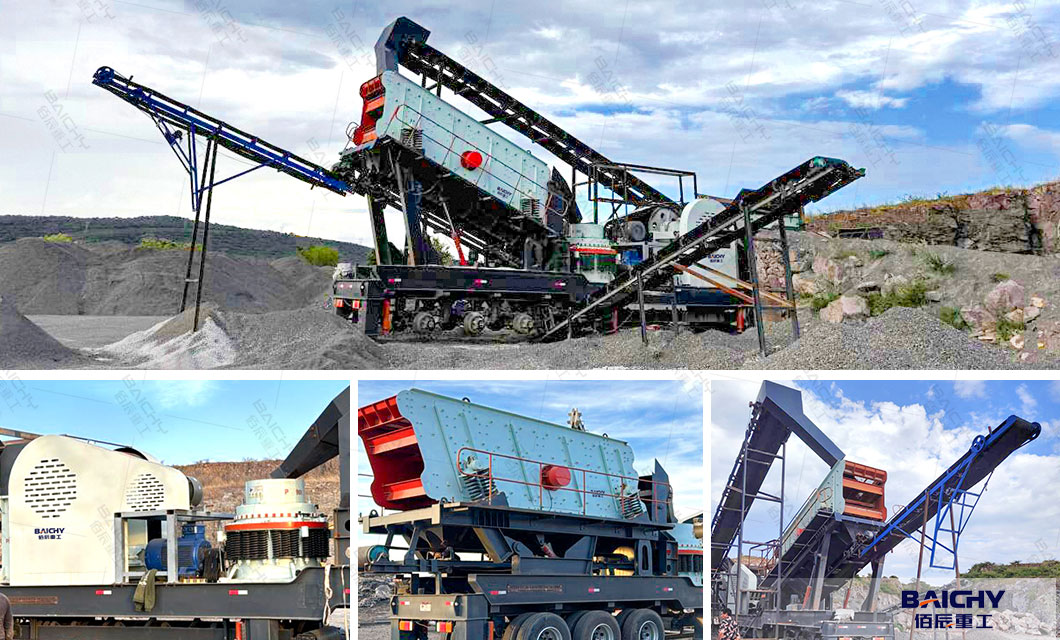
Mobile crushing and screening plant
9. Why Choose Baichy Wheeled Mobile Crushing Plant?
Baichy Machinery provides mobile crushing and screening equipment for quarrying, mining, aggregate production, and construction waste recycling.
Our wheeled mobile crushing solutions can be configured with different equipment combinations according to project requirements.
The main configuration options include:
-
Mobile jaw crushing stations for primary crushing.
-
Mobile impact crushing stations for limestone and concrete processing.
-
Mobile cone crushing stations for hard rock applications.
-
Mobile screening plants for aggregate classification.
-
Integrated mobile crushing and screening systems for multi-stage production.
Baichy focuses on matching equipment specifications to the customer's material, capacity, product grading, and site conditions. Before selecting a mobile crushing station, our engineering team can evaluate the feed size, crushing stages, screening requirements, and transportation conditions to help determine a suitable configuration.
Need a wheeled mobile crushing station for your quarry or construction project? Send Baichy your material type, maximum feed size, required capacity, and finished aggregate sizes. Our team can help develop a practical mobile crushing solution based on your production requirements.
Frequently Asked Questions About Wheeled Mobile Crushing Stations
Q1. What is the difference between a wheeled mobile crusher and a portable crusher?
A wheeled mobile crusher is a type of portable crushing equipment mounted on a tire-based chassis. The term portable crusher is broader and may also refer to trailer-mounted or transportable crushing systems. In practical applications, both terms are often used to describe equipment designed for relocation rather than permanent installation.
Q2. Can a wheeled mobile crusher produce multiple aggregate sizes?
Yes. When equipped with a multi-deck vibrating screen, the plant can separate crushed material into different size fractions. A closed-circuit arrangement can return oversized material for further crushing.
Q3. Does a wheeled mobile crushing station require a concrete foundation?
Not necessarily. One of its advantages is reduced dependence on permanent concrete foundations. However, the equipment still requires a properly prepared and sufficiently stable working platform. Supporting legs or stabilization devices must be deployed according to the manufacturer's installation instructions.
Q4. How do I choose between a mobile jaw crusher and a mobile impact crusher?
A mobile jaw crusher is generally used for primary crushing of large rocks, especially hard and abrasive materials. A mobile impact crusher is often selected for secondary crushing, limestone processing, concrete recycling, and applications requiring good aggregate particle shape. The final selection depends on feed conditions and product requirements.




 2026-11-14






 86-15093113821
 86-15093113821