Home About us
Products
News
Solution
Video Service Contact us
Home  /  News

In mineral processing plants, the ball mill is the core grinding equipment, and knowing which end is the feed end and which is the discharge end is essential for operation, maintenance, and troubleshooting. Whether you are a mill operator, a maintenance technician, or a process engineer, being able to tell the two ends apart quickly—without shutting down and opening the manhole—saves time and prevents costly mistakes.


How-to-Identify-the-Feed-End-vs.-Discharge-End-of-a-Ball-Mil


This guide focuses on the grate discharge ball mill, the most commonly used type in mineral processing, and also covers the overflow ball mill. You will learn how to identify the feed and discharge ends using external visual cues, internal structures, spiral direction, and process piping.


1. External Visual Identification (Fastest On-Site Method)

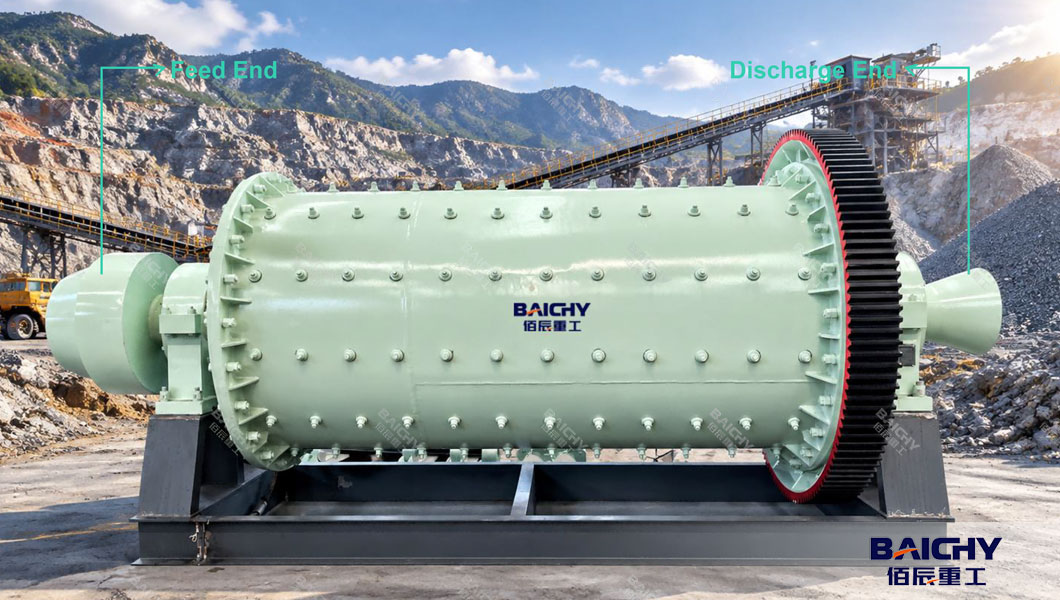
✅ Feed End (Feed / Inlet End)
   ● Feeder attached on the outside: Spoon feeder , drum feeder, or combination feeder. There is a feed chute where ore or slurry is fed by belt conveyor or pump.

   ● Trunnion (hollow shaft) inner diameter is smaller.

   ● Internal spiral is a forward spiral  — its job is to push ore into the mill shell.

   ● Generally located away from the girth gear (the large gear is usually mounted on the discharge-end shell).

✅ Discharge End (Discharge / Outlet End)
   ● No spoon feeder. Instead, it connects to a discharge cover and slurry chute where the ground pulp flows out.

   ● Trunnion inner diameter is larger.

   ● Internal spiral is a reverse spiral — it pushes coarse particles and small grinding balls back into the mill, preventing them from escaping.

   ● The girth gear (drive gear) on the shell is usually close to the discharge end.


Quick Mnemonic
With a spoon feeder = feed end; near the girth gear and connected to the product slurry chute = discharge end.


2. Internal Structure Inspection (During Shutdown / Manhole Entry)

✅ Grate Discharge Ball Mill (Commonly Used for Coarse Grinding)
   ● Discharge end: Fitted with a grate plate — a perforated sector-shaped screen plate. Slurry passes through the grate into the discharge device.

   ● Feed end: The end liner is a solid wear-resistant plate with no grate holes.

✅ Overflow Ball Mill (Commonly Used for Fine Grinding)
   ● Neither end has a grate plate. Material overflows by slurry level.

   ● Distinguish the ends by trunnion spiral direction + trunnion inner diameter: the discharge trunnion is larger in diameter and has a reverse spiral for returning coarse material.


3. Spiral Direction (Key Point During Maintenance)

Stand at the mill end face and observe the spiral inside the trunnion:

   ● Feed spiral: Follows the mill rotation direction, pushing material inward into the shell.

   ● Discharge spiral: Opposite to the mill rotation direction, pushing coarse material back into the shell, allowing only fine slurry to exit.


4. Process Piping as a Supporting Clue

   ● Feed end: Connected to raw ore + makeup water.

   ● Discharge end: Connected to ground pulp, going to the classifier or cyclone.

⚠️ Important Note
In a few non-standard layouts, the girth gear may be mounted on the feed end. Do not judge solely by the gear position. Prioritize the feeder and the internal grate plate when identifying the ends.


Summary Table

Feature Feed End Discharge End
Feeder Spoon / drum / combination feeder None (discharge cover + chute)
Trunnion inner diameter Smaller Larger
Internal spiral Forward (pushes ore in) Reverse (returns coarse material)
Girth gear position Usually far Usually near
Grate mill internal Solid end liner Grate plate with holes
Overflow mill internal No grate No grate; larger trunnion + reverse spiral
Process piping Raw ore + water Ground pulp to classifier/cyclone


Identifying the feed end and discharge end of a ball mill is a fundamental skill in mineral processing plant operations. By combining external visual checks (feeder, trunnion size, girth gear), internal inspection (grate plate, spiral direction), and process piping clues, you can quickly and accurately distinguish the two ends—even in the field. Remember the golden rule: When in doubt, check the feeder first, then the internal grate plate. The girth gear alone is not a reliable indicator. 


Maybe you are interested in