Selecting the right ore powder grinding mill is critical for maximizing production efficiency, product quality, and operational cost savings. With multiple options available — from traditional ball mills to advanced vertical roller mills — understanding their differences is essential. In this guide, we compare six major types of ore grinding mills: YGM Raymond Mill, HGM Micro Powder Mill, Vertical Roller Mill, and Ball Mill. We cover key parameters such as feed size, capacity, output fineness, applicable materials, and unique features, followed by a step-by-step selection strategy.
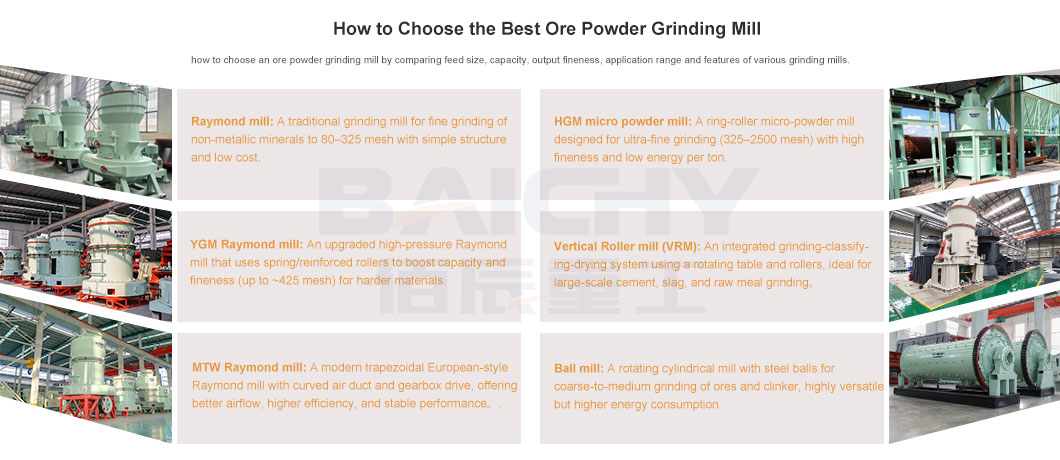
The R series Raymond mill is a traditional pendulum roller mill. Feed size is typically up to 25mm, handling materials with Mohs hardness below 7 and moisture under 6%. Capacity ranges from 0.5 to 20 t/h, with output fineness between 30 and 325 mesh. The screening rate can reach 99%, meaning minimal oversize particles in the finished product. Its main advantages are mature technology and low initial cost. The simple structure makes operation and maintenance easy, ideal for small to medium-sized businesses with limited budgets. Centralized electrical control allows the workshop to run with minimal manual intervention. However, the Raymond mill cannot handle high-moisture feed effectively, as damp material tends to clog the chamber. Energy consumption is moderate but higher than modern designs, and it struggles to produce powder below 400 mesh. For basic powder production without extreme fineness requirements, it remains a cost-effective choice.
The YGM Raymond Mill is the most reliable solution for small to medium processing. It handles a feeding size below 30mm and offers a capacity ranging from 1 to 20 tons per hour. The output fineness typically stays between 80 and 325 mesh, making it ideal for limestone and gypsum. This mill is known for its small footprint and low initial cost. It remains a staple in the mineral processing industry due to its simple operation and ease of maintenance, ensuring high stability for non-metallic ores.
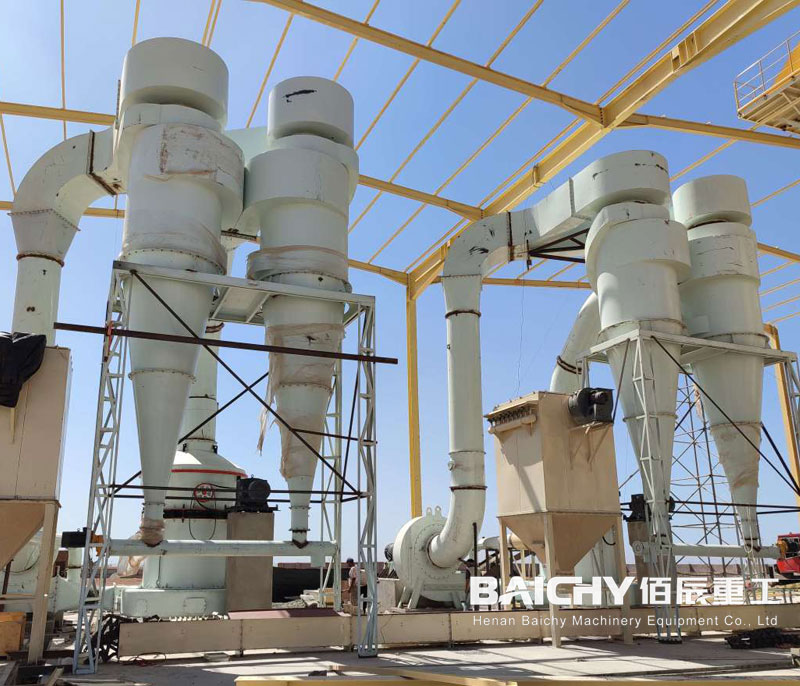
The HGM Micro Powder Mill is specialized for ultra-fine production. It accepts materials smaller than 20mm and delivers a throughput of 0.5 to 12 tons per hour. Its primary strength is the output fineness, which ranges from 325 up to 2500 mesh. It is extensively used for high-value minerals like talc and kaolin. Baichy Machinery provides these mills with multi-layer grinding rings to maximize efficiency. The system includes pulse dust collectors, ensuring an environmentally friendly workspace with minimal noise.
The MTW European Type Raymond Mill represents an upgraded version of the traditional pendulum mill. It takes a larger feeding size up to 35mm and achieves a higher capacity between 3 and 50 tons per hour. The fineness range is 80 to 425 mesh, covering a wide variety of industrial needs. Its unique integral bevel gear drive improves efficiency compared to belt drives. The design features a curved air duct to reduce resistance, making it an excellent choice for large-scale barite and calcite processing projects.
The Vertical Roller Mill (VRM) is a high-capacity machine integrating drying, grinding, and classifying. It can handle large feeding sizes up to 80mm and provides a massive capacity from 10 to over 100 tons per hour. The fineness range is 80 to 400 mesh, perfect for cement clinker and coal desulfurization. Its main advantage is its high energy efficiency and ability to process materials with high moisture content. This system is a preferred choice for large industrial plants looking to reduce long-term operational costs.
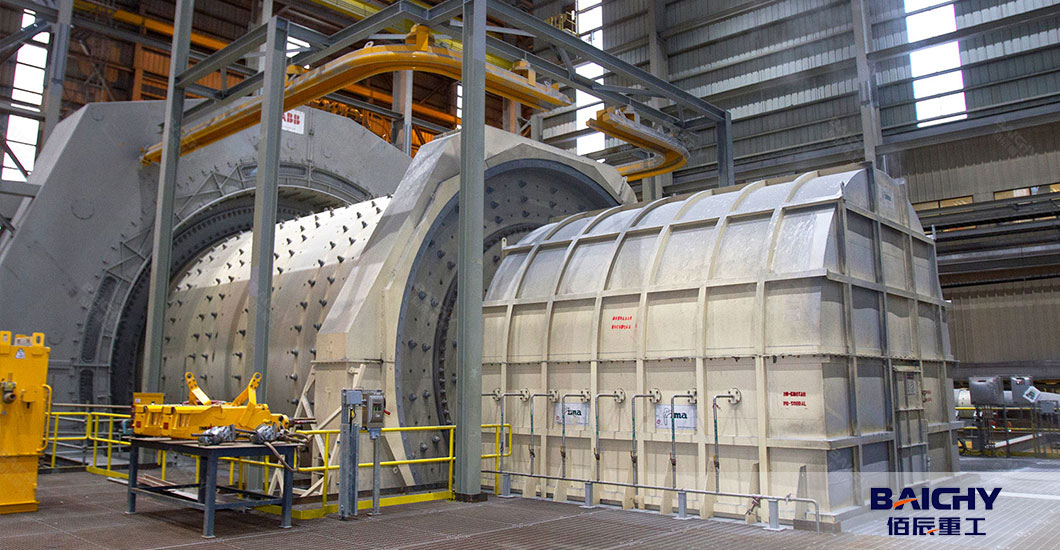
The Ball Mill is the ultimate workhorse for high-hardness minerals and mining operations. It accepts feeding sizes up to 25mm and offers a broad capacity range, reaching up to 600 tons per hour. The output fineness is usually between 35 and 200 mesh. It is uniquely capable of both wet and dry grinding, making it essential for gold, copper, and iron ore processing. Its robust design allows for continuous operation. Baichy Machinery recommends this mill for projects requiring extreme durability and high-volume output of metallic ores.
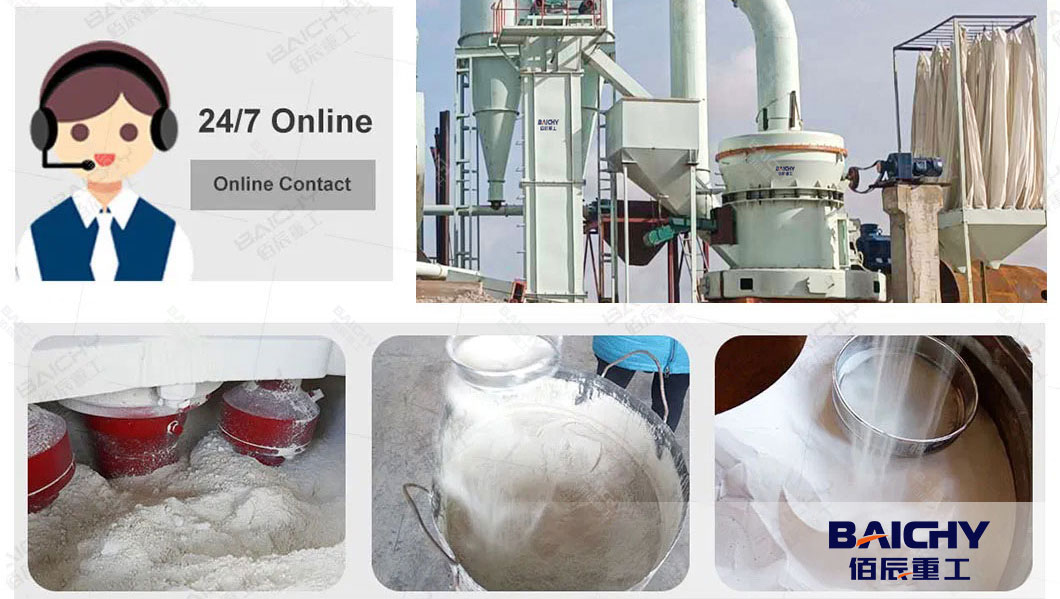
How to Choose the Right Mill?
To finalize your equipment selection, follow this 4-step decision process:
● Fineness Requirement: If you need standard powder (80-325 mesh), choose YGM or MTW. For ultra-fine powder (>400 mesh), choose HGM.
● Production Scale: For small batches (<10 TPH), use YGM. For medium scale (up to 50 TPH), use MTW. For massive industrial output (>50 TPH), use VRM or Ball Mill.
● Material Hardness: Soft minerals (Mohs <7) work well with Raymond or Vertical mills. Hard ores (Mohs >7) must be processed with a Ball Mill.
● Moisture Content: If raw materials have moisture >6%, a Vertical Roller Mill is superior due to its integrated drying capability.
Besides that, we also could choose right grinding mill as follows:
● For limestone, gypsum, calcite, barite, and other non-metallic minerals, Raymond mill, YGM Raymond mill, or MTW Raymond mill are commonly considered when the required fineness is within the conventional fine powder range.
● For applications requiring ultrafine powder, such as calcium carbonate, talc, and kaolin processing, HGM micro powder mill is more suitable because it can achieve much finer particle sizes.
● For large-scale industrial production, vertical roller mill is a better choice when high capacity, continuous operation, and stable production are required.
● For metal ore processing and beneficiation, ball mill is commonly selected because the grinding process is designed to achieve mineral liberation before separation.
Before selecting equipment, users should confirm:
Raw material type and hardness
Maximum feed size
Required output fineness
Expected production capacity
Final application of the powder
The best grinding mill is not the largest or most expensive equipment, but the one that matches the material properties, production target, and operating conditions. A correct selection can improve grinding efficiency, maintain stable product quality, and reduce unnecessary operating costs.
Frequently Asked Questions
Q1: Which mill is most energy-efficient?
Vertical roller mills consume 15-30% less energy than ball mills. YGM mills are more efficient than standard Raymond mills.
Q2: Can I use a Raymond mill for hard materials?
Standard Raymond mills handle Mohs <7. YGM mills handle up to Mohs 9.3. For harder materials, use ball mills or VRMs.
Q3: When should I choose HGM over YGM?
When you need output finer than 425 mesh down to 3000 mesh. HGM is specifically designed for ultra-fine applications.
Q4: What moisture level is acceptable without drying?
Raymond and YGM: <6%. HGM: <5%. VRM: can handle 15-20% with integrated drying. Ball mill requires pre-drying for dry grinding.
Q5: How do I decide between ball mill and VRM?
Choose VRM for large capacity, energy efficiency priority, and integrated drying needed. Choose ball mill for very abrasive materials, wet grinding requirement, or lower capital cost priority.




 2026-10-24





 86-15093113821
 86-15093113821