Processing raw sand and gravel mixtures from riverbeds is a highly profitable venture, but it comes with a major technical hurdle: sticky, plastic clay. If your raw material contains up to 30 tons of mud per hour, a standard crushing line will simply fail. The screens will blind, the crushers will choke, and your final product will be rejected. How do you build a system that guarantees 50-60 tons of clean washed sand and 30-40 tons of cubic crushed stone per hour? Here is the detailed, step-by-step engineering guide for a professional 100-130 TPH crushing, screening, and washing plant.
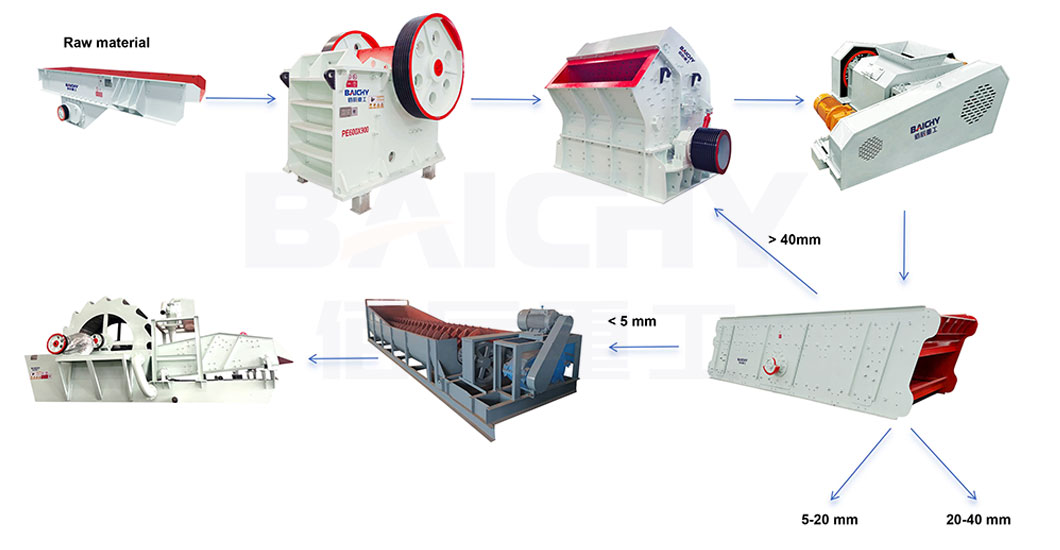
Stage I: Smart Receiving & Pre-Screening
The first line of defense against mud is your feeder. Do not feed everything directly into your primary crusher!
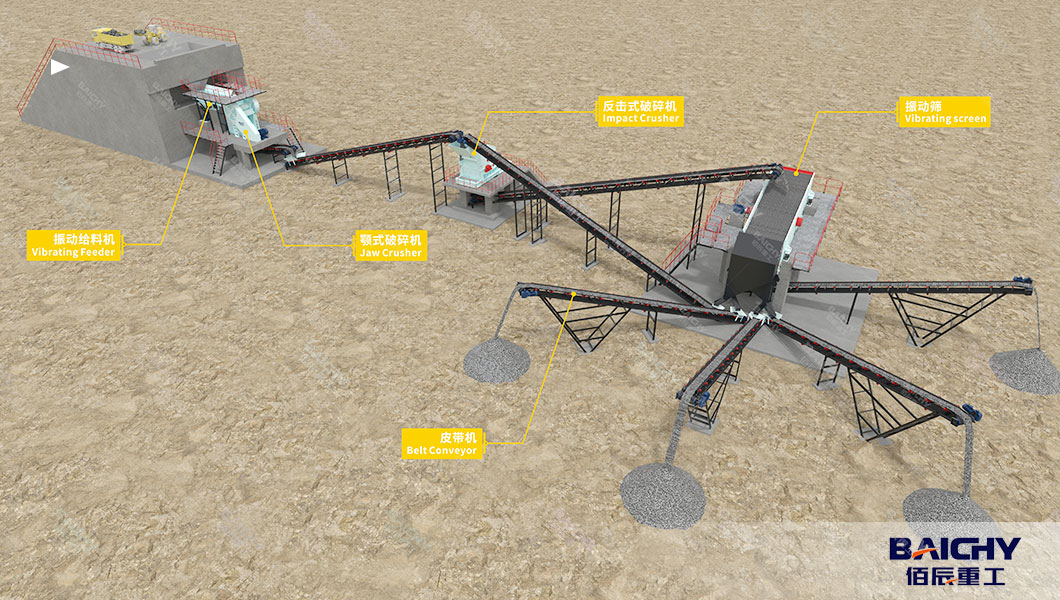
Equipment Setup: Use a heavy-duty Vibrating Grizzly Feeder (model GZD-960x3800 or GZD-1100x4200) paired with a large 15–20 m³ hopper. This ensures a standard 3m³ wheel loader (like a ZL50) can continuously feed the plant without causing delays.
Process Logic: Set the grizzly bar gap to 60–80 mm. Large river stones (up to 500 mm) glide over the bars into the jaw crusher. Meanwhile, rocks under 60 mm—along with the vast majority of the sticky clay—fall right through the gaps.
Engineering Benefit: This bypass conveyor routes the mud directly to the washing stage. It prevents the jaw crusher from getting jammed by plastic mud and instantly increases your primary crushing capacity by 20% to 30%.
Stage II: Primary Crushing (Coarse Reduction)
Now, we must break down the oversized river stones.
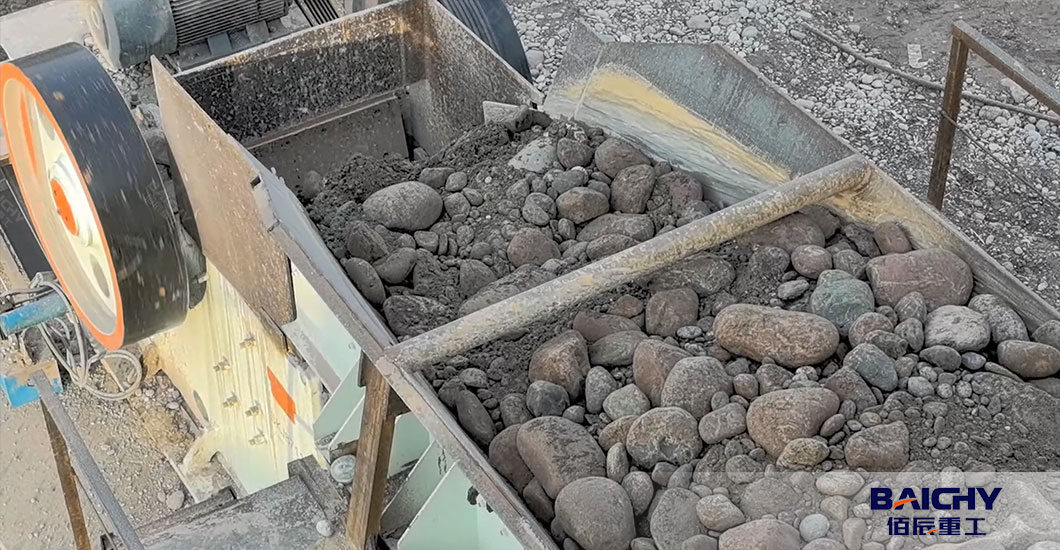
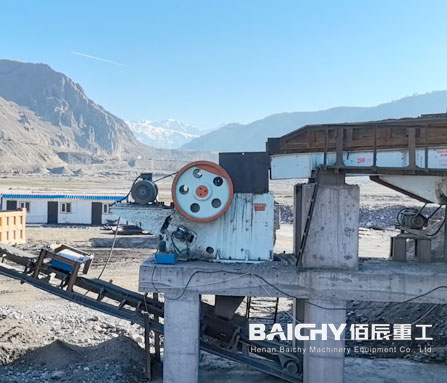
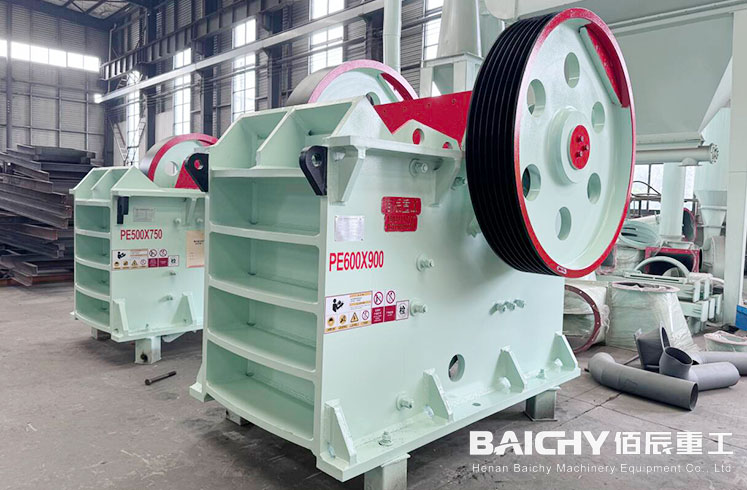
Equipment Setup: A PE-600x900 Jaw Crusher. It is powered by a 75 kW motor equipped with a soft-start system to protect your electrical grid.
Process Logic: The crusher is set with a Closed Side Setting (CSS) of 65–160 mm.
Pro Tip for Operators: River stones are highly abrasive. Ensure your crusher frame is made of heat-annealed cast steel to eliminate stress. More importantly, insist on high-manganese steel jaw plates (Mn13Cr2 or higher) to drastically extend wear life and reduce maintenance costs.
Stage III: Secondary Crushing (Cubic Shaping)
Construction standards demand that gravel be perfectly cubic, not flat or flaky.
Equipment Setup: A PF-1214 Impact Crusher (132–160 kW motor).
Process Logic: Crushed stones from the jaw crusher enter the impactor, which shatters the material along its natural fault lines. This guarantees that flaky and elongated particles in your final gravel make up less than 10%.
Pro Tip for Operators: Because river pebbles wear down metal quickly, standard chrome iron blow bars will wear out too fast. Order custom blow bars with cermet inserts or high-chrome molybdenum alloys directly from your manufacturer to ensure continuous operation.
Stage IV: Tertiary Crushing (Precision Sand Making)
To turn small gravel into high-quality concrete sand (Fineness Modulus 1.5–2.5), you need the right breaking action.
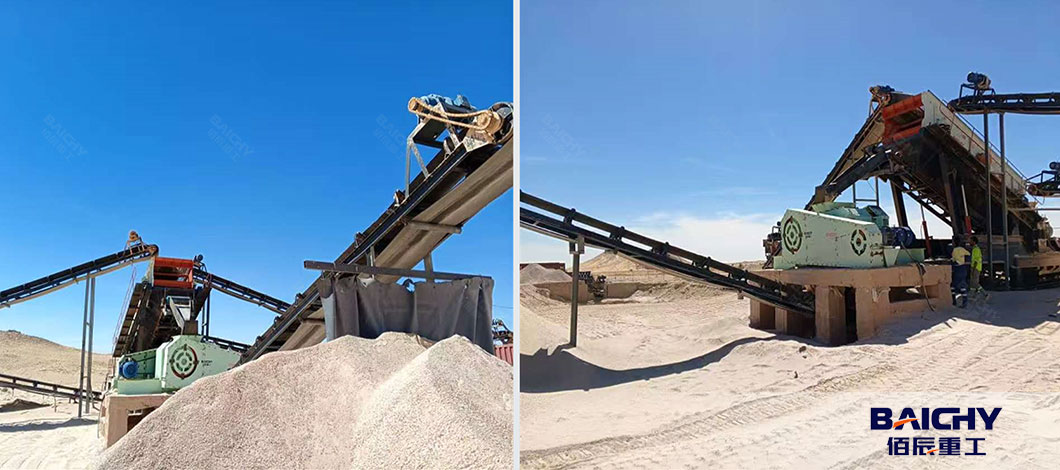
Equipment Setup: A 2PG-1010 Double Roller Crusher driven by dual 45 kW motors.
Process Logic: Unlike impact crushers that violently smash rocks and create useless microscopic dust, a roller crusher uses a squeezing and splitting action. You can adjust the gap between the rollers (2–20 mm) to strictly control the sand size.
Engineering Benefit: This method minimizes the creation of "harmful" stone powder (under 0.16 mm). If an uncrushable piece of metal accidentally falls in, the heavy-duty spring protection system allows the rollers to separate, pass the metal, and instantly return to position.
Stage V: Screening and Grading (Material Flow)
The crushed material is sent to a 3YK-1860 Vibrating Screen (3 layers, 1800×6000 mm, set at a 15–20 degree incline). Here is the strict material flow:
Top Deck (40 mm mesh): Oversized rocks (>40 mm) are sent back to the Impact Crusher in a closed loop.
Middle Deck (20 mm mesh): Collects perfect 20–40 mm coarse crushed stone for the stockpile.
Bottom Deck (5 mm mesh): Collects perfect 5–20 mm fine crushed stone for the stockpile.
Under Screen (<5 mm): All sand, dust, and bypassed mud are flushed with water and sent to the heavy-duty washing system.
Stage VI: The 3-Step Intensive Washing & Recovery System
This is the most critical node of the plant. A standard spiral washer cannot handle 30 tons of clay; it will merely roll the mud into balls. You must use a dual-stage system.
Step 1: The Log Washer (Trench Blade Washer): Twin robust shafts with rotating blades aggressively scrub the material. The intense friction between the stones breaks down the plastic mud blocks and turns the clay into a liquid slurry.
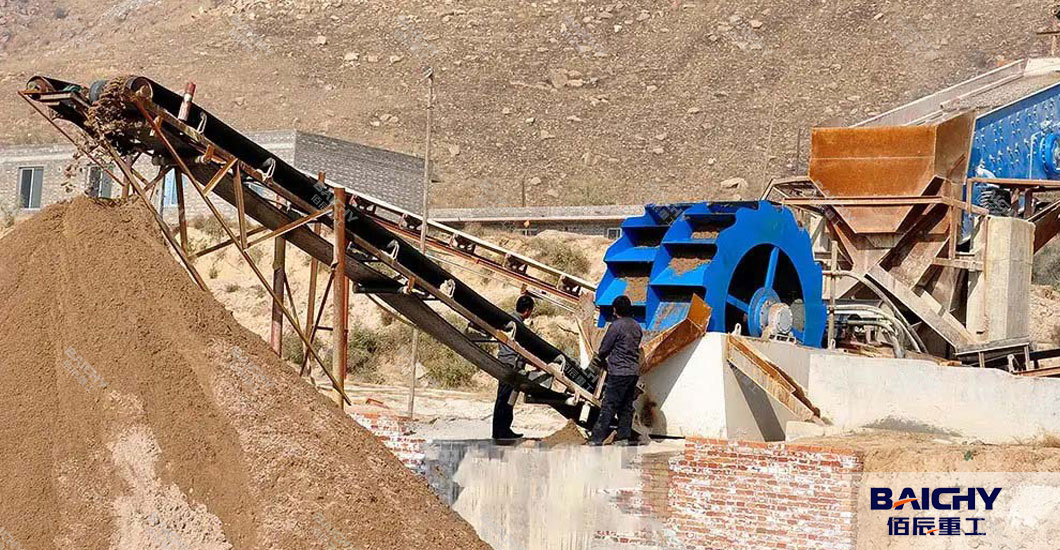
Step 2: Spiral/Wheel Washer: The scrubbed sand moves into a large 1500x9000 washer for a final, clean water rinse.
Step 3: Fine Sand Recovery (Hydrocyclone): During intense washing, up to 15-20% of valuable fine sand (0.16–1.0 mm) floats away with the muddy water. A slurry pump catches this water and fires it into a Hydrocyclone. Centrifugal force separates the mud out the top, while the precious fine sand drops onto a high-frequency dewatering screen. This single step rescues up to 15 tons of premium sand per hour from being lost to the waste pond!
Stage VII: Auxiliaries & Water Management
A complete stone crusher plant is only as strong as its supporting infrastructure.
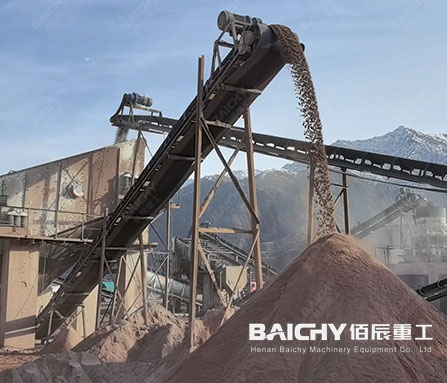
Conveyors: Use multi-ply belts (at least 4 layers of cord). Ensure all transfer points use rubber-lined buffer idlers to prevent belt damage.
Electrical Control: Install a centralized control cabinet with a strict "Interlock System." If a conveyor or screen suddenly stops, the interlock automatically shuts down the crushers and feeders behind it. This prevents catastrophic material pile-ups.
Water Recycling System: Washing 130 tons of muddy material requires 100–150 m³ of water per hour. Construct a 500 m³ step-settling pond. The heavy mud settles at the bottom, and clean water is pumped back into the plant using a 22 kW pump, creating a sustainable closed-loop system.
Designing a production line for heavy-clay river stones requires absolute precision. From mud-bypassing feeders to fine sand recovery systems, every detail impacts your final profit. Contact Baichy Machinery today to speak with our senior engineers, get a customized equipment layout, and secure a competitive quote for your next crushing and washing plant!




 2026-10-26





 86-15093113821
 86-15093113821