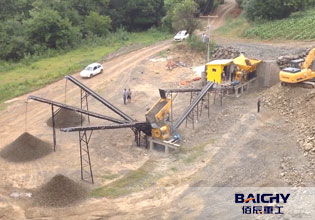
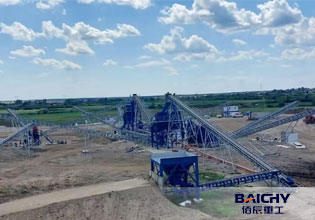
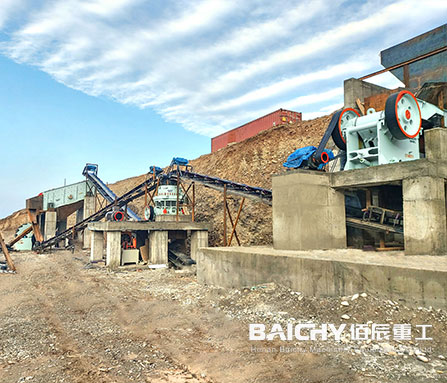
As infrastructure development continues to accelerate across Africa, the demand for high-quality aggregates for roads, bridges, housing projects, and industrial construction is growing rapidly. To meet this demand, many quarry operators are investing in automatic stone crushing plants that combine high productivity, reliable performance, and intelligent operation. Recently, a 150 TPH automatic two-stage stone crusher plant supplied by Henan Baichy Machinery Equipment company was commissioned for an aggregate production project in Africa. Designed to process hard rock materials efficiently, the plant provides a stable supply of construction aggregates while reducing labor requirements and operating costs.
Project Overview
The customer required a crushing solution capable of producing multiple aggregate sizes for local construction projects. The raw material consisted of hard granite with a feed size of up to 500 mm. The target capacity was approximately 150 tons per hour, with finished products including 0–5 mm manufactured sand, 5–10 mm aggregate, 10–20 mm aggregate, and 20–31.5 mm aggregate.
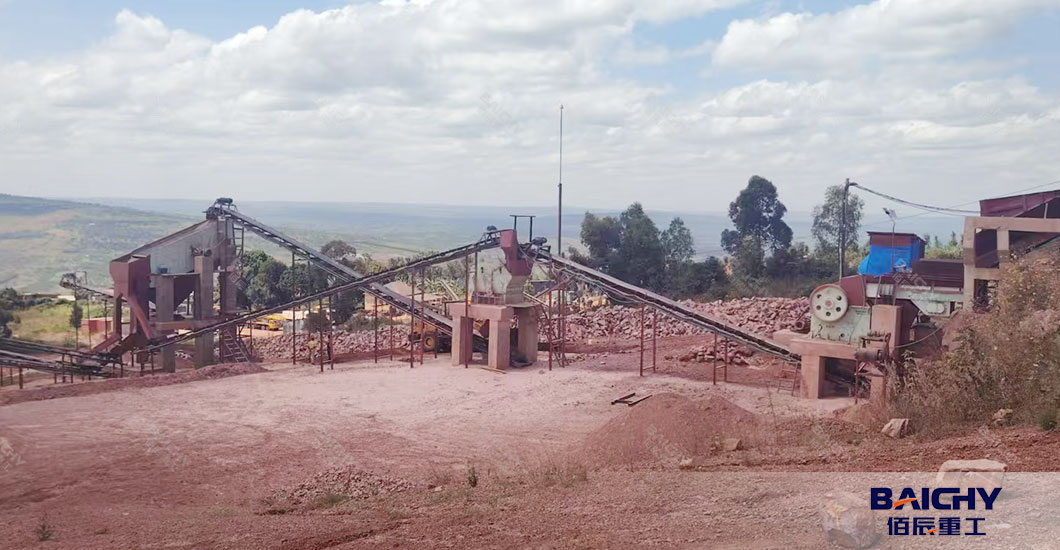
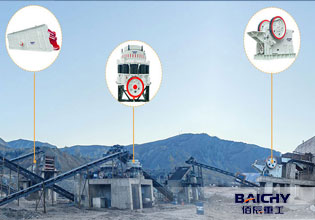
After evaluating the project requirements, Baichy engineers designed a fully automatic two-stage crushing plant that combines primary crushing, secondary crushing, screening, and centralized control into a compact and efficient production system. The plant operates continuously with minimal manual intervention, ensuring consistent product quality and reliable output throughout the production cycle.
Why Choose a Two-Stage Crushing Process?
For medium-capacity aggregate production, a two-stage crushing process offers an ideal balance between investment cost and production efficiency.
The first stage performs primary crushing, reducing large stones into manageable sizes. The second stage further crushes the material to achieve the desired aggregate specifications. Compared with a single-stage process, two-stage crushing improves particle shape, increases crushing efficiency, and enhances overall product quality.
For hard rock applications such as granite, basalt, and gabbro, a two-stage configuration can significantly improve aggregate grading while maintaining stable production capacity.
Main Equipment Configuration
1. Vibrating Feeder
The vibrating feeder transfers raw material from the hopper to the primary crusher at a controlled rate. It ensures uniform feeding and prevents sudden overloads that could affect crusher performance.
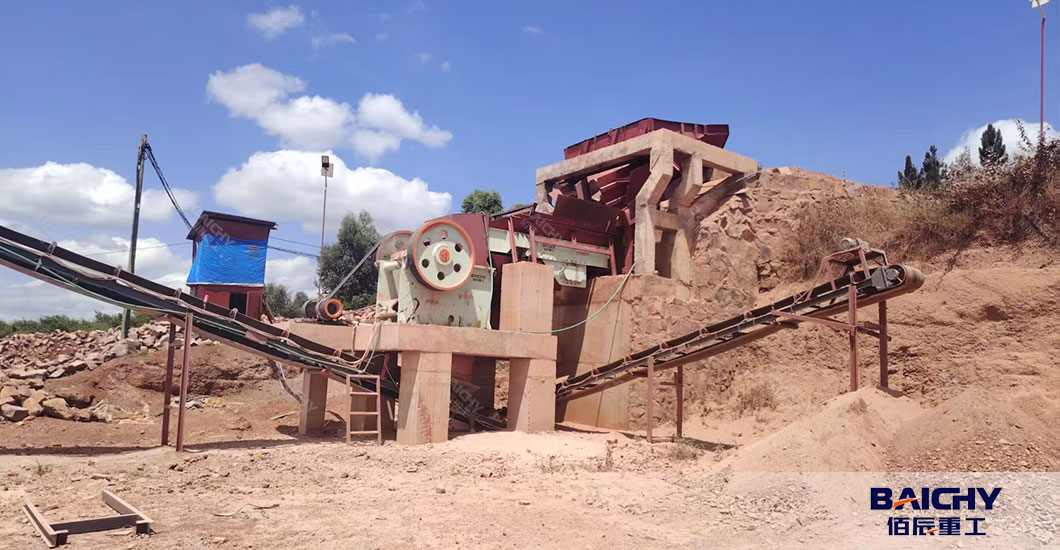
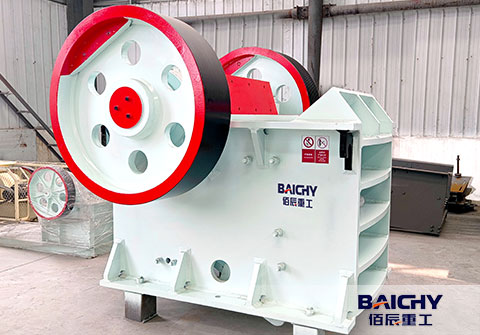
2. Jaw Crusher – Primary Crushing
A heavy-duty jaw crusher PE600X900 serves as the first crushing stage. Large granite rocks are reduced from approximately 500 mm down to 100–150 mm, preparing the material for secondary crushing.
The jaw crusher features a robust frame, high crushing ratio, and reliable operation, making it suitable for demanding quarry environments.
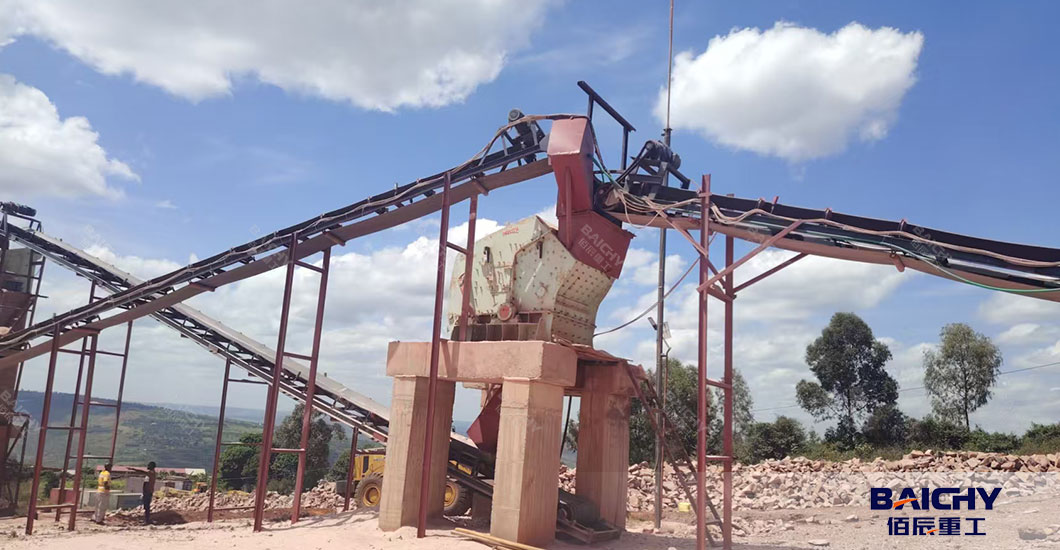
3. Impact Crusher – Secondary Crushing
The secondary crushing stage utilizes a classical PFW impact crusher. This crusher machine further reduces the material to produce high-quality aggregates with excellent particle shape and consistent size distribution.
The hydraulic adjustment device can adjust the discharge outlet and facilitate the replacement of wear-prone parts.
4. Vibrating Screen
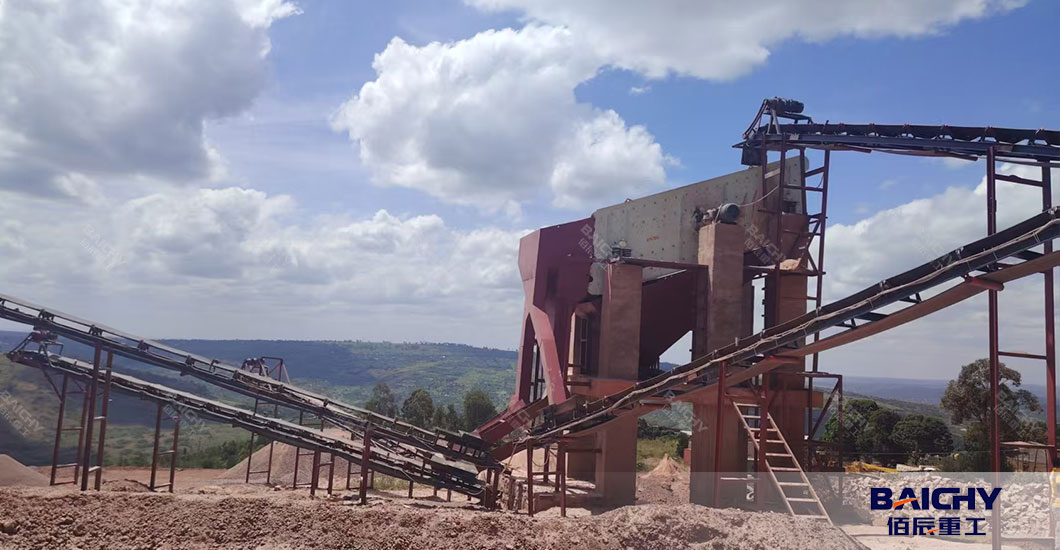
A multi-layer vibrating screen separates the crushed material into different aggregate sizes according to market requirements. Oversized material is returned to the cone crusher through a closed-circuit system, ensuring maximum utilization of raw materials.
5. Belt Conveyor System
A series of belt conveyors connects all equipment and enables smooth material transfer throughout the plant. The conveyor system is designed for continuous operation and low maintenance requirements.
6. Automatic PLC Control System
One of the key features of this project is the fully automatic PLC control system. Operators can monitor and control the entire production process from a centralized control panel.
Real-time monitoring of equipment status, production capacity, motor load, and alarm conditions improves operational safety and reduces labor costs.
Limestone Aggregates Production Process
● The production process begins when raw granite is loaded into the hopper by a wheel loader. The vibrating feeder delivers the material evenly to the jaw crusher for primary crushing.
● After the first crushing stage, the material is transported to the cone crusher for secondary crushing. The crushed aggregates are then screened into different sizes by the vibrating screen.
● Qualified products are conveyed directly to stockpiles, while oversized material is automatically returned to the cone crusher for further crushing. This closed-circuit system ensures consistent product quality and maximizes production efficiency.
● The entire process is managed by the automatic control system, allowing the plant to operate with minimal manual intervention.
Benefits of the Automatic Crushing Plant
1. Higher Production Efficiency. Automatic control enables stable feeding and optimized crusher operation, helping the plant consistently achieve its 150 TPH design capacity.
2. Reduced Labor Costs. With centralized PLC control, fewer operators are required to manage daily production activities, reducing labor expenses.
3. Consistent Product Quality. The closed-circuit crushing and screening system ensures uniform aggregate sizes suitable for concrete production, road construction, and infrastructure projects.
4. Lower Maintenance Requirements. The hydraulic systems, automatic protection devices, and high-quality components contribute to reduced wear and longer equipment service life.
5. Flexible Product Output. The plant can produce multiple aggregate sizes according to market demand, helping quarry operators maximize profitability.
Installation and Commissioning Support
To ensure smooth project implementation, Baichy engineers provided complete technical support from equipment manufacturing to on-site commissioning. The service included equipment installation guidance, system testing, production optimization, and operator training.
During commissioning, engineers worked closely with the customer’s team to optimize crusher settings, adjust screening parameters, and ensure the plant achieved its target capacity and product specifications.
The customer's operators received practical training covering equipment operation, routine maintenance, troubleshooting procedures, and safety management.
Key Maintenance Tips for African Quarry Owners
● Dust Control:. Use integrated water spray systems to protect your motors and bearings from the fine dust common in dry African regions.
● Spare Parts Inventory: Always keep a 3-month supply of "wear parts" (jaw plates, mantles, liners) on-site. Shipping delays to remote regions can kill your profitability.
● Power Stability: If the local grid is unstable, consider a hybrid diesel-electric configuration to ensure 24/7 operation.
Frequently Asked Questions (FAQ)
1. What is the average price of a 150TPH stone crusher plant in Africa?
The price varies based on the configuration (stationary vs. mobile) and the choice of secondary crusher (cone vs. impact). Generally, a high-quality two-stage 150TPH plant ranges from $180,000 to $350,000 USD.
2. Can a 150TPH plant handle granite and basalt?
Yes, when equipped with a secondary cone crusher, a 150TPH plant is highly efficient at processing hard and abrasive rocks like granite, basalt, and quartzite.
3. Is it better to choose a mobile or stationary plant for a 150TPH capacity?
If your project is long-term (3+ years) at a single location, a stationary plant offers lower operational costs. However, for road construction projects that move every few months, a mobile or portable plant is significantly more efficient.




 2026-10-16





 86-15093113821
 86-15093113821