Both jaw crusher and hammer mill machines are designed to reduce the size of rocks, their internal mechanics, target materials, and final outputs are completely different. One is a slow, unstoppable brute built for the hardest rocks on earth. The other is a high-speed precision tool designed to shatter soft materials into a fine powder. So, how do you choose? Let’s break down the ultimate battle of Jaw Crusher Vs Hammer Mill across five critical categories to help you make the best equipment decision for your plant.
1. Working principle: Compression Vs. Impact
The most fundamental difference between these two crushers is how they apply force to break the rock.
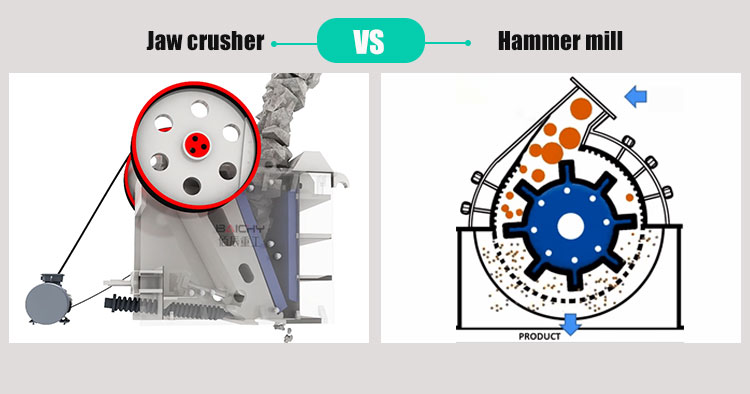
● The Jaw Crusher (The Squeezer):
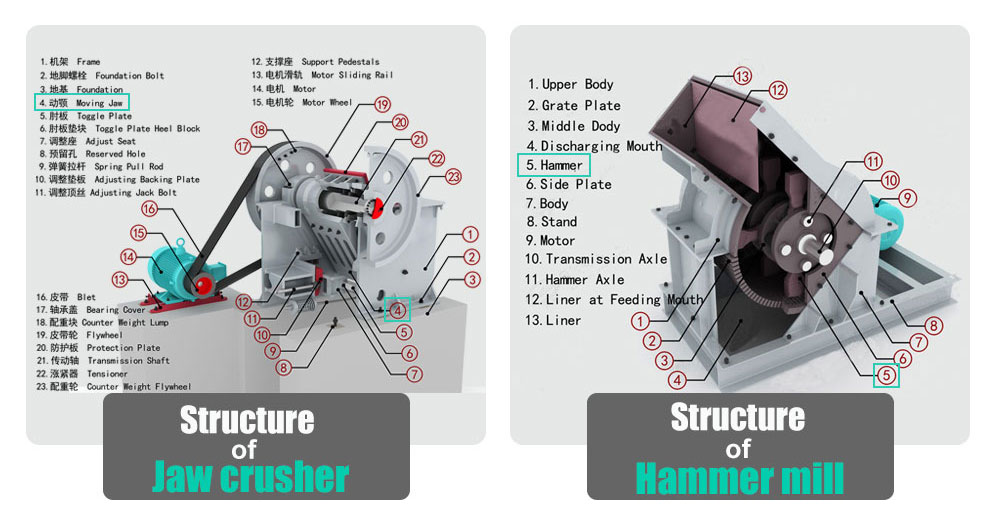
A jaw crusher relies on pure, immense compressive force. It consists of a V-shaped chamber with two heavy steel plates (jaws). One plate is stationary, while the other swings back and forth. As a rock falls into the chamber, the swinging jaw relentlessly squeezes it against the fixed jaw until the rock cracks, shatters, and drops through the bottom opening.
● The Hammer Mill (The Shatterer):
A hammer mill operates using high-speed kinetic impact. Inside the crushing chamber, a central rotor spins at incredibly high speeds, swinging heavy steel hammers. When material is fed into the machine, these hammers violently strike the rocks in mid-air. The shattered rocks are then thrown against heavy-duty breaker plates before being forced through a sizing screen at the bottom.
2. Feed Size and Reduction Ratio
Where do these machines belong in your production line? Their feed capacities dictate their roles.
● Jaw Crusher (Primary Stage):
The jaw crusher is a primary crusher. It is built with a massive, gaping feed opening designed to swallow gigantic boulders straight from the quarry face. However, its reduction ratio is relatively low (usually 3:1 to 5:1). It takes a massive boulder and turns it into medium-sized rocks, preparing the material for the next crushing stage.
● Hammer Mill (Secondary or Fine Stage):
A hammer mill has a much smaller feed opening but boasts an incredibly high reduction ratio (up to 10:1 or even 50:1). It takes medium-to-small rocks and instantly reduces them to tiny particles. In a single pass, a hammer mill can do the work of two different crushers, making it a highly space-efficient machine.
3. Material Suitability: Hard Vs. Soft Rock
Because they crush in completely different ways, they are built to process entirely different types of materials.
● Jaw Crusher (For Hard & Abrasive Rocks):
If you are mining extremely hard, tough, and abrasive materials, the jaw crusher is the only logical choice. Because it crushes by squeezing rather than striking, it experiences very low wear. It easily handles granite, basalt, quartzite, river pebbles, and iron ore without breaking a sweat.
● Hammer Mill (For Soft & Brittle Rocks):
A hammer mill is strictly designed for soft, brittle, and low-abrasion materials. If you put hard granite into a hammer mill, the high-speed impact will completely destroy your steel hammers in a matter of hours. However, for materials like limestone, coal, gypsum, chalk, and glass, the hammer mill is incredibly efficient.
4. Final Product Output: Coarse Rocks Vs. Fine Powder
What are you trying to sell? Your final product requirements will instantly decide which machine you need.
● Jaw Crusher Output (Coarse and Jagged):
A jaw crusher simply cracks rocks along their natural fault lines. Therefore, the finished product is coarse, rough, and highly variable in size. It often contains flat and elongated pieces. This output is ideal as raw feed for a secondary crusher, but it is not a finished aggregate ready for concrete or asphalt.
● Hammer Mill Output (Fine and Uniform):
This is where the hammer mill shines. Because the material is repeatedly smashed until it is small enough to pass through a bottom sizing screen, the output is exceptionally fine and uniform. A hammer mill is the ultimate machine for producing agricultural limestone (aglime), fine industrial powders, or high-quality small aggregates.
5. Maintenance and Operating Costs
Finally, let’s look at your long-term operating expenses (OPEX).
● Jaw Crusher Maintenance:
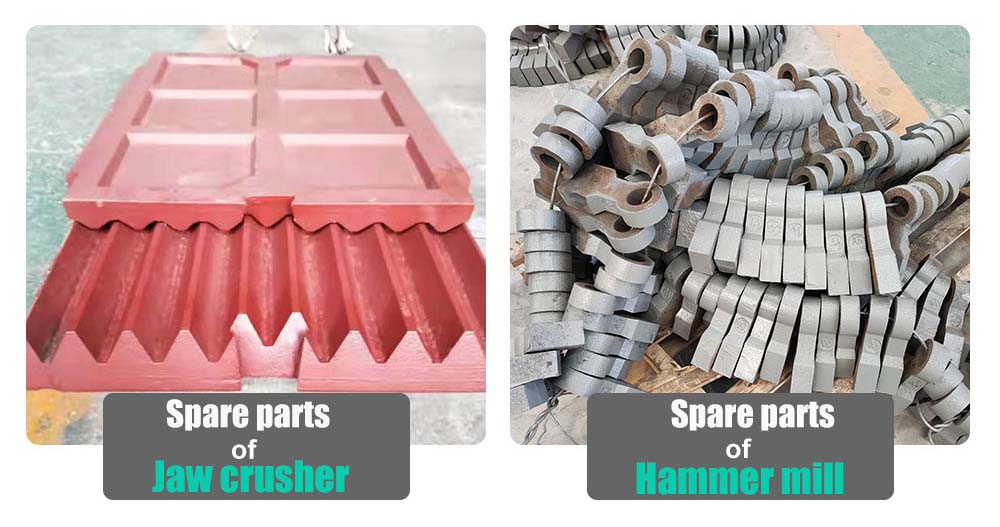
Jaw crushers are famous for their reliability. With very few moving parts, their maintenance is simple and affordable. The high-manganese steel jaw plates last a very long time, keeping your daily operating costs incredibly low.
● Hammer Mill Maintenance:
A hammer mill requires much more frequent maintenance. The heavy, swinging hammers take a massive beating every single day. Even when crushing soft limestone, these hammers will eventually wear down and lose their shape, which lowers crushing efficiency. You will need to rotate, weld, or replace the hammers regularly to maintain a high-quality output.
Which crusher is right for your application?
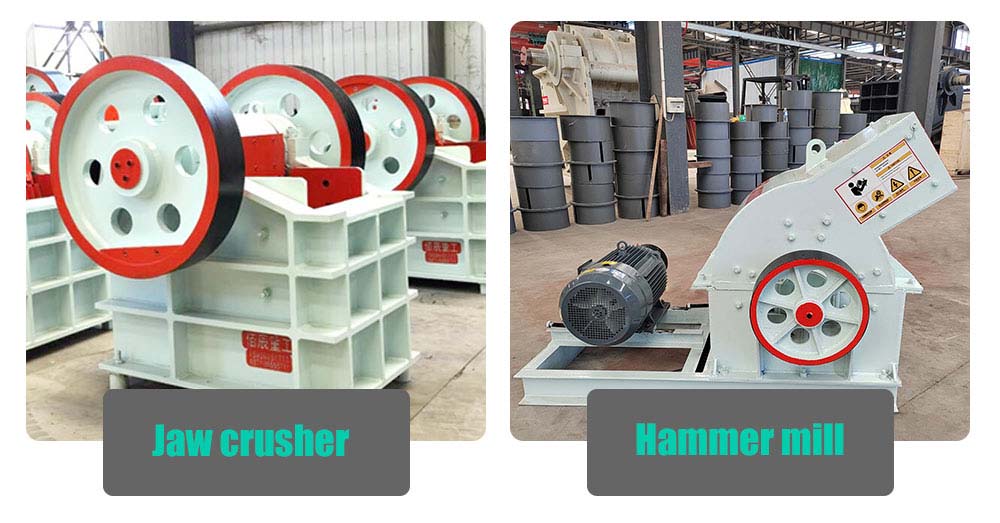
Jaw crushers and hammer mills serve distinct roles: jaw crushers are “workhorses” for hard materials and primary crushing, while hammer mills are “specialists” for soft materials and fine output.
For complex projects (e.g., processing hard limestone into fine concrete aggregates), use a jaw crusher as primary crushing (reduce 1m lumps to 100mm) and a hammer mill as secondary crushing (refine to 10mm). This hybrid setup balances durability and precision—saving time and costs.
Choose a suitable crusher according to the material type, production requirements, investment budget and other conditions. No matter what material you need to reduce, Baichy Machinery can supply the kinds of stone crushers and vibrating screens you need to complete the job efficiently. Selecting the wrong crusher can ruin your profitability and cause endless maintenance headaches. Contact our expert engineering team today for a free material analysis, and let us help you choose the exact equipment you need for your project!
People also frequently asked questions- FAQ
A jaw crusher uses compressive force to break down materials by squeezing them between two plates. Impact crushers use impact force to crush material. They are generally used for crushing soft materials and producing fine aggregate.
2.Is hammer mill a crusher?
The hammer mill is the most widely used crushing device employing the impact principle of breaking and grinding stone. It has high crushing ratio and get sand size or smaller size as final product.
3.What are the advantages of jaw crusher?
Jaw crushers have a relatively simple structure, which means that inspection, repairs and maintenance are pretty straightforward. Jaw crushers are known to be sturdy and reliable, ideal for crushing material with a moisture content of less than 15%, and sticky materials. Moreover, jaw crusher do not jam easily.
4.Which crusher is more efficient?
Compression-style jaw, cone, impact crushers, and gyratory crushers are most often appropriate as primary crushing equipment types, though there can be overlap between primary and secondary crushers as far as suitable types.




 2026-09-28





 86-15093113821
 86-15093113821