In temporary construction waste disposal sites, rugged mining areas, and road construction sites, mobile crushing plants have become indispensable core equipment. Based on their different mobility methods, mobile crushing plants are mainly divided into two types: wheeled and tracked. Their design concept eliminates the obstacles to crushing operations caused by the crushing site, environment, complex foundation configurations, and complicated logistics, making them increasingly popular among users. This article will analyze the similarities and differences between these two types of mobile stone crushing plants, highlighting their characteristics and respective advantages.
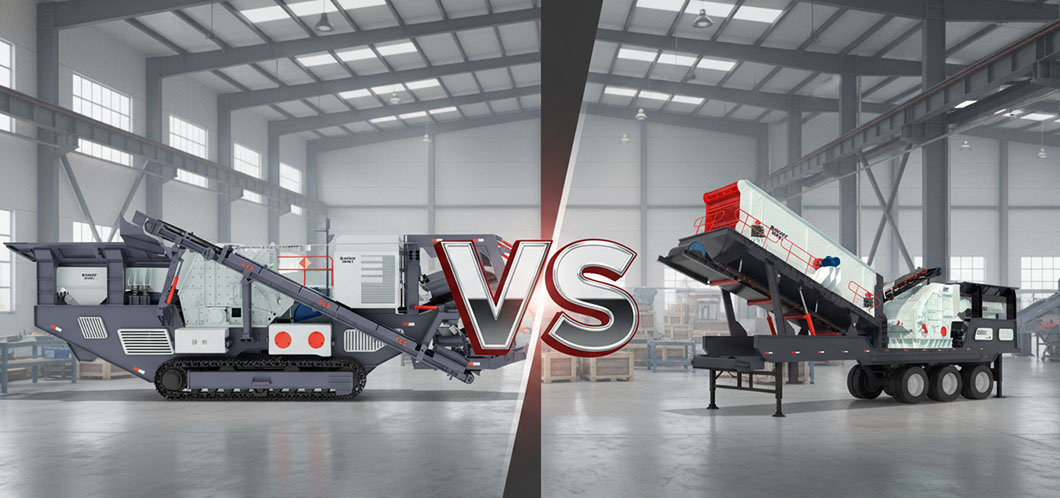
Similarities of Crawler-type Mobile Crushing Plant And Wheel-type Mobile Crushing Plant
Both wheeled and tracked mobile crushing plants share common characteristics, such as the following:
1. Flexible and Time-Saving
Mobile crushers can directly reach the mining site, unaffected by changes in the site. After adjusting the position in a short time, they can begin operation. Due to their small size, they are particularly suitable for narrow crushing sites. At the same time, they eliminate the cumbersome steel frame structure and foundation construction required for traditional crushing, saving a significant amount of time and operating costs.
2. Integrated Complete Unit
The integrated unit equipment installation eliminates the complex on-site infrastructure installation work of separate components, reducing material and labor costs. It is a production line that integrates receiving, crushing, and conveying equipment. The reasonable and compact spatial layout of the unit improves the flexibility of site deployment.
3. Reduced Material Transportation Costs
Mobile crushing plants can process materials on-site, eliminating the need to transport materials off-site for processing, significantly reducing material transportation costs.
4. Flexible Combination and Complete Functions
According to the user's actual production requirements, corresponding equipment can be configured for various combinations. It can be configured as a "crushing first, then screening" or "screening first, then crushing" process. It can be combined into a two-stage crushing and screening system (coarse and fine crushing), or a three-stage crushing and screening system (coarse, medium, and fine crushing), and can also operate independently, offering great flexibility.

Differences Between Wheeled And Tracked Mobile Crushing Plants
1. Different Mobility Methods
● Wheeled mobile crushing plants use a semi-trailer towing mode and require an external tractor for long-distance transfers. However, due to its short wheelbase and small turning radius, it can move flexibly on ordinary roads and in complex terrains, making transitions convenient and efficient.
● The crawler-type mobile crushing plant uses a fully hydraulic-driven crawler chassis and can travel short distances independently, but requires truck transportation for long distances. Its outstanding advantage lies in its strong climbing ability, allowing it to penetrate complex environments such as mountainous areas and wetlands.
2. Different Applicable Sites
● The wheeled mobile crushing plant, with its vehicle-mounted traction capable of long-distance travel, is widely used in construction waste treatment, earthwork engineering, urban infrastructure, and road engineering for aggregate processing.
● The crawler-type mobile crushing plant can easily handle rugged mountainous areas, muddy roads, steep slopes, and other complex terrains, and can be used for crushing operations in harsh working conditions such as mining and open-pit coal mines.
3. Working Efficiency
● When the wheeled mobile crushing plant is working, the hydraulic support legs under the frame are fixed, which increases the stability of the entire plant. Stability is the foundation of mobile crushing plant operation. Good stability allows the entire plant to be equipped with large crushing equipment, meaning that the wheeled mobile crushing plant can perform large-scale material crushing operations with extremely high efficiency.
● The crawler-type mobile crushing plant has weaker stability, which leads to lower crushing efficiency compared to the wheeled mobile crushing plant.
4. Different Power Systems
● The wheeled mobile crushing plant mainly relies on electric power, but also supports diesel power generation, which can adapt to the needs of temporary site operations where power supply is inconvenient.
● The crawler-type mobile crushing plant is equipped with a diversified power system, supporting electric drive, oil-electric dual-power drive, direct connection + hydraulic drive, and full hydraulic drive. It can meet the continuous operation needs of mining crushing and adapt to remote areas or field operation sites where power supply is inconvenient.
5. Different Investment Costs
● The wheeled mobile crushing plant has a variety of models and stronger modularity, allowing for flexible configuration according to the needs of different users. It has outstanding overall cost-effectiveness and a relatively low investment threshold.
● The crawler-type mobile crushing plant is equipped with more advanced heavy-duty walking and integrated systems, resulting in a relatively higher cost. However, it has more advantages in crushing operations under complex working conditions and offers outstanding long-term production benefits.

In summary, both wheeled and tracked mobile crushing plants have distinct advantages compared to stationary crushers. Understanding their respective performance benefits is crucial for selecting the appropriate equipment type based on the actual operating environment. Currently, tracked mobile crushing plants are gaining more popularity among users due to their superior performance and production efficiency. If you are interested in these two types of equipment, please feel free to contact Baichy Machinery to get solution with price list, a 20-year-old manufacturer in Henan. We offer direct sales of various common models and can also customize equipment to meet your specific needs. Welcome to visit our factory at any time.
People Also Frequently Asked For - FAQ:
Q1: Which type is better for my specific job site terrain?
A: If your site has muddy, wet, or uneven ground, or involves climbing slopes (like a mountain mine or a messy demolition site), the Crawler type is the best choice because it offers high traction and stability. If your site is flat, hardened, or paved (like a managed quarry or recycling yard), the Wheel type is sufficient and more economical.
Q2: What is the difference in how they are transported?
A: The Wheel type is essentially a semi-trailer; you can attach a truck head and tow it directly on the highway, making it easier for frequent long-distance moves. The Crawler type cannot travel on roads; it must be loaded onto a low-bed trailer (lowboy) for transport, but once on-site, it can move around freely by remote control without a truck.
Q3: Is there a significant price difference between the two?
A: Yes. Generally, the Crawler type is more expensive (often 20-30% higher) because of the complex hydraulic tracking system and heavy-duty chassis. The Wheel type is cheaper to buy and has lower maintenance costs since tires and axles are simpler to maintain than steel tracks.




 2026-09-28





 86-15093113821
 86-15093113821