Jaw crushers and cone crushers are commonly used crushing equipment, so what is the difference between these two crushing equipment? Which crusher is better to choose?The choice between a jaw and cone crusher depends on the crushing stage. Use a jaw crusher for primary reduction of large raw feed. Use a cone crusher for secondary or tertiary stages to achieve smaller, cubical aggregate and process abrasive materials efficiently. Let’s explore the difference and benefits now.
Jaw crusher VS cone crusher: comparation
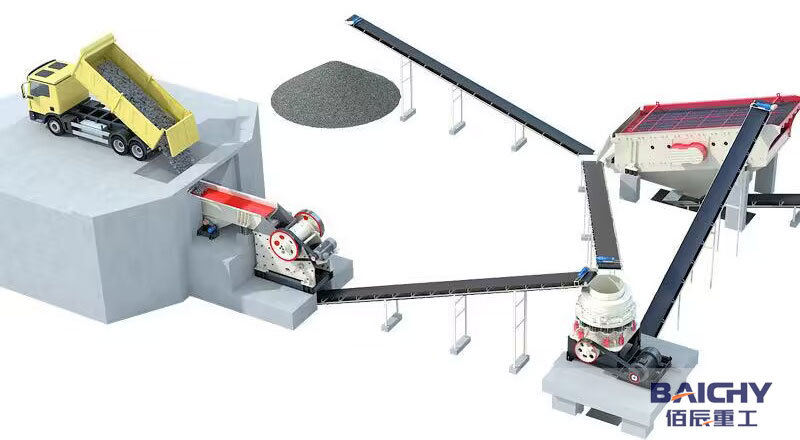
The jaw crusher is mainly used for primary crushing, and the crushed stone is relatively large. Stones with size 1500mm could be crushed to stones with a diameter of less than 100mm for next crushing stage.
Cone crushers are used for crushing medium-sized stones fragment, and are mostly used for secondary crushing. The cone crusher is specially designed for crushing hard stones, when the cone crusher crushes hard stones, the safety device opens to protect the equipment to prevent the equipment from being damaged.
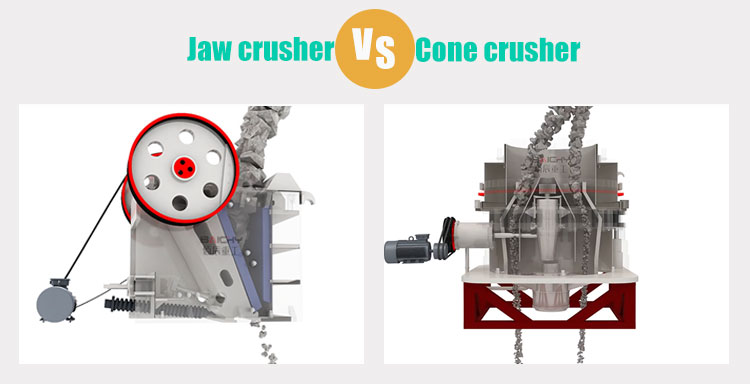
What’s The Difference Between Jaw Crusher and Cone Crusher?And how to choose suitable crushing machine? Their key differences may help you to make good decision. Let’s begin now.
1.Overall Structure
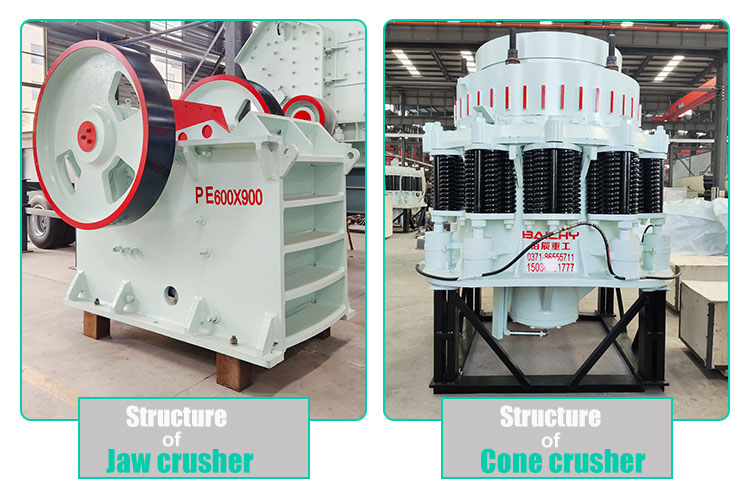
● Jaw crusher:It is mainly composed of frame, transmission mechanism, adjustment device, tensioning device, safety device and lubrication system. The transmission mechanism, as an important mechanism connecting the jaw crusher as a whole, plays an irreplaceable role. It mainly uses compressive force to break hard stone material with high crushing ratio. It features a simple V-shaped crushing chamber made of two massive steel plates. One jaw is totally stationary, while the other jaw constantly swings back and forth. As rocks fall into the chamber, the swinging jaw crushes them against the fixed jaw using brutal compressive force. It is straightforward, incredibly rugged, and very easy to maintain.
● Cone crusher: It is mainly composed of frame, horizontal shaft, moving cone, balance wheel, eccentric sleeve, upper crushing wall (fixed cone), a lower crushing wall (moving cone), a hydraulic coupling, a lubrication system, a hydraulic system, etc. Crushing walls are the main wearing parts. A cone crusher is much more complex. Imagine a steel cone (the mantle) spinning eccentrically inside a larger steel bowl (the concave). As the cone spins, it continuously wobbles, squeezing and grinding the rocks against the outer bowl. Because it crushes material continuously in a circular motion—rather than the open-and-close motion of a jaw crusher—it is highly efficient but mechanically more complicated.
2.Different feeding requirement
● Jaw Crusher (Primary Stage):
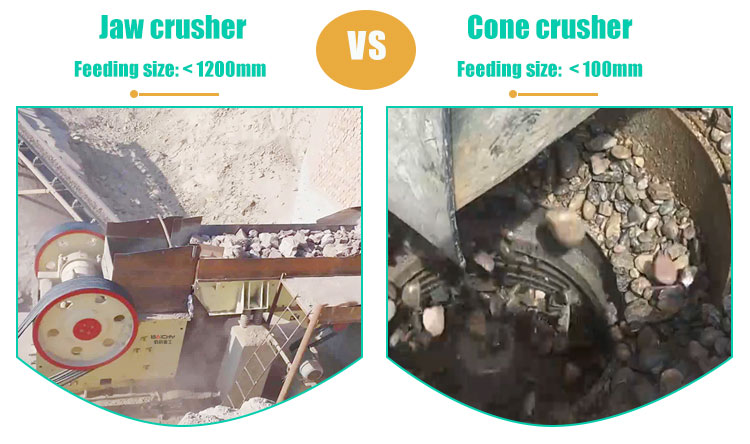
The primary jaw crusher has a relatively large feed size range. They are designed to take the first hit. They have a massive, rectangular feed opening that can swallow gigantic boulders straight from the blasting site. Because of this wide opening and deep crushing cavity, the jaw crusher is almost always used as a primary crusher. Its main job is to take rocks the size of a car tire and reduce them to the size of a football. The feed inlet of the large jaw crusher is larger than 600mm, up to 1200mm mostly, the medium one is 300-600mm, and the small one is below 300mm.
● Cone Crusher (Secondary Stage):
Cone crushers have a much smaller, restricted feed opening. Feeding size of Cone crusher is relatively small, generally requiring less than 450mm (depending on the specific conditions of the product). If you throw a massive boulder into a cone crusher, it simply won't fit. Therefore, cone crushers are used as secondary or tertiary crushers. They require the rocks to be pre-crushed by a jaw crusher first. Once the jaw crusher does the heavy lifting, the cone crusher takes those medium-sized rocks and grinds them down even further.
3.Shape of finished product
● Jaw Crusher Output:
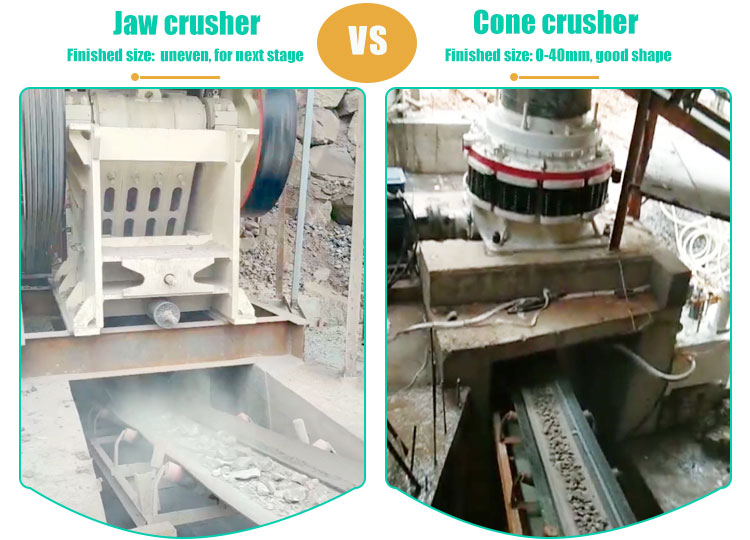
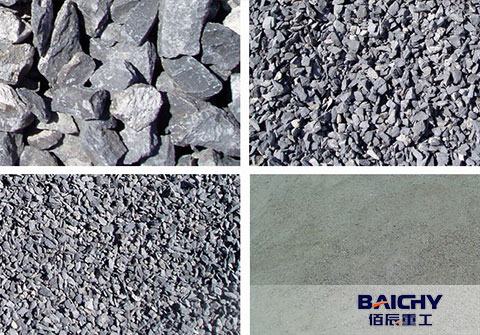
The Jaw crusher is normally used for primary crushing which will give you a big crushing capacity and the output size is bigger but suitable for secondary crushing stage. Because a jaw crusher simply cracks a rock in half along its natural fault lines, the finished product isn't very pretty. The output tends to be coarse, jagged, and often contains flat or elongated pieces. It is perfect for raw size reduction, but it is rarely suitable as a final construction aggregate.
● Cone Crusher Output:
This is where the cone crusher shines. Because the rock is repeatedly squeezed and ground between two curved surfaces, the finished product comes out much finer and more uniform. Modern cone crushers produce an excellent, high-quality cubical shape. This perfectly shaped aggregate is exactly what construction companies look for when mixing high-grade asphalt and concrete. Cone crusher is for secondary and tertiary crushing stages, thus having a smaller discharging size. The rocks are continually crushed until they are small enough to move through the narrow opening at the bottom of cone crusher. The final product is in good finished shape.
4.Price for jaw crusher and cone crusher 
● Jaw Crusher Cost:
Generally, a jaw crusher has a lower initial purchase price. Because its overall structure is relatively simple, it is cheaper to manufacture. Furthermore, maintenance is very straightforward. Replacing the jaw plates is easy, which keeps long-term operating costs and downtime to a minimum.
● Cone Crusher Cost:
A cone crusher comes with a higher initial price tag. It is a sophisticated piece of engineering, packed with complex hydraulic systems, lubrication systems, and advanced automation. Maintenance requires more technical skill. However, don't let the price scare you away. When processing highly abrasive rocks (like granite or quartzite), a cone crusher experiences far less wear-and-tear than other machines. In the long run, its high efficiency and low replacement-part costs make it an incredibly profitable investment.
5.Take 300tph crusher for example
Through the above comparison, it can be found that when the capacity is same, the cone crusher is about twice heavier than jaw crusher, so the price is higher, and the cost of civil engineering and later maintenance and repair is higher too. While the crushing ratio of the cone crusher is not as large as that of the jaw crusher, and it is more efficient when processing materials with higher hardness.
Jaw crusher VS cone crusher: 300tph capacity
|
Model
|
PE jaw crusher
|
PYB cone crusher
|
|
Max feeding size
|
630 mm
|
215 mm
|
|
Outlet adjusting size
|
60-150 mm
|
25-60 mm
|
|
Capacity
|
110-380 tph
|
180-360 tph
|
|
Motor power
|
110 kw
|
160 kw
|
|
Weight
|
29 ton
|
60 ton
|
To sum up, jaw crushers and cone crushers have their own advantages. Both jaw crushers and cone crushers have better particle shapes. These two crushing machines complement each other. The specific choice is mainly depending on the type and hardness of the material, the size of the finished product, the site and actual needs, etc., users can click here to make reasonable purchases under the guidance of professionals.
People Frequently Asked Questions-FAQ:
1.Which is better cone crusher or jaw crusher?
Jaw crushers can work on a range of stone from the softer ones like limestone to harder basalt or granite. A cone crusher is similar to a gyratory crusher because it operates using a mantle that rotates within a bowl, but it has less steepness in the crushing chamber.
2.Why use cone crusher?
Cone crushers are capable of crushing all types of medium to hard mineral rocks and stones. It also offers many advantages over other crusher designs, such as low energy consumption, reliability, high efficiency (compared to other crushers), and a high reduction ratio (feed/input size compared to product/output size).
3.How fine can a cone crusher crush?
Cone crusher is better suited for secondary crushing. It is designed to crush pre-dimensioned materials, generally of 100 mm, 150 mm or 200 mm, and provide finished products of small dimensions.
4.Which crusher is best for stone?
Different types of crushers are optimal for distinct crushing needs. Subjected to type and hardness of materials, capacity, feeding size, finished granular size, construction site, the chosen crusher could be jaw crusher, impact crusher, cone crusher, roller crusher, hammer crusher, vsi sand crusher etc.




 2026-10-16





 86-15093113821
 86-15093113821