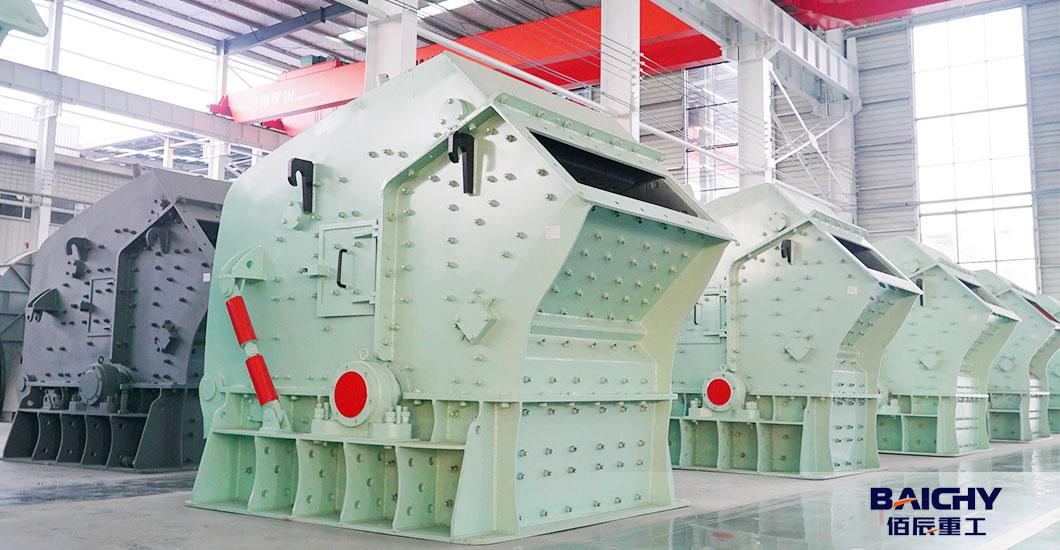
An impact crusher produces cubical aggregates mainly because of its high-speed impact crushing mechanism, repeated material collisions, controlled crushing chamber design, and adjustable crushing conditions. Unlike compression crushers that break rocks primarily through squeezing forces, an impact crusher uses kinetic energy to fracture materials, helping reduce elongated and flaky particles.
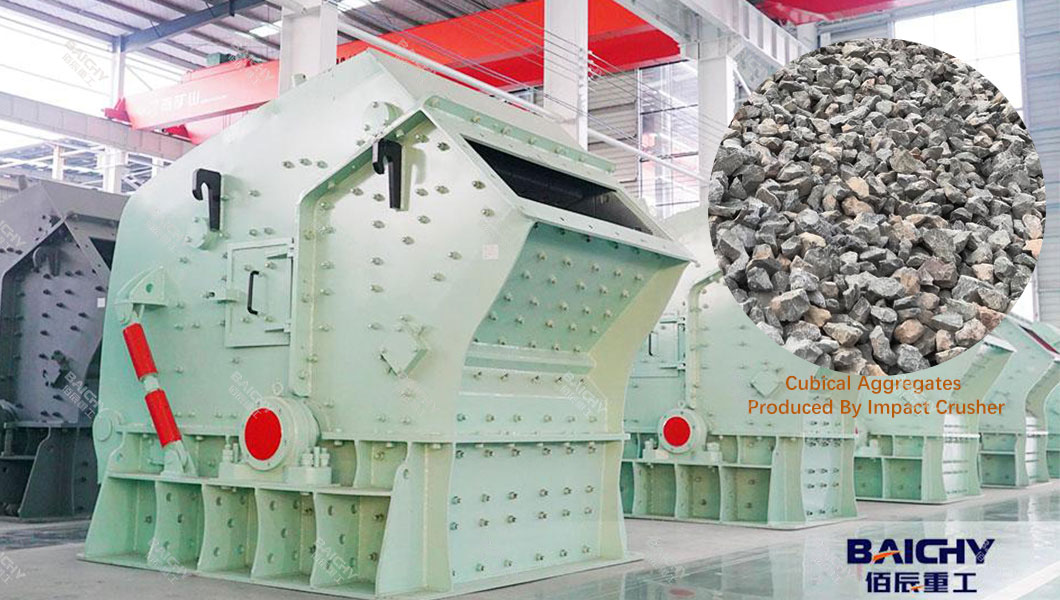
1. High-Speed Impact Creates More Natural Fracture Surfaces
The impact crusher uses a high-speed rotating rotor equipped with wear-resistant blow bars. As raw materials enter the crushing chamber, the rotating blow bars strike the rocks with considerable kinetic energy, accelerating them toward the impact plates. When the impact force exceeds the material's internal tensile strength, cracks develop along natural weak points, mineral boundaries, and existing fractures. The rock then breaks into smaller pieces rather than being gradually flattened under continuous compression. This fracture-based crushing process helps create particles with more balanced length, width, and thickness. As a result, the finished aggregates generally have a more cubical shape and fewer excessively elongated particles. The effect is particularly valuable when producing aggregates for concrete and asphalt, where particle shape influences aggregate interlocking, packing characteristics, and mixture performance.
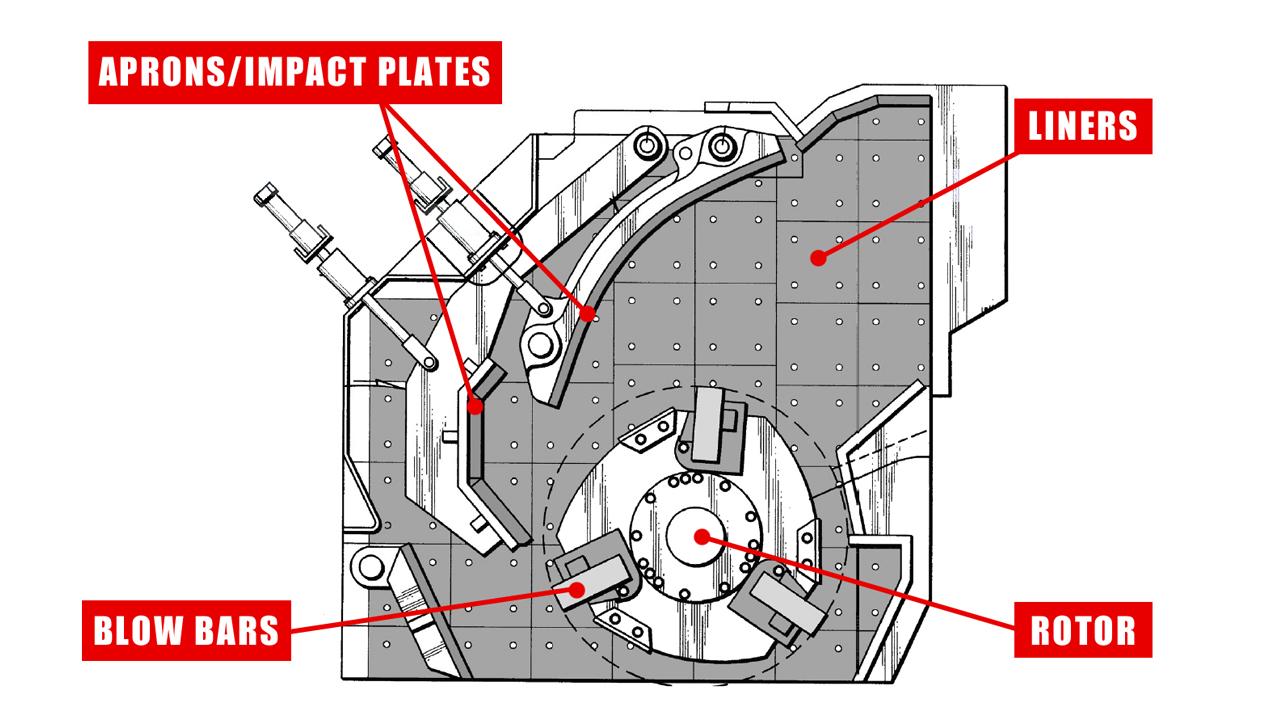
2. Repeated Impact and Collision Improve Particle Shape
An impact crusher does not rely on a single crushing action. After the initial blow from the rotor, crushed materials are thrown against the impact plates, where they undergo another crushing process. Larger particles may experience multiple impacts before reaching the discharge opening. During this process, particles can also collide with each other, creating additional fracture points and reducing oversized or irregular pieces.This repeated impact action helps improve particle shape in several ways:
-
Breaks elongated particles: Repeated impacts can break long, narrow rock pieces into shorter, more equidimensional particles.
-
Reduces oversized fragments: Large particles receive additional crushing until they can pass through the discharge opening.
-
Improves particle uniformity: Multiple crushing interactions help reduce the proportion of irregularly shaped coarse particles.
-
Creates fresh fracture surfaces: New fracture surfaces develop as particles break, helping produce more angular aggregate particles.
This is one reason impact crushers are commonly used in secondary and tertiary crushing stages when aggregate producers need better particle shape.
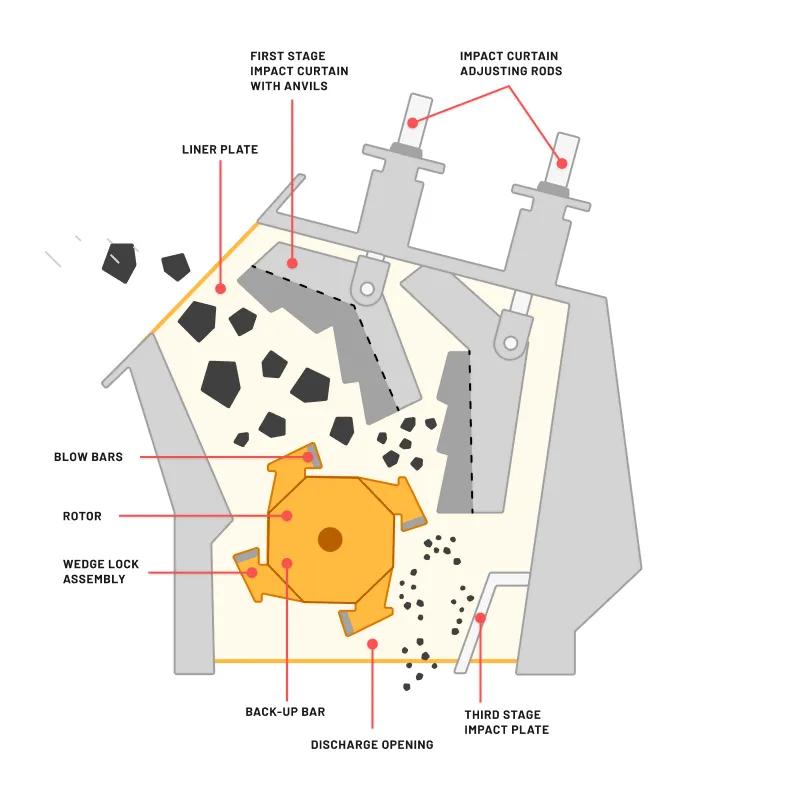
3. Crushing Chamber Design Controls Material Movement and Crushing Action
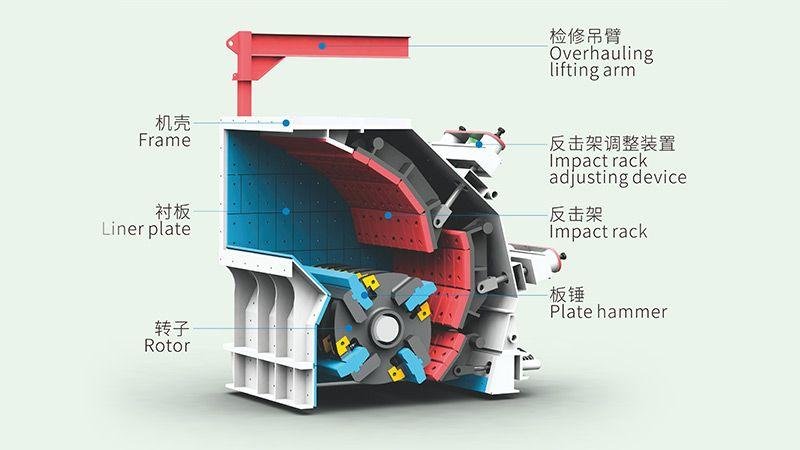
The internal structure of an impact crusher plays an important role in determining the final aggregate shape. The crushing chamber consists mainly of a rotor, blow bars, impact plates, and an adjustable discharge area. These components work together to control how materials move through the crushing process. When rocks enter the chamber, the rotor accelerates them toward the impact plates. The impact plates redirect the material back into the crushing zone, creating additional opportunities for impact and breakage. The position and clearance of the impact plates influence the crushing space and the number of effective crushing interactions. A properly adjusted chamber allows materials to receive sufficient impact energy without unnecessary over-crushing. For aggregate production, the objective is not simply to achieve a high crushing ratio. It is to balance reduction ratio, particle shape, product gradation, and the generation of unwanted fines.
4. Adjustable Rotor Speed and Impact Plate Clearance Optimize Particle Shape
The operating parameters of an impact crusher directly affect its crushing performance and finished aggregate quality.
Rotor speed determines the kinetic energy delivered to the material. Increasing rotor speed generally increases impact energy, which can improve the crushing effect on certain materials. However, excessive speed may increase fine-particle generation, power consumption, and wear on blow bars and impact plates.
Impact plate clearance determines the space available for material reduction. A smaller clearance generally produces a smaller discharge product and increases the degree of crushing. A larger clearance allows larger particles to pass through.
The relationship between these two parameters needs to be considered together with material hardness, feed size, moisture content, and required output gradation. For example, when producing 5–20 mm aggregates, operators should adjust rotor speed and impact plate clearance according to the actual feed characteristics and product requirements, rather than simply maximizing rotor speed or minimizing the discharge gap. The goal is to achieve the required particle shape and size distribution while maintaining stable capacity and reasonable wear costs.
Summary: Four Factors Behind Cubical Aggregate Production
| Key factor |
Crushing mechanism |
Effect on aggregate shape |
| High-speed impact |
Blow bars strike rocks with kinetic energy |
Creates natural fracture surfaces and more equidimensional particles |
| Repeated collisions |
Material repeatedly impacts plates and other particles |
Breaks elongated and oversized fragments |
| Crushing chamber design |
Rotor and impact plates control material movement |
Provides multiple crushing opportunities and more controlled reduction |
| Adjustable operating parameters |
Rotor speed and impact plate clearance regulate crushing conditions |
Helps optimize particle shape, size distribution, and fines content |
Engineering note: An impact crusher can produce a high proportion of cubical aggregates, but it does not guarantee that every particle will have a perfect cubic shape. Actual results depend on rock properties, feed gradation, rotor speed, crushing chamber configuration, and operating conditions. Aggregate shape should ultimately be verified through particle-shape testing, such as flakiness and elongation index measurements.




 2026-11-17






 86-15093113821
 86-15093113821