Home About us
Products
News
Solution
Video Service Contact us
Home  /  News

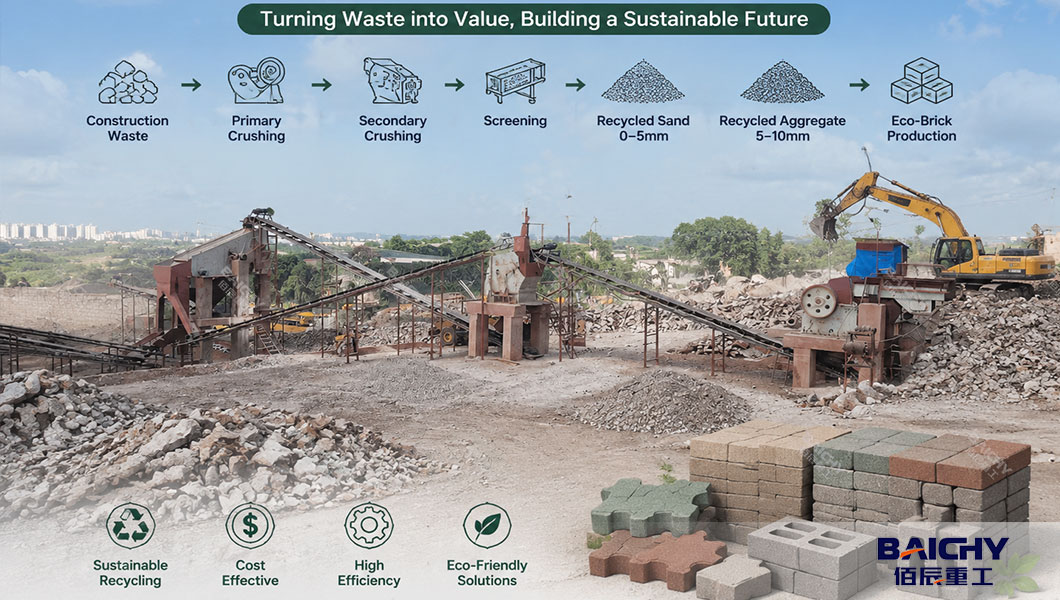
The global construction industry is shifting towards a circular economy. Instead of paying high landfill fees for concrete debris and old bricks, savvy investors are turning this "waste" into high-value aggregates. If you are aiming to produce non-fired bricks, the quality of your raw material—specifically the 0-5mm sand and 5-10mm stone—is critical. Below, we break down a professional 30-40 TPH construction waste recycling solution designed to deliver high-purity materials.


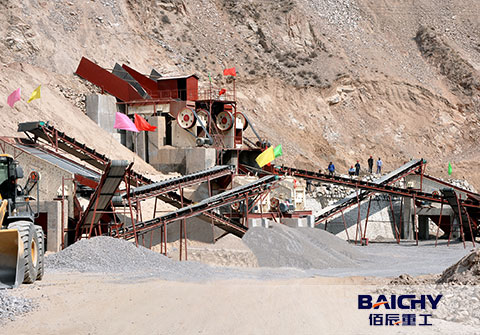
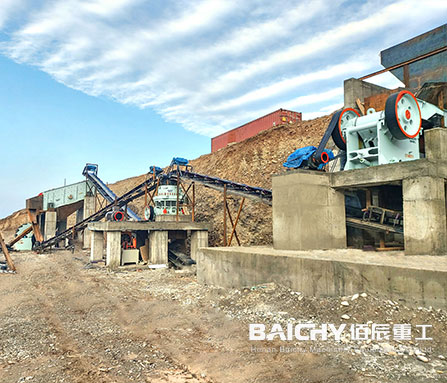
construction-waste-recycling-solution-for-eco-brick-making.jpg


The Equipment Lineup: Core Components for 30-40 TPH

To achieve an input capacity of 30-40 tons per hour, a balanced configuration of primary crushing, metal removal, and secondary shaping is essential.

1. Primary Crushing: PE Series Jaw Crusher
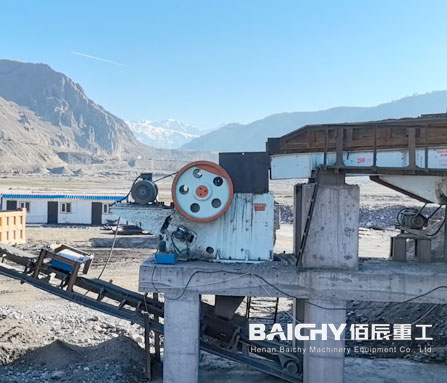
The first step in any recycling plant is breaking down large slabs of concrete and masonry. The Jaw Crusher is the "workhorse" here, designed to handle high-pressure materials with ease. For a 30-40 TPH capacity, a model like the PE400x600 or PE500x750 provides the perfect balance of opening size and throughput.


2. Purification: Self-Cleaning Magnetic Separator
Construction waste is notoriously "dirty," often containing rebar, wire, and scrap metal. A high-strength Metal Magnetic Separator is installed above the belt conveyor. It automatically extracts ferrous metals, protecting the secondary crusher from damage and ensuring your final sand is metal-free—a must for high-quality brick making.


3. Secondary Crushing & Shaping: Impact Crusher
To produce the cubical 0-5mm and 5-10mm sizes required for bricks, an Impact Crusher (such as the PF1007) is superior. Unlike cone crushers, impact crushers use "strike" energy to break stones along natural cleavage planes, resulting in superior grain shape and a higher percentage of "fines" (sand) needed for the brick binder.


4. Classification: Multi-Deck Vibrating Screen
The final step is precision grading. A Multi-Deck Vibrating Screen (YK Series) separates the crushed material into three distinct streams:

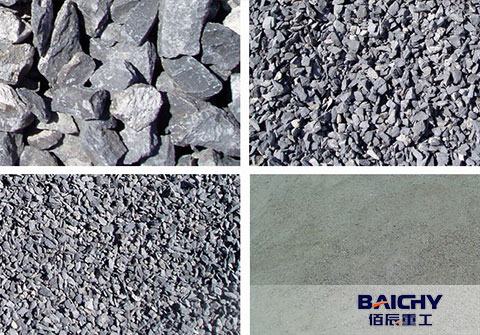
   0-5mm: Fine sand for the brick-making mixture.
   5-10mm: Structural stone/gravel.
   >10mm: Oversize material returned to the impact crusher for re-crushing.


The Processing Flow: Turning Debris into Sand

  ● Feeding: Raw waste is fed into the Jaw Crusher via a vibrating feeder to ensure a steady 30-40 TPH flow.
  ● Primary Crushing: The Jaw Crusher reduces the debris to <100mm.
  ● Iron Removal: As the material moves on the conveyor, the Magnetic Separator pulls out rebar and nails.
  ● Secondary Crushing: The metal-free concrete enters the Impact Crusher for fine reduction.
  ● Screening: The Multi-Deck Screen sorts the material into the final 0-5mm and 5-10mm products.


Why This Solution is Perfect for Non-Fired Bricks

Non-fired bricks (or cement bricks) rely on a specific particle size distribution to achieve maximum compressive strength.

  ● Perfect Grain Shape: The impact crusher ensures the aggregate has a rough, cubical surface, which creates a stronger bond with cement.
  ● Cost Efficiency: Using recycled aggregates reduces raw material costs by up to 40-60% compared to buying natural river sand.
  ● Sustainability: Meeting local "Green Building" regulations can often qualify your brick factory for tax incentives or government contracts.


At 30-40 TPH, this construction waste recycling plant is an ideal entry-point for contractors and brick manufacturers. It offers a compact footprint, low energy consumption, and high-purity output.  Are you looking to start your recycling project? Baichy Machinery specializes in customized crushing plants for the construction and mining industries. We provide the complete technical layout and equipment supply to ensure your success.


Maybe you are interested in