Properly adjusted M sand (manufactured sand) properties—including fineness modulus (FM), fines content, and particle gradation—are non-negotiable for concrete workability, compressive strength, and long-term durability. Whether you’re producing M sand for high-strength concrete (FM 2.6-2.9, fines ≤7%) or mortar (FM 2.3-2.6, fines 8-10%), the right adjustments can reduce material waste by 15-20% and improve construction quality. Most adjustments can be made via VSI sand crusher settings, screen configuration, or process optimization. This guide breaks down actionable methods for each parameter, with real-world data and quick-reference checklists to streamline your operations.
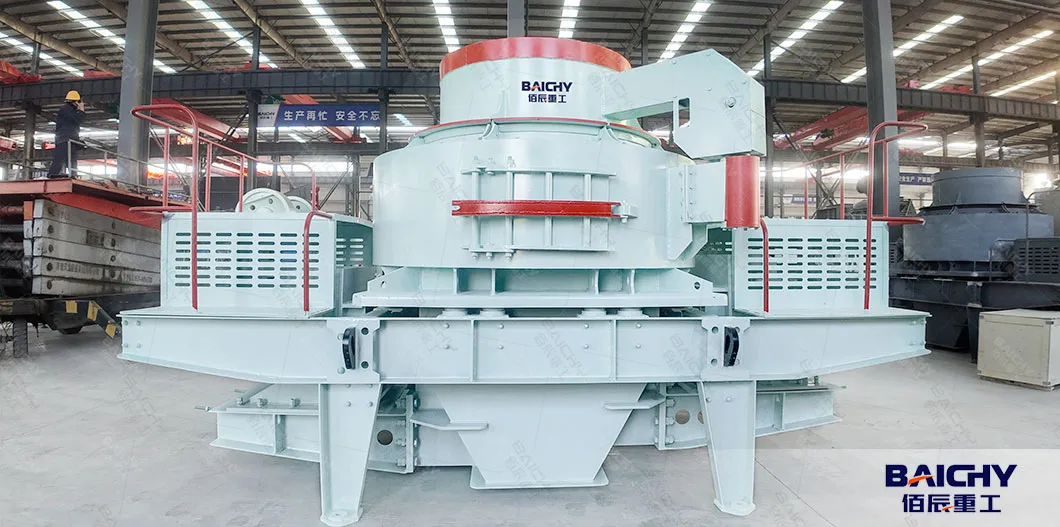
Adjusting M Sand Fineness Modulus
1. What Is Ideal Fineness Modulus?
Fineness modulus (FM) measures M sand’s coarseness/fineness, calculated from particle size distribution. The industry-standard range for quality M sand is 2.3-3.1:
•Coarse M sand (FM 2.8-3.1): Ideal for structural concrete, precast elements, and asphalt mixes.
•Medium M sand (FM 2.6-2.8): Versatile for general-purpose concrete, mortar, and plaster.
•Fine M sand (FM 2.3-2.6): Suited for masonry mortar, tile adhesive, and grout.
A FM above 3.2 leads to poor concrete workability (requires more water/cement), while a FM below 2.2 increases shrinkage and cracking risk.
2. Key Adjustment Methods
a.VSI Rotor Speed Tuning:
Rotor speed directly impacts crushing intensity—higher speed = finer sand, lower speed = coarser sand. For most VSI crushers (e.g., 5X, VSI series), adjusting speed by 100-150 rpm changes FM by 0.2-0.5. Example: If your current FM is 3.3 (too coarse for medium concrete), increase rotor speed from 1700 rpm to 1850 rpm to lower FM to 2.9. Avoid exceeding 200 rpm adjustments at once—this causes uneven particle shape.
b.Feed Mode Switch:
VSI crushers offer two feed modes:
◦“Stone-on-stone” (shaping mode): Material collides with itself, producing coarser, cubical sand (FM increases by 0.3-0.4). Best for boosting FM when sand is too fine.
◦“Stone-on-iron” (crushing mode): Material impacts metal anvils, yielding finer sand (FM decreases by 0.2-0.3). Ideal for reducing FM in overly coarse batches.
c.Screen Mesh Size Replacement:
Screens control the final particle size exiting the crusher. Swap to a larger mesh (e.g., 4.75mm → 5mm) to retain coarser particles, increasing FM by 0.3-0.6. Use a smaller mesh (4.75mm → 4mm) to filter out coarse fractions, lowering FM by 0.2-0.4. For precision, use woven wire screens with uniform openings—clogged or damaged screens skew results.
Controlling M Sand Fines Content
1. Fines Content Standard
Fines are particles smaller than 0.075mm (75 microns). Industry standards (e.g., GB/T 14684-2022, ASTM C33) limit fines to ≤10% for general concrete; high-strength concrete (C60+) requires ≤7%. Excess fines absorb water, increasing the water-cement ratio and reducing concrete strength by 10-15%. Too few fines (≤5%) lead to poor cohesion and segregation.
2. Reduce Fines Content
•Install a Sand Washer: Spiral or wheel sand washers remove 30-50% of excess fines by scrubbing and rinsing sand. A 100 TPH M sand plant in India reduced fines from 12% to 7% within 1 week of adding a spiral washer.
•Adjust VSI Feed Rate: Over-crushing (low feed rate) increases fines. Increase feed rate by 10-15% (within equipment capacity) to reduce fines by 15-20%—this minimizes material residence time in the crusher.
•Add a Dust Collector: Capture airborne fines during crushing with a baghouse or cyclone dust collector. This not only reduces fines in the final product but also improves workplace air quality.
3. Increase Fines Content
•Optimize VSI Settings: Switch to “stone-on-iron” mode and increase rotor speed by 100-150 rpm—this boosts fines by 10-15% by enhancing particle fragmentation.
•Reduce Screen Mesh Size: Add a 0.15mm deck to the screen to retain more fine particles. For example, adding a 0.15mm deck increased fines from 6% to 9% in a Chinese mortar production plant.
•Minimize Washing Time: For wet processing, reduce sand washer runtime by 30% to retain more fines. Avoid over-washing, which strips essential fines needed for cohesion.
Optimizing M Sand Gradation
1. What Is Well-Graded M Sand?
Well-graded M sand has a uniform particle size distribution across all fractions, ensuring dense packing in concrete. The ideal gradation (per GB/T 14684-2022) is:
•4.75mm (10-20%)
•2.36mm (25-35%)
•1.18mm (15-25%)
•0.6mm (10-15%)
•0.3mm (5-10%)
•≤0.075mm (0%)
Poor gradation (e.g., excess coarse particles or gaps in fractions) leads to higher cement consumption and lower concrete density.
Gradation Adjustment Methods
1.Multi-Deck Screen Configuration:
Install a 3-4 deck screen with openings at 4.75mm, 2.36mm, 1.18mm, and 0.6mm. This segregates particles into distinct fractions, allowing you to blend them in precise ratios. For example, if your sand lacks 1.18mm particles, mix 60% coarse fraction (4.75mm+2.36mm) with 40% fine fraction (1.18mm+0.6mm) to balance gradation.
2.Blending with Natural Sand:
Mix M sand (70-80%) with natural river sand (20-30%) to fill gaps in particle distribution. Natural sand typically has more fine fractions, making it ideal for improving gradation of overly coarse M sand. A Malaysian construction project blended 75% M sand (FM 2.9) with 25% natural sand (FM 2.4) to achieve a well-graded mix (FM 2.7) for high-rise concrete.
3.VSI Cascade Feed Mode:
Use dual-feed mode (center + ring feed) in VSI crushers to improve particle distribution by 20%. This mode ensures uniform crushing of both coarse and fine feedstock, reducing gaps in gradation.
Practical Adjustment Checklist
| Target Adjustment |
Equipment Tweaks |
Process Changes |
Expected Result |
| FM from 3.3 → 2.9 |
Increase VSI rotor speed by 150 rpm; use 4.75mm screen |
Maintain feed rate at 80% of capacity |
FM reduced to 2.9; cubical particle shape retained |
| Fines from 12% → 8% |
Add spiral sand washer; install dust collector |
Increase feed rate by 10% |
Fines reduced by 4%; concrete strength improved by 12% |
| Poor gradation → Well-graded |
Install 4-deck screen (4.75/2.36/1.18/0.6mm) |
Blend 70% M sand + 30% natural sand |
Meets GB/T 14684-2022 gradation standard; cement usage reduced by 8% |
Common Mistakes to Avoid
•Over-Adjusting Rotor Speed: Changing speed by ≥200 rpm causes uneven particle shape (needle-flake content >10%) and increases wear on liners.
•Ignoring Feed Size: VSI crushers require feed size ≤50mm—oversized feed (≥60mm) leads to poor crushing efficiency and inconsistent gradation.
•Skipping Screen Maintenance: Clogged screens (from wet or sticky material) cause inaccurate particle separation. Clean screens daily and replace worn ones every 3 months.
•Neglecting Sampling: Test M sand properties (FM, fines, gradation) every 2 hours during production to catch deviations early. Use a standard sieve set (0.075mm-4.75mm) for accurate testing.
FAQ about how to adjust M sand?
Q: How long does it take to adjust M sand fineness modulus?
A: Quick tweaks (rotor speed, screen changes) take 1-2 hours. Installing equipment (sand washer, dust collector) takes 1 day. Allow 2-3 production batches to stabilize results after adjustments.
Q: Can I adjust gradation without changing equipment?
A: Yes—blend different M sand batches (coarse + fine) or add natural sand. For example, mixing 50% coarse M sand (FM 3.0) with 50% fine M sand (FM 2.4) achieves a balanced FM of 2.7.
Q: What’s the impact of excess fines on concrete?
A: Excess fines (≥12%) increase water demand by 10-15%, leading to higher shrinkage, lower compressive strength (reduced by 10-15%), and increased cracking risk in hardened concrete.
Q: How often should I test M sand properties?
A: Test FM, fines content, and gradation every 2 hours during continuous production. For batch production, test each batch to ensure consistency.




 2026-09-21





 86-15093113821
 86-15093113821