In the coal industry, producing excessive "fines" or dust during the crushing process is a direct blow to profitability. Unlike hammer crushers that use high-speed impact to shatter material into unpredictable sizes, a double roller crusher utilizes a precise "squeeze and shear" method. Once the coal reaches the pre-set gap size, it is immediately discharged, preventing unnecessary re-crushing. For example, a large coal preparation plant in South Africa recently replaced their impact crushers with toothed roller systems. They reported a 15% increase in high-value lump coal yield and a significant reduction in waste dust. This precision ensures that the final product meets strict size requirements for boilers or coking ovens while maximizing the market value of every ton processed.
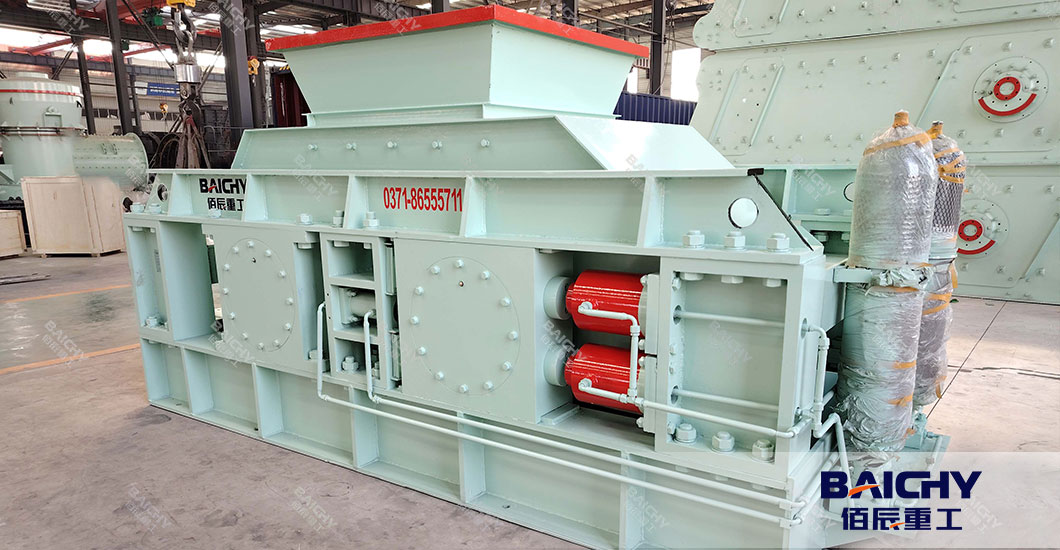
Double Roller Crusher the Ultimate Choice for Coal Processing
1. Minimizing Over-Crushing: How to Protect Your Lump Coal Value?
In the coal industry, the goal is often to produce specific lump sizes for boilers or coking ovens. Excess coal fines (dust) are not only low-value but also create massive headaches during transport due to loss and environmental dust. Traditional hammer crushers often "over-kill" the material by striking it repeatedly until it passes through a screen. In contrast, a double roller crusher works on a simple "extrude and discharge" principle. Once the coal reaches the pre-set gap size, it is immediately released from the crushing chamber. There is no unnecessary agitation or secondary impact. This results in an incredibly uniform grain size with minimal fine powder, directly protecting the market value of your product.
2. Unbeatable Moisture Adaptation: Why Wet Coal Won't Stop Your Production?
Raw coal is rarely bone-dry; it often carries significant moisture from mining or washing processes. For impact or hammer crushers, wet coal is a nightmare that leads to clogged screens, "pasting" of the crushing chamber, and frequent downtime. The double roller crusher solves this through a rugged, self-cleaning design. Its toothed rollers act like mechanical claws that "tear" through sticky, muddy coal and force it downward. Instead of getting trapped, the material is shredded and moved along the line. For example, a large coal wash plant recently reported zero clogs during the monsoon season after switching to toothed rollers. This reliability ensures your plant maintains a high throughput regardless of the weather or coal source.
3. High-Efficiency Mechanism: Leveraging Coal’s Natural Weakness
Coal has a unique physical profile: it possesses high compressive strength but very low shear and tensile strength. It is essentially "brittle." While a jaw crusher tries to overcome coal’s strongest point (compression), the roller crusher attacks its weakest. By using sharp teeth to pierce the surface, the machine creates intense shearing and splitting forces along the coal’s natural cleavage planes. This "Shear + Tension" mechanism is far more efficient than brute-force squeezing. It requires much less force to achieve the same reduction ratio, which means the machine doesn't have to work as hard. This smart approach to physics makes it the most specialized tool for the job.
4. Precise Gap Adjustment: One Machine for Multiple Grain Requirements
Different industries—from power generation to chemical processing—demand vastly different coal specifications. A major advantage of the roller crusher is its exceptional flexibility. Operators can precisely control the discharge size by adjusting the shims or hydraulic cylinders that manage the gap between the rollers. This allows you to switch from producing 50mm lumps to 10mm grains with minimal downtime. One piece of equipment can serve multiple production lines or adapt to changing customer orders in minutes. This level of precision ensures that you are always delivering exactly what the client requested without wasting material.
5. Lower Operational Costs: Saving Energy and Reducing Maintenance
When it comes to the bottom line, the double roller crusher is a champion of ROI. Because it uses shearing instead of impact, it consumes 30% to 40% less electricity than a cone or hammer crusher. Furthermore, the simple structural design means there are fewer moving parts to break. Maintenance is straightforward, and wear-resistant roller skins are easily replaceable. Modern units also feature hydraulic safety systems. If a piece of "tramp iron" or an uncrushable rock enters the machine, the rollers automatically retract to let it pass safely. This prevents catastrophic internal damage, saving you from expensive emergency repairs and keeping your operational costs at an industry low.
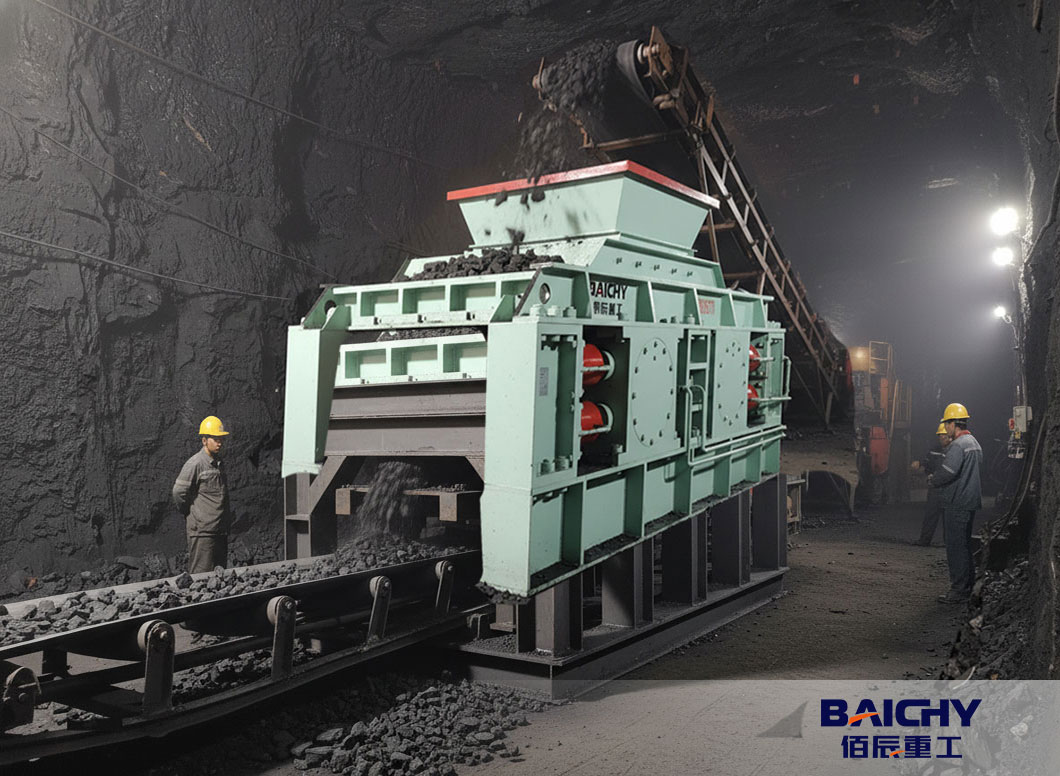
Here are some cases about double roller crusher applicated in coal plant
1. How Does Double Roll Coal Crusher Achieve Low Over-Crushing? Real Mine Case
Over-crushing is a costly problem in coal mining, as it turns valuable lump coal into low-value fine powder, reducing revenue and wasting resources. Unlike impact-based crushers that shatter coal with high-speed blows, double roll coal crusher uses a gentle extrusion method: two counter-rotating rolls press coal along its natural fracture lines, minimizing unnecessary fragmentation.
A medium-sized coal mine in Wyoming, USA, switched from a hammer crusher to a double roll model last year, and the results were striking. Previously, their over-crushing rate reached 35%, with only 55% of the output qualifying as high-value lump coal (10-50mm). After the switch, the over-crushing rate dropped to 12%—a 65% reduction—and lump coal yield jumped to 78%. This translated to an additional $1.2 million in annual revenue, as the lump coal was sold to industrial boiler plants at a 30% premium over fine coal. For coal gasification projects and coking plants that rely on consistent lump coal quality, this advantage is irreplaceable. The mine’s operations manager noted, “The double roll crusher’s gentle crushing action preserved the coal’s structure, maintaining its calorific value and making it more desirable to our key customers.”
2. Can Double Roll Coal Crusher Handle Wet Coal Without Clogging? Cement Plant Case
Wet and sticky coal is a nightmare for many crushers, causing clogging, downtime, and increased maintenance.
A cement plant in Indiana faced this exact issue when processing lignite with 14% moisture content. Their old hammer crusher would clog every 2-3 hours, requiring workers to manually clear the blockages—wasting up to 8 hours of production per week. They switched to a double roll coal crusher with wide rolls (1.2m) and low rotational speed (180rpm), and the transformation was immediate. The crusher’s design prevents coal from adhering to the rolls, while the adjustable gap allows wet coal to pass through smoothly without bridging. Over six months of operation, the plant reported zero clogging incidents, and production efficiency increased by 15%. The maintenance team also saved 120+ man-hours previously spent on clearing blockages.
“We used to dread processing lignite during rainy seasons, but the double roll crusher handles it effortlessly,” said the plant’s maintenance supervisor. This case proves that double roll coal crusher is not just a solution for dry coal but a reliable workhorse for high-moisture coal varieties like lignite and weathered coal.
3. How Precise Is Double Roll Coal Crusher in Particle Size Control? Power Plant Case
Consistent particle size is critical for efficient combustion in power plants, as uneven particles lead to incomplete burning, higher emissions, and increased fuel consumption. A 500MW power plant in Texas needed a crusher that could produce coal particles between 10-20mm for its boilers. After testing jaw crushers and impact crushers—both of which had inconsistent output with 25-30% of particles outside the desired range—they invested in a double roll coal crusher with adjustable roll gaps. By setting the gap to 15mm, the plant achieved a particle size accuracy of 92%, with only 8% of the output falling outside the target range. This precision improved boiler efficiency by 4%, reducing coal consumption by 3,000 tons per year and cutting CO2 emissions by 7,500 tons. The plant’s energy manager explained, “The uniform particle size ensures even combustion, so we get more energy from each ton of coal while meeting environmental standards.” Additionally, the consistent output eliminated the need for a secondary screening system, saving the plant $80,000 in equipment and installation costs.
4. What Cost Savings Can Double Roll Coal Crusher Bring? Small-Scale Mine Case
For small and medium-sized coal operations, cost-effectiveness is often the top priority—and double roll coal crusher delivers on this front. A small coal mine in Pennsylvania with a 50-ton-per-hour capacity was struggling with high maintenance costs and energy bills from its old impact crusher. They replaced it with a compact double roll coal crusher, and the savings were significant. First, the new crusher has only one key wearing part: the roll skins, which last 8,000 hours compared to the impact crusher’s blow bars that needed replacement every 2,000 hours. This reduced maintenance costs by 60%—from 12,000 per year to 4,800. Second, the double roll crusher’s unit energy consumption is 0.5kWh/ton, compared to the impact crusher’s 1.2kWh/ton, cutting annual electricity bills by 18,000. Third, its compact design required no major modifications to the mine’s existing layout, saving 50,000 in infrastructure costs. Over two years, the mine recouped its investment in the new crusher. “We were hesitant to switch at first, but the cost savings and reliability have exceeded our expectations,” said the mine owner. The crusher also features a spring safety device that automatically separates the rolls when encountering iron debris, avoiding costly repairs—something the old crusher lacked, leading to two $10,000 breakdowns in the previous year.
5. Which Coal Types & Scenarios Benefit Most from Double Roll Coal Crusher?
Double roll coal crusher’s versatility makes it suitable for a wide range of coal types and applications, as proven by the cases above. It excels with medium-to-low hardness materials, including bituminous coal, anthracite, lignite, coal gangue, and coke. In coal mines, it’s ideal for raw coal crushing and lump coal classification—like the Wyoming mine that boosted revenue with higher lump coal yield. For power plants and cement factories, it ensures efficient combustion and reliable operation, even with wet coal—just like the Indiana cement plant and Texas power plant. Small-scale mines benefit from its low maintenance and energy costs, while large processing plants appreciate its scalability and consistent performance. It’s also a top choice for coal gange and coking plants that require precise particle sizes and high lump coal rates. Whether you’re processing dry coal in a desert region or wet lignite in a humid area, the double roll coal crusher adapts to the conditions, delivering consistent results with minimal downtime.
In conclusion, double roll coal crusher stands out for its low over-crushing rate, anti-clogging design, precise particle size control, and cost savings—all backed by real-world cases. From large power plants to small mines, it has proven to be a reliable, efficient, and profitable investment. If you’re looking for a coal crusher that delivers on performance and value, the double roll model is worth considering. It’s not just a piece of equipment; it’s a solution that helps coal plants maximize productivity, reduce costs, and stay competitive in the industry.




 2026-09-21





 86-15093113821
 86-15093113821