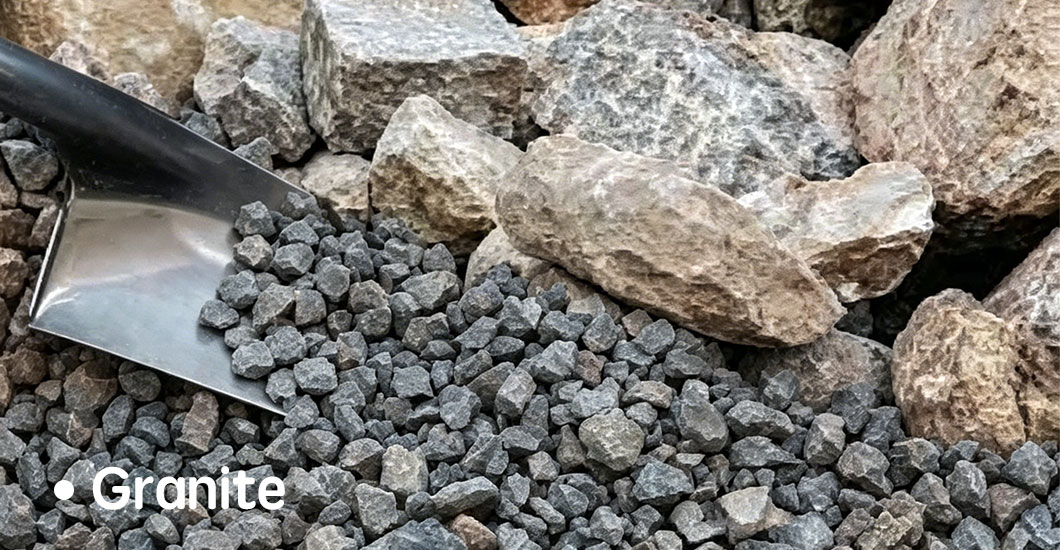
Granite is an igneous rock with high silica content. It is extremely hard and abrasive adn known for its high hardness (Mohs 6–7) and durability. It is a premium raw material for high-quality construction aggregates. 500TPH granite aggregate production line is designed for large-scale quarries and infrastructure projects. It integrates feeding, crushing, screening, conveying, and dust removal systems, forming a closed-loop operation to convert raw granite into graded aggregates. Unlike single crushers, the integrated crushing plant optimizes process flow, reduces material loss, and ensures continuous and stable production.
Project Quick Facts
Overview: 500 TPH (Tons Per Hour) high-capacity granite production line designed for large-scale infrastructure projects.
Location: Uzbekistan (Delivered Feb 2022)
Raw Material: Hard Granite (Mohs 6–7)
Production Capacity: 500–550 T/H
Output Sizes: 0-5mm, 5-10mm, 10-20mm, 20-31.5mm
Primary Equipment: Jaw Crusher + Cone Crusher + VSI Sand Maker
Investment Range: $800,000 – $1,500,000
Core Benefit: 3-stage crushing ensures cubic aggregate shape with minimum needle-like content.
2. Case Study: 500 TPH Granite Plant Delivery to Uzbekistan
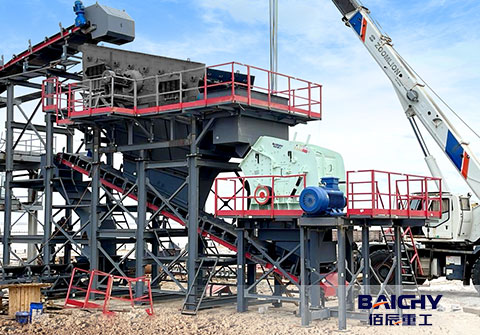
Baichy successfully commissioned a complete 500 TPH granite aggregate production line in Uzbekistan. This project represents a benchmark for large-scale infrastructure supply in Central Asia.
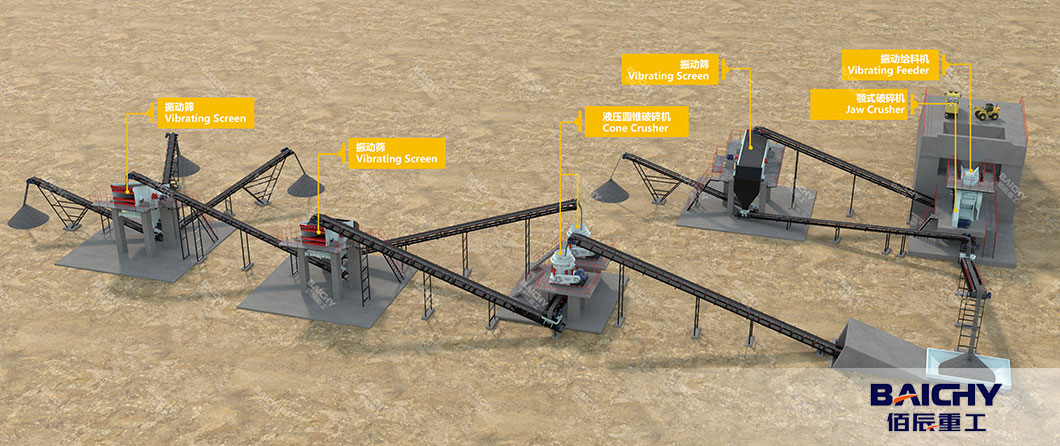
- Dual-Line Reliability: The plant features a parallel configuration (2 sets of primary and secondary crushers). This allows for continuous production; even if one unit undergoes routine maintenance, the plant maintains a 250 TPH output, ensuring no downtime for the client.
- Full-Chain Processing: Unlike basic setups, this plant integrates a Sand Washing & Dewatering System. By processing the 0-5mm fines through a spiral sand washer, the client produces "Premium Manufactured Sand," which carries a 30% higher market value than standard crusher dust.
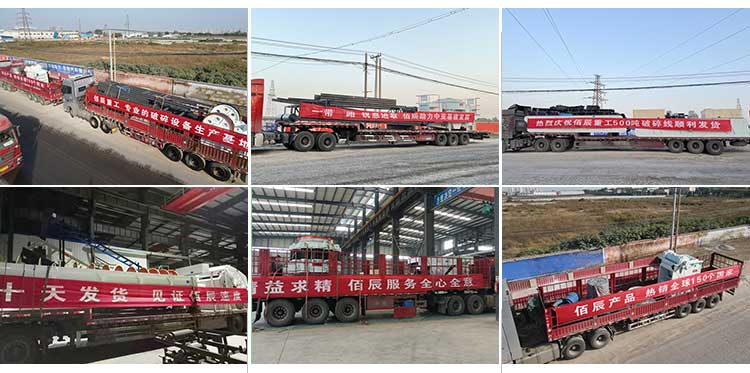
- Cross-Border Logistics: The entire plant was delivered via a heavy-duty truck fleet. Baichy optimized the modular design of the frames to ensure easy assembly upon arrival, reducing on-site installation time by 20%.
3. Technical Deep-Dive: The 3-Stage 500 tph Stone Crushing Plant Workflow
Granite's high silica content and Mohs hardness (6–7) make it highly abrasive. A professional 3-stage process is essential to balance output quality with wear-part longevity.
Stage 1: Primary Crushing (Volume Reduction)
- Equipment: 2 sets of PE-Series Deep-Cavity Jaw Crushers.
- Technical Role: Handles raw granite boulders up to 1200mm. The deep-cavity design ensures a high crushing ratio, reducing the rock to a manageable size (<300mm) for the secondary stage.
Stage 2: Secondary Crushing (High-Efficiency Reduction)
- Equipment: Single-Cylinder Hydraulic Cone Crushers.
- Technical Role: For hard rocks like granite, cone crushers are superior to impact crushers. They use "laminated crushing" principles, which are more energy-efficient and significantly reduce the wear cost per ton of material processed.
Stage 3: Tertiary Crushing & Shaping (Final Specification)
- Equipment: Multi-Cylinder Hydraulic Cone Crushers + VSI (Vertical Shaft Impactor) Sand Maker.
- Technical Role:Multi-Cylinder Cones handle the bulk of the 10-31.5mm aggregate production.
VSI Sand Maker acts as the "Shaper." It uses high-speed "stone-on-stone" impact to eliminate needle-like particles, ensuring the final aggregate meets the strict "cubic shape" requirements for high-speed railway and airport runway concrete.
4. Pricing Analysis & Return on Investment
Investing in a 500 TPH plant requires a strategic balance between initial Capital Expenditure (CAPEX) and long-term Operational Expenditure (OPEX).
Price Determinants:
4-1. Automation Level : Full PLC integration with remote monitoring allows for a "smart factory" setup, reducing manual labor costs by 3-4 operators per shift.
4-2. Environmental Compliance ($): Inclusion of pulse dust collectors and enclosed conveyor belts is now mandatory for mining permits in Uzbekistan.
4-3. Wear Part Quality: Opting for high-manganese alloy liners increases upfront costs but doubles the service life when crushing abrasive granite.
ROI Projection:
Production Volume: With an average 10-hour shift, the plant produces approx. 5,000 tons of aggregate daily.
Payback Period: Given the high demand for granite aggregates in Uzbekistan’s urban expansion, most investors achieve a Full ROI within 12 to 18 months.
Long-term Profitability: By using a 3-stage cone crusher layout instead of impact crushers, maintenance costs are reduced by roughly 15-20% annually, directly increasing the net profit margin.
5. FAQ: Expert Insights for Operators
Q: Why use multiple vibrating screens for a 500 TPH line?
A: At 500 TPH, the material volume is too high for a single screen to handle efficiently. Multiple screens prevent "material blinding" (clogging) and ensure that each grade (0-5, 5-10, 10-20, 20-31.5mm) is accurately separated to meet international construction standards.
Q: How does the plant handle Uzbekistan's extreme climate?
A: The hydraulic systems in our cone crushers are equipped with independent air-cooling and heating modules, ensuring stable oil viscosity and 24/7 operation in both summer heat and winter cold.
Q: What is the typical lead time for a plant of this scale?
A: Manufacturing usually takes 45-60 days. Including logistics to Uzbekistan and on-site commissioning, a client can expect the plant to be fully operational within 3-4 months from the date of contract.
To get a customized quote for your quarry (based on location, raw material properties, and output requirements), contact our team of aggregate equipment experts—we’ll help you
optimize configuration and minimize costs.




 2026-10-24





 86-15093113821
 86-15093113821