The demand for natural sand has continued to increase, while many regions are facing restrictions on river sand mining. As a result, more quarry owners and aggregate producers are turning to machine-made sand as a reliable alternative for concrete, asphalt, and construction projects. However, producing good-quality manufactured sand is not simply about crushing stones into smaller pieces. The final sand quality is affected by many factors, including raw material properties, crushing process, equipment selection, particle shape, and production control.
A properly designed sand production line can produce manufactured sand with stable grading, good particle shape, and controlled powder content, helping meet the requirements of modern construction projects.
What Is Machine-made Sand?
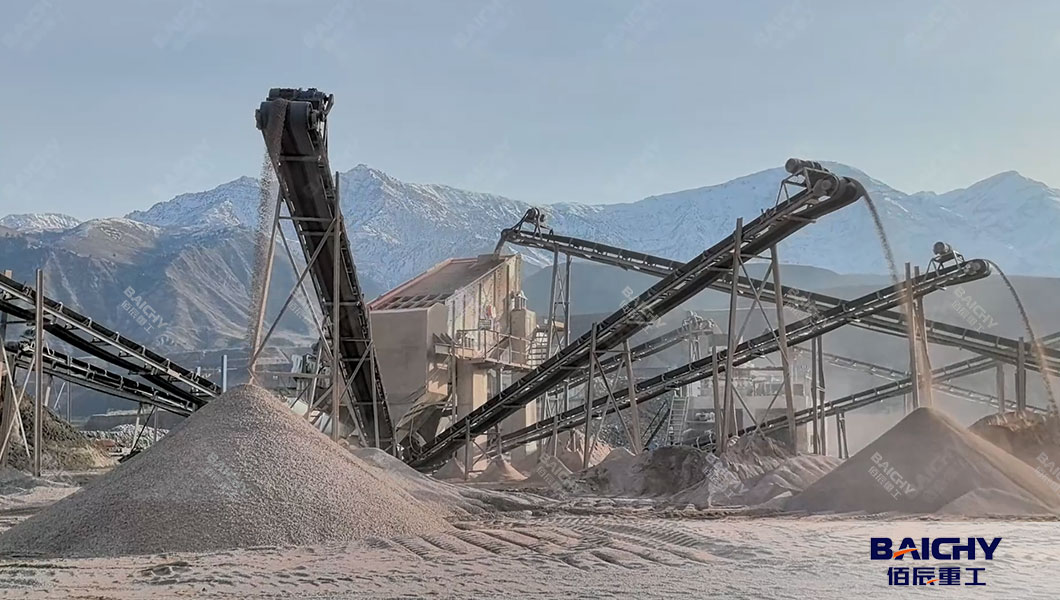
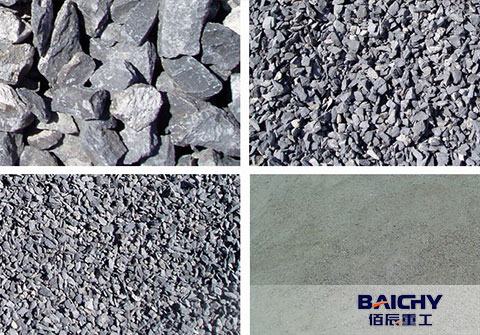
Machine-made sand, also known as manufactured sand or artificial sand, is produced by crushing and shaping rocks with mechanical equipment. Common raw materials include granite, basalt, limestone, quartzite, and river pebbles. Unlike natural sand formed through years of weathering and erosion, machine-made sand is produced under controlled conditions, which allows producers to adjust the particle size distribution according to project requirements.
The quality of manufactured sand is mainly judged by factors such as gradation, fineness modulus, particle shape, and stone powder content. When properly processed, it can replace natural sand in many concrete and infrastructure applications. A high-efficiency sand-making solution includes:
1. Choosing the Right Raw Material
The quality of machine-made sand starts with the choice of raw material.
Hard and dense rocks are usually preferred because they produce stronger particles and have better wear resistance during crushing. Granite and basalt, for example, are widely used for producing high-quality sand for concrete and road construction.
The properties of the stone directly affect the production process. Materials with high moisture content or excessive clay can cause screen blockage and reduce production efficiency. Softer rocks may generate more powder during crushing, which can affect the final sand quality.
Before designing a sand production line, it is necessary to analyze the material hardness, abrasiveness, moisture content, and final product requirements. This helps determine the most suitable equipment configuration.
2. Designing an Efficient Crushing Process
The crushing process has a direct impact on the quality of machine-made sand.
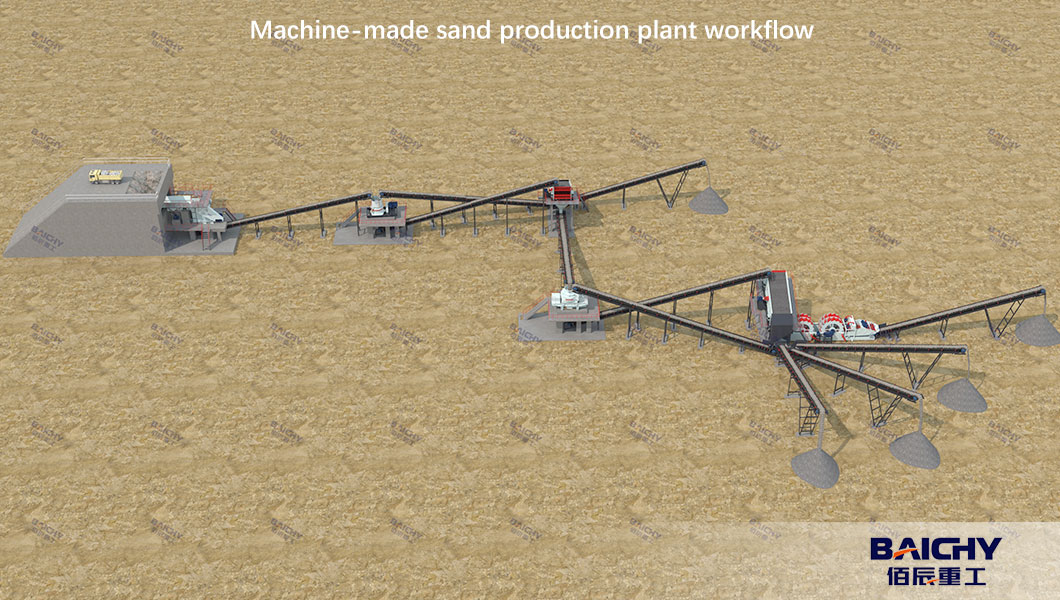
A complete manufactured sand production line usually includes feeding, primary crushing, secondary crushing, sand making, screening, and sometimes washing.
Large rocks are first reduced to smaller sizes through primary and secondary crushing. The crushed material is then sent to a sand making machine for further shaping and fine crushing.
For hard rock applications, a combination of jaw crusher, cone crusher, and VSI sand making machine is commonly used.
The jaw crusher handles the first stage of size reduction and provides stable performance when processing large stones. The cone crusher further reduces the material size while improving crushing efficiency. The VSI sand making machine plays an important role in particle shaping, producing more cubic sand particles.
The equipment combination should always be selected according to the actual material and production target. A limestone sand plant may require a different process compared with a granite or basalt project.
3. Improving Particle Shape with VSI Sand Making Machine
Particle shape is one of the most important factors affecting manufactured sand performance.
Traditional crushing methods may produce more elongated or flaky particles. These particles can reduce concrete workability and increase the amount of cement required.
A VSI sand making machine improves particle shape through the "rock-on-rock" crushing principle. Inside the rotor, stones are accelerated at high speed and collide with each other, creating a more cubical shape while reducing unnecessary flaky particles.
For projects such as highways, bridges, and high-strength concrete production, good particle shape is especially important because it directly affects aggregate performance.
4. Controlling Sand Gradation and Fineness
Stable particle size distribution is essential for producing consistent machine-made sand.
Sand that contains a balanced range of particle sizes can fill gaps between particles more effectively and improve concrete density. If the sand is too fine, it may increase cement consumption. If it is too coarse, concrete workability may be affected.
A vibrating screen is normally used to classify crushed material into different sizes. By adjusting screen mesh sizes and operating parameters, producers can control the final sand grading.
For applications with strict requirements, additional equipment such as powder separators or classifiers can be installed to improve product consistency.
5. Managing Stone Powder Content
A certain amount of stone powder is naturally produced during the sand making process. A controlled amount can improve concrete performance, but excessive powder may affect strength and workability.
A sand washing machine can remove excess dust, clay, and impurities from finished sand. This process is commonly used when producing high-quality sand for commercial concrete plants.
In areas where water resources are limited, dry sand production technology with a powder separator can also be considered. It reduces water consumption while allowing recovery of fine materials.
6. Optimizing the Complete Sand Production Line
Producing high-quality machine-made sand requires the entire production system to work efficiently together.
Equipment selection is only one part of the project. The layout of the production line, material transfer distance, energy consumption, and maintenance requirements also influence operating costs.
A well-designed plant should maintain stable feeding, smooth material flow, and accurate screening. Automatic control systems can help operators monitor production conditions and adjust equipment parameters when necessary.
When planning a sand production line, producers should consider raw material characteristics, required capacity, final sand specifications, investment budget, and long-term operating costs.
Common Problems in Manufactured Sand Production
During operation, some producers may experience problems such as unstable output, excessive powder content, poor particle shape, or high wear costs.
In many cases, these problems are related to unsuitable equipment selection or an incomplete crushing process.
For example, using only a traditional crusher may produce irregular particles with poor shape. Adding a VSI sand making machine can improve particle quality and make the final sand more suitable for concrete applications.
Regular maintenance is also necessary. Worn wear parts, incorrect equipment settings, and overloaded machines can reduce production efficiency and affect the consistency of the final product.
Case Study: Granite Manufactured Sand Production Plant
A quarry in Southeast Asia planned to produce manufactured sand for local construction projects. The original production process had problems with unstable grading and a high percentage of flaky particles.
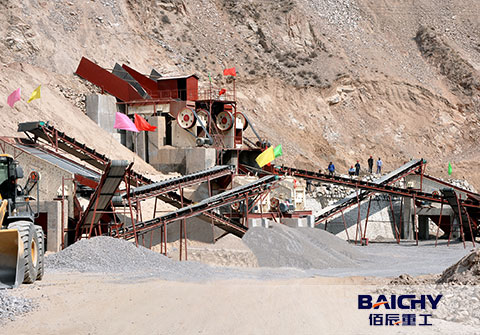
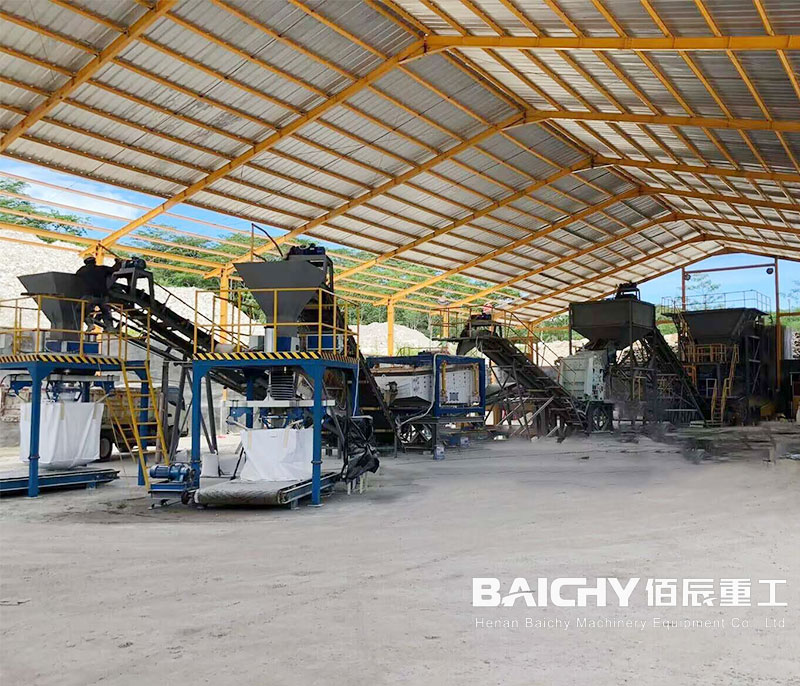
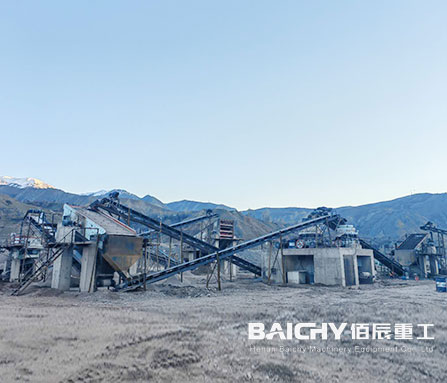
After analyzing the granite characteristics and production requirements, a new crushing and sand making system was designed. The plant included a jaw crusher for primary crushing, a cone crusher for secondary crushing, a VSI sand making machine for shaping, and vibrating screens for size classification.
After commissioning, the production line achieved more stable output and improved sand quality. The manufactured sand was supplied to local concrete mixing plants and infrastructure projects.
Finding the Perfect Sand Making Plant For Your Use Case
Producing high-quality machine-made sand requires a complete approach rather than a single crushing machine. The right raw material, reasonable crushing process, effective shaping equipment, and accurate screening system all work together to determine the final product quality. At Baichy, we are the experts in sand crushers. Our extensive experience allows us to help you choose the sand crusher that is perfectly suited for your project’s unique needs, budget, and materials. For more information, reach out to our team of professionals today at (86) 150-9311-3821 or email: hnbc@baichy.com




 2026-10-16





 86-15093113821
 86-15093113821