For aggregate producers who need to process 10–50 mm stone into 3–10 mm finished material, a 100 TPH smooth double roller crusher can provide a controlled crushing solution. The main challenge in this application is not simply reducing stone size. It is achieving the required production capacity while controlling the amount of unwanted fine material. When 0–3 mm powder has little or no market value, excessive crushing directly reduces the proportion of saleable aggregate and increases production costs. A smooth double roller crusher uses compression to reduce material size. When combined with appropriate pre-screening and final screening, it can help aggregate producers control the finished product size and avoid unnecessary crushing.
This guide explains the working principle, production process, equipment configuration, capacity considerations, and selection requirements for a 100 TPH fine aggregate crushing system.
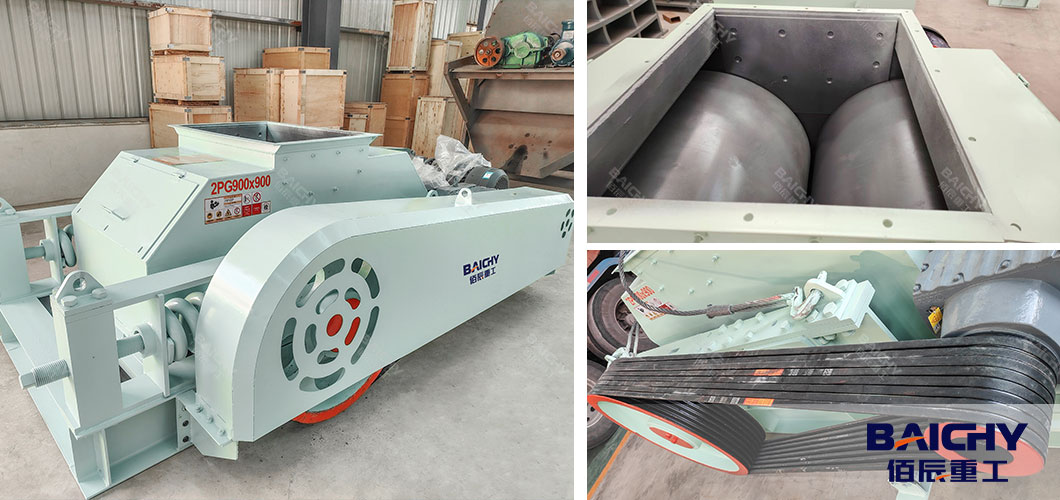
1. What Is a 100 TPH Smooth Double Roller Crusher?
A smooth double roller crusher is a compression-type crushing machine equipped with two parallel rollers. The rollers rotate inward at controlled speeds, drawing material into the crushing gap and reducing its size through compression.
The two roller surfaces apply pressure to the material as it passes through the gap. The crushed particles then discharge from the bottom of the machine.
Unlike crushing methods that rely mainly on high-speed impact, this machine uses mechanical compression to achieve controlled size reduction.
How Does It Work?
The crushing process involves three main actions:
-
Material feeding: A vibrating feeder delivers stone evenly into the space between the two rollers.
-
Compression crushing: The rotating rollers pull the material inward and compress it until it breaks.
-
Discharge: The crushed material falls through the roller gap and moves to the next screening stage.
The roller gap is one of the most important operating parameters. A smaller gap generally produces finer material, while a larger gap allows relatively larger particles to pass through.
However, the roller gap does not directly equal the maximum finished particle size. Actual product gradation also depends on rock strength, particle shape, feed distribution, roller condition, and operating speed.
Main Advantages for Fine Aggregate Production
1. Controlled Size Reduction
The adjustable roller gap allows operators to regulate the crushing process according to the required product size.
2. Reduced Unnecessary Crushing
Compression crushing can help limit excessive size reduction when the machine is correctly selected and operated. This is particularly important when fine powder has limited commercial value.
3. Continuous Material Processing
With stable feeding and suitable downstream screening, the crusher can operate as part of a continuous production system.
4. Relatively Simple Maintenance
The mechanical structure is straightforward. Routine inspection should focus on roller surfaces, bearings, drive components, gap adjustment, and lubrication.
5. Flexible Production Configuration
The machine can be integrated with vibrating feeders, screening equipment, belt conveyors, and return conveyors to meet different production requirements.
2. How to Achieve a Stable 100 TPH Output?
For medium-sized aggregate plants, a 100 TPH production target provides a useful basis for equipment selection and production planning. Several factors directly affect the actual production capacity.
1. Feed Gradation
A feed containing too many small particles may reduce the proportion of material that needs crushing. Sending all of it through the roller crusher wastes processing capacity and may generate unnecessary fines.
2. Material Hardness
Harder materials require greater crushing force. If the roller crusher is undersized, actual throughput may fall below the required capacity.
3. Feeding Uniformity
Uneven feeding causes fluctuations in the material load across the roller width. This can lead to unstable output, uneven wear, and reduced operating efficiency.
4. Roller Gap and Speed
The gap and rotational speed must match the material characteristics and target product gradation. Excessive compression may increase the fine fraction, while an unsuitable gap may allow oversized particles to pass.
5. Screening Efficiency
Even when the crusher performs properly, inefficient screening can cause excessive circulating loads or contamination of the finished product.
For these reasons, a 100 TPH project should be designed as a complete crushing and screening system rather than selected solely according to the crusher's nominal capacity.
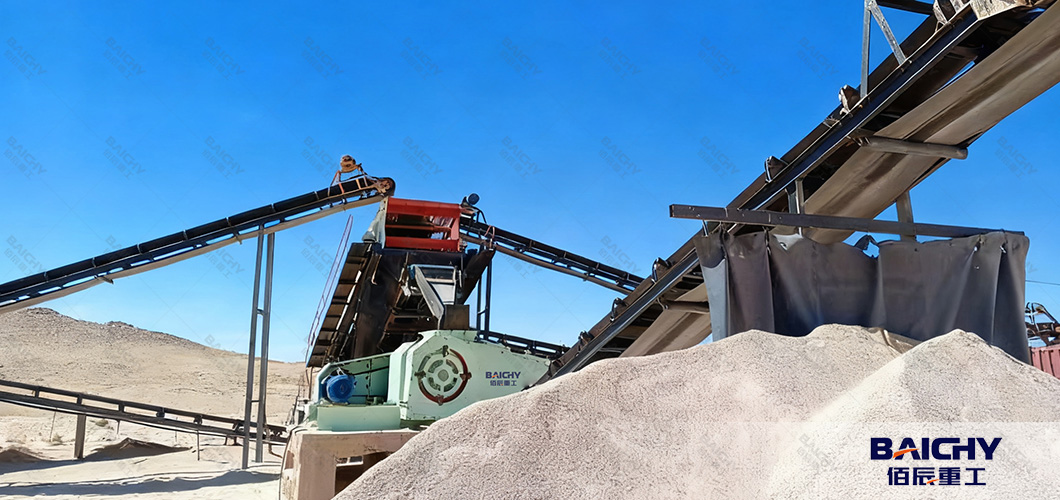
3. How Does a Smooth Double Roller Crusher Produce 3–10 mm Aggregates?
For customers who want 3–10 mm aggregate and have little or no demand for 0–3 mm material, the most important process-design principle is: Do not crush material that already meets the required particle-size conditions. A suitable process should separate undersized material before crushing and remove oversized material after crushing.
Step 1: Raw Material Feeding and Pre-Screening
Raw materials are delivered to a receiving hopper and fed through a vibrating feeder.
A pre-screening stage separates material smaller than 10 mm from the 10–50 mm feed.
This step has two important functions:
For example, if the raw material contains a significant proportion of 3–10 mm stones, these particles can be recovered directly instead of being crushed again.
The exact screening arrangement should be determined by analyzing the original feed-size distribution.
Step 2: Smooth Double Roller Crushing
The 10–50 mm material requiring further size reduction enters the smooth double roller crusher.
The two rollers rotate inward and apply compression to the stones.
Operators adjust the roller gap according to the feed characteristics and required discharge gradation.
The goal is not to crush every particle to the smallest possible size. It is to produce sufficient 3–10 mm material while limiting unnecessary generation of particles below 3 mm.
For consistent performance, the feeding rate should remain stable, and roller wear should be checked regularly.
Step 3: Final Screening and Product Separation
The crushed material is transferred to a vibrating screen for particle-size classification. A suitable screening arrangement separates the material into three fractions:
| Particle Size |
Treatment |
| 3–10 mm |
Finished aggregate |
| Below 3 mm |
Separated as fine material |
| Above 10 mm |
Returned for further crushing if required |
The return of oversized particles creates a closed-circuit crushing process. This arrangement helps prevent oversized material from entering the finished product while reducing unnecessary repeated crushing of already qualified particles.
Step 4: Finished Product Conveying and Storage
The qualified 3–10 mm aggregate is transported by belt conveyors to a finished-product stockpile. Separate stockpiles or discharge conveyors should be provided for different material fractions to prevent mixing. If the customer needs consistent commercial product quality, the finished aggregate should be sampled regularly to check particle-size distribution.
Key Point: How to Reduce 0–3 mm Fine Material?
This is often the biggest concern for aggregate producers.
The following operating measures can help:
-
Screen out existing undersized material before crushing.
-
Select an appropriate roller gap based on material testing.
-
Avoid excessively small roller gaps.
-
Maintain stable feeding across the roller width.
-
Monitor the fine fraction in the finished discharge.
-
Adjust the crushing circuit when feed characteristics change.
It is important to understand that no crusher can guarantee zero fines. The amount of 0–3 mm material depends on rock properties and crushing conditions. A material test and production trial are the most reliable ways to estimate the achievable product distribution.
4. Recommended 100 TPH Fine Aggregate Production Line
For a customer processing 10–50 mm raw material into 3–10 mm finished aggregate, Baichy recommends evaluating a screening and smooth double roller crushing system.
The main design objective is to maximize the recovery of qualified 3–10 mm material rather than send the entire feed through the crusher.
Recommended Process Flow
<escape>Raw Material → Vibrating Feeder → Pre-Screening → Smooth Double Roller Crusher → Final Vibrating Screen → Finished Aggregate</escape>
Oversized material from the final screen can be returned to the roller crusher for additional size reduction.
Main Equipment Configuration
| Production Stage |
Main Equipment |
Function |
| Feeding |
Receiving hopper and vibrating feeder |
Provides stable and continuous material feeding |
| Pre-screening |
Vibrating screen |
Separates existing undersized particles |
| Crushing |
Smooth double roller crusher |
Reduces the size of 10–50 mm feed material |
| Final screening |
Multi-deck vibrating screen |
Separates 3–10 mm, below 3 mm, and oversized particles |
| Return system |
Belt conveyor |
Returns oversized material for further crushing |
| Product conveying |
Belt conveyors |
Transfers qualified aggregate to stockpiles |
Why Is Pre-Screening Important?
Without pre-screening, all feed material enters the crusher, including particles that may already meet the required product size.
This creates three potential problems:
Higher Operating Costs: The crusher processes material that does not need further size reduction.
More Fine Material: Qualified small particles may be crushed again, increasing the unwanted 0–3 mm fraction.
Reduced Effective Capacity: Crusher capacity is consumed by unnecessary processing, leaving less available capacity for oversized material.
Pre-screening helps solve these problems by separating the material according to actual size requirements before crushing.
Why Is Closed-Circuit Screening Recommended?
A closed-circuit system returns oversized material to the crusher rather than allowing it to enter the finished-product stockpile.
This improves product-size control and reduces the risk of oversized particles contaminating the final aggregate.
However, the return conveyor and crusher must be designed for the circulating load, not just the initial feed rate. Otherwise, material accumulation can occur and reduce the stability of the entire production line.
Important Design Considerations
Before finalizing the 100 TPH configuration, engineers should evaluate:
-
Raw material gradation and the percentage of each size fraction.
-
Required 3–10 mm finished product quantity.
-
Expected proportion of 0–3 mm fines.
-
Crusher throughput under actual material conditions.
-
Screen area and screening efficiency.
-
Conveyor capacity, including circulating material.
-
Installation space, power supply, and maintenance access.
This information helps prevent a common purchasing mistake: selecting a 100 TPH crusher without checking whether the complete production line can deliver the required finished product output.
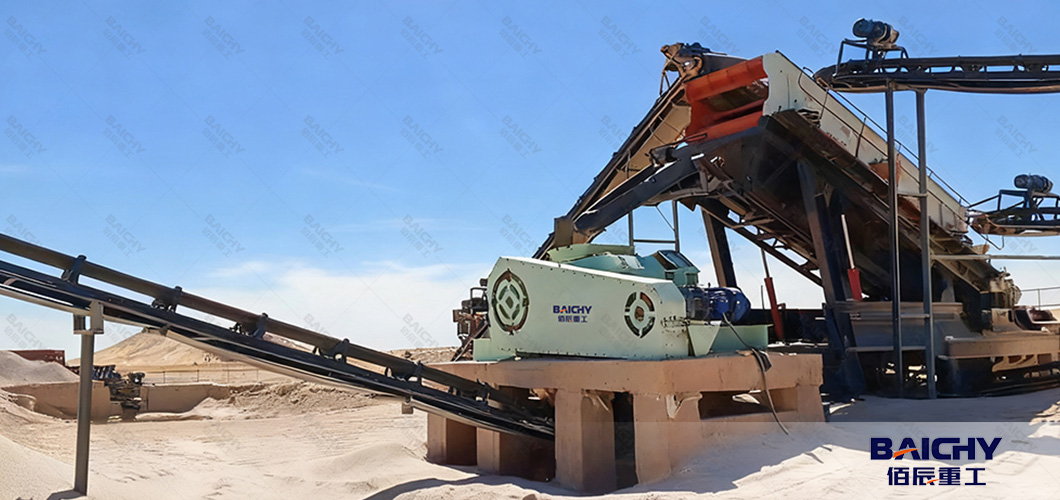
5. Get a 100 TPH Smooth Double Roller Crusher Solution from Baichy
Baichy Machinery provides crushing equipment and customized crushing plant solutions for aggregate producers and mineral processing customers. For a 100 TPH fine aggregate project, the first step is to understand the customer's actual production requirements rather than simply recommend a crusher model. For the application discussed in this article, the initial design conditions are:
| Project Parameter |
Requirement |
| Required processing capacity |
100 TPH |
| Feed size |
10–50 mm |
| Target finished product |
3–10 mm |
| Unwanted fine fraction |
0–3 mm |
| Main equipment |
Smooth double roller crusher |
| Supporting equipment |
Feeder, vibrating screens, and belt conveyors |
Based on these requirements, Baichy engineers can evaluate:
-
Whether pre-screening is necessary.
-
Suitable roller dimensions and crushing capacity.
-
Roller gap and operating parameters.
-
Required vibrating screen specifications.
-
Closed-circuit return conveyor arrangement.
-
Expected finished-product distribution.
The final configuration should be confirmed according to the actual material characteristics and feed-size analysis.
To help engineers recommend a suitable 100 TPH smooth double roller crusher, please provide the following information:
-
What material do you need to crush?
-
What is the maximum feed size?
-
Is the feed size consistently within 10–50 mm?
-
Do you need 100 TPH crusher throughput or 100 TPH of finished aggregate?
-
Is the required product size 3–10 mm?
-
Do you need to separate or minimize the 0–3 mm fraction?
With these details, Baichy can evaluate the equipment configuration and provide a more practical crushing and screening solution for your project.
Frequently Asked Questions
Q1: Can a smooth double roller crusher produce 3–10 mm aggregates?
Yes. By selecting an appropriate roller gap and combining the crusher with a vibrating screen, the production system can separate the required 3–10 mm fraction. Actual particle-size distribution depends on the feed material and operating conditions.
Q2: Can a double roller crusher handle 100 TPH?
Yes, a 100 TPH application can be evaluated for a suitable double roller crusher. However, the required roller diameter, roller width, speed, and motor power must be determined based on material characteristics and feed size.
Q3: Does a smooth roller crusher produce less powder?
Its compression-based crushing principle can help reduce excessive over-crushing compared with some impact-based applications. However, the actual fines content depends on material properties, roller gap, feed gradation, and operating conditions.
Q4: Is a smooth double roller crusher suitable for hard stone?
It depends on the stone's compressive strength and abrasiveness. For very hard and abrasive rocks, roller wear and production costs must be evaluated before choosing this equipment.
Q5: What is the difference between a smooth roller crusher and a toothed roller crusher?
A smooth roller crusher uses smooth roller surfaces and is commonly used for controlled crushing of relatively small materials. A toothed roller crusher uses specially designed teeth to grip and break materials, making it more suitable for certain applications involving larger feed sizes or softer materials.




 2026-11-09






 86-15093113821
 86-15093113821