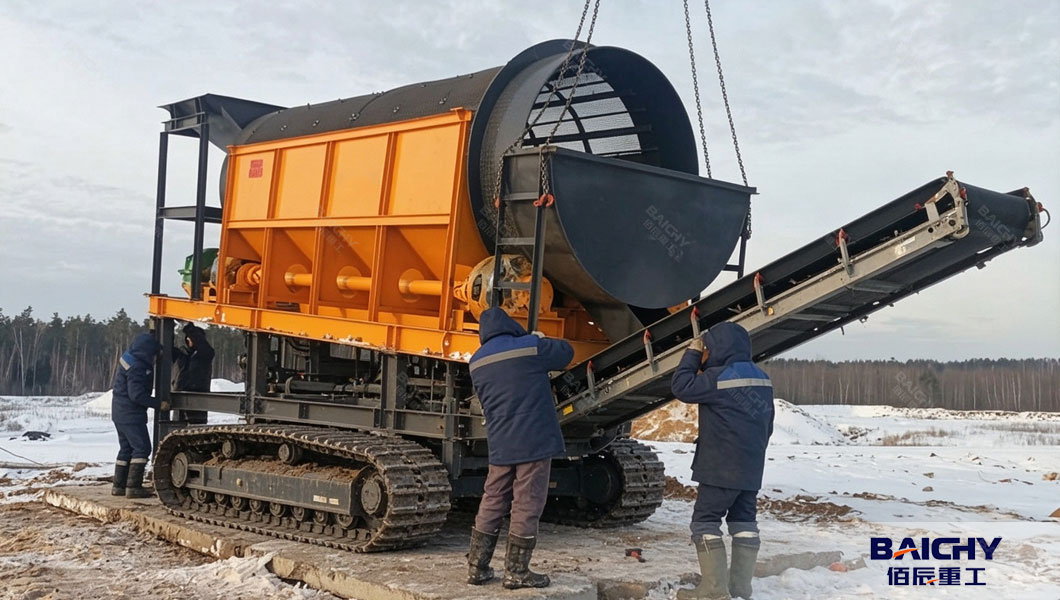
A heavy duty tracked trommel screen is a self-propelled, rotary-drum screening plant built to separate, size, and scrub bulk materials directly at the job site. Unlike stationary or wheeled units, the tracked undercarriage lets the machine crawl across uneven, muddy, or rocky terrain and reposition beside active stockpiles without a lowboy or crane . At its core is a rotating cylindrical drum fitted with perforated punch plates or woven mesh. Feed material enters one end, tumbles through the spinning drum, and separates by particle size: fines fall through the screen apertures while oversized rock and debris exit the far end . These machines are engineered for abrasive, wet, sticky, and oversized feeds that would blind or choke conventional flat-deck screens. Typical heavy-duty tracked models handle rock up to 600–800 mm (24–32 in) and deliver 150–450+ tons or cubic yards per hour depending on drum size, screen media, and material conditions .
How a Heavy Duty Tracked Trommel Screen Works
At its core, the heavy duty tracked trommel operates on a principle of simplicity and physical efficiency. The machine features a large, inclined cylindrical drum—often referred to as the screen—which rotates slowly. Raw material is fed into the upper end of the drum via a hopper, frequently equipped with a hydraulic tipping grid or grizzly to scalp off oversized boulders before they enter the screening chamber.
As the drum rotates, the material tumbles and spirals down its length. The screening action is purely mechanical: smaller particles fall through the apertures of the screen media (which can be wire mesh, punch plate, or specialized tensioned screens), while larger materials continue their journey to the discharge end. The rotation is driven by a hydraulic or direct-drive system that allows operators to adjust the drum speed—typically from 0 to 25 rpm—to optimize screening efficiency based on material moisture and composition. On a tracked unit, this entire process is powered by an onboard diesel engine, with the tracks providing the mobility to reposition the machine as the stockpiles grow or the job site shifts.
Key Advantages of a Heavy Duty Tracked Trommel Screen
1。 Excellent Mobility for Different Working Sites
One of the main advantages of a tracked trommel screen is its crawler undercarriage. Unlike stationary screening equipment, it can move around a working site without requiring a separate towing vehicle for routine repositioning. This is useful for construction waste recycling, landfill operations, composting yards, and mobile aggregate production. The crawler design also helps distribute machine weight over a larger contact area than conventional wheels, depending on track width and machine configuration. However, operators should still consider ground bearing capacity, slope, and site conditions before moving the machine.
2。 Heavy-Duty Construction for Demanding Materials
A heavy duty tracked trommel screen is designed to handle regular material loading, drum rotation, and continuous screening operations.
Its structural components may include:
-
Reinforced steel chassis and support frame.
-
Heavy-duty feed hopper and conveyor.
-
Wear-resistant perforated drum panels.
-
Durable drum support rollers and drive components.
-
Hydraulic systems for drum and track operation.
These components help the machine withstand repeated material impact and mechanical loads during operation. For abrasive materials such as gravel and crushed stone, selecting suitable drum materials and wear protection is particularly important.
3. Flexible Screening for Different Material Sizes
The screening drum can be equipped with different perforated plates or mesh configurations according to the required product size. For example, a soil screening operation may need to separate fine topsoil from stones and roots, while a compost producer may need to remove oversized organic materials before the final product is packaged. Changing the screen opening allows the same machine to serve different screening requirements, provided the drum design supports the required configuration. Some machines also offer interchangeable drums, allowing operators to change screening specifications more efficiently.
4. Better Adaptability to Variable Material Conditions
Trommel screens use a rotating and tumbling screening process. This movement helps loosen and redistribute materials across the drum surface. Compared with some conventional flat screening arrangements, the rotary action can be useful when processing mixed, irregular, or moderately moist materials. This is especially relevant to topsoil, compost, green waste, and construction waste containing different particle sizes. However, extremely sticky clay, highly cohesive wet soil, or materials with long fibrous components can still cause screen blinding or wrapping. Appropriate screen media, drum cleaning devices, and feed control may be necessary.
5. Reduced Dependence on Fixed Infrastructure
A tracked trommel screen is generally designed as a self-contained mobile unit. It does not require the same permanent foundation and fixed conveyor arrangement as a stationary screening installation. This can reduce site preparation requirements and make it easier to deploy screening equipment at temporary projects. It is particularly beneficial for contractors handling demolition waste, land reclamation, and temporary material processing projects.
The separation process relies on a controlled tumbling action inside an inclined rotating drum :
- Feeding – Raw material is loaded into a hopper, often via a hydraulic variable-speed push feeder or tipping grid that removes oversized lumps before they reach the drum .
- Tumbling & Scrubbing – The drum rotates at a variable speed (typically 0–25 RPM). Lifter bars or the drum wall itself lift and drop the material repeatedly. This tumbling breaks up clay clumps, scours sticky coatings off rock, and exposes every particle to the screen surface .
- Sizing Separation – Particles small enough to pass through the mesh or punch-plate apertures fall onto a fines conveyor below. Multiple screen decks or a 3-way split configuration can produce several sized fractions in a single pass .
- Discharge – Oversized material that cannot pass the apertures travels to the end of the drum and discharges onto a separate oversize conveyor .
6. Dual-Power System for Flexible Operation
A heavy duty tracked trommel screen equipped with a dual-power system (electricity and diesel) offers greater flexibility across different working environments. When grid electricity is available, the machine can operate using an external power supply, helping reduce diesel consumption and operating costs. In areas without reliable electricity or at temporary job sites, the diesel power system allows the equipment to operate independently of the local power grid. This dual-power configuration is particularly suitable for remote mining areas, construction waste recycling sites, mobile screening projects, and locations with limited power infrastructure.
Main Applications
The robust construction and mobility of heavy duty tracked trommels make them indispensable across several key industries.
Construction and Demolition (C&D) Debris. C&D waste is notoriously abrasive and heterogeneous, containing everything from pulverized concrete and rebar to wood and soil. A heavy duty tracked trommel is ideal for primary sorting here. It can scalp out large chunks of rubble while separating the finer soil fraction, which can often be reused on-site as fill or capping material. The ability to handle rebar and large rock without clogging is a distinct advantage over lighter screening equipment.
Compost and Topsoil Production. In the organics recycling sector, mobility is key. Windrows are often spread across large yards. A tracked trommel allows the operator to move directly down the windrow line, screening finished compost and leaving the oversize material behind for further processing. The adjustable drum speed and optional dual brush systems help handle the sticky, high-moisture content typical of organic materials.
Aggregates and Quarrying. For primary screening of blasted rock, overburden, or riprap, tracked trommels offer a mobile alternative to fixed crushing circuits. They are particularly effective at removing fines from large rock products before further crushing, reducing the load on secondary crushers and minimizing wear. In quarrying, a tracked trommel can produce three separate streams—oversize, mid-size, and fines—directly at the face, reducing haul truck traffic.
Municipal Solid Waste (MSW) and Recycling. In waste transfer stations and recycling facilities, space is at a premium. A tracked trommel can be maneuvered into tight spots to screen commercial and light demolition waste, separating the fines for disposal while concentrating recoverable materials like metals and plastics for further sorting.
For operators seeking to maximize throughput while minimizing material handling, the heavy duty tracked trommel screen represents a strategic investment. It bridges the gap between the raw power of a stationary plant and the logistical freedom required on today’s dynamic job sites.
8. Frequently Asked Questions About Heavy Duty Tracked Trommel Screens
Q1: What is the main difference between a tracked trommel screen and a stationary trommel screen?
The main difference is mobility. A tracked trommel screen uses a crawler chassis to move around a working site, while a stationary trommel screen is installed at a fixed location. Both use a rotating drum to separate materials by particle size.
Q2: What materials can a heavy duty tracked trommel screen process?
Common applications include topsoil, compost, sand, gravel, wood chips, biomass, construction and demolition waste, and selected mining materials. The drum and screen media must be matched to the feed characteristics.
Q3: Can a tracked trommel screen process wet materials?
Yes. Trommel screens can process certain moist materials, including compost and soil. However, highly sticky clay or excessively wet cohesive materials may block screen openings. Material testing and appropriate drum cleaning options are recommended.
Q4: Can a tracked trommel screen produce different material sizes?
Yes. Different drum openings can separate different particle sizes. Some models support interchangeable drums or multiple screening sections. The number of final fractions depends on the machine's design.




 2026-11-19






 86-15093113821
 86-15093113821