Home About us
Products
News
Solution
Video Service Contact us
Home  /  News

In the aggregate and mining industries, the cone crusher output size is one of the most critical factors for determining the commercial value of the finished product. Whether you are producing road base, high-quality concrete aggregate, or preparing ore for a ball mill, understanding how to control and predict output size is essential for operational efficiency.


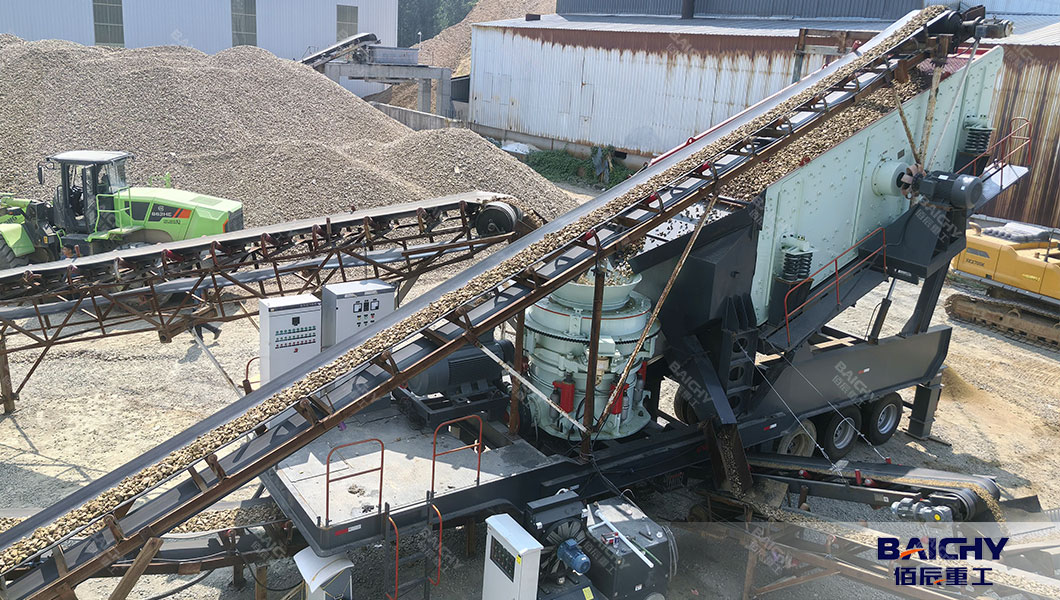
mobile-cone-crusher-HPC300-in-China.jpg


The Short Answer: What Determines Output Size?

The output size of a cone crusher is primarily determined by the Closed Side Setting (CSS). The CSS is the narrowest distance between the crushing members (the mantle and the concave) at the bottom of the crushing chamber during the closed part of the cycle.


Generally, a cone crusher produces a range of material sizes, where approximately 80% to 90% of the crushed product will be smaller than the CSS.

1. Understanding CSS vs. OSS

To master output size, you must distinguish between two key settings:

CSS (Closed Side Setting): As mentioned, this is the narrowest point. It defines the maximum size of the product. If your CSS is set to 25mm, most of your output will be 25mm or smaller.
OSS (Open Side Setting): This is the widest distance between the crushing members at the bottom. The OSS is crucial for determining the throughput capacity and the maximum feed size the machine can accept without clogging.


2. Factors Influencing Output Size Distribution

It is a common misconception that a cone crusher produces a single uniform size. In reality, it produces a gradation curve. Several factors influence this:


Crushing Cavity Type

The shape of the crushing chamber (cavity) dictates the reduction ratio.

   ● Coarse Cavity: Used for secondary crushing, allowing larger feed but producing a coarser output.
   ● Medium/Fine Cavity: Used for tertiary crushing, producing smaller, more uniform particles.
   ● Short-head Cavity: Designed specifically for fine crushing and sand making.


Material Hardness and Feed Moisture

Harder rocks (like basalt or granite) shatter differently than softer rocks (like limestone). High moisture content can cause "pancaking" in the chamber, which restricts flow and can lead to a finer but less efficient output.


Eccentric Speed and Throw

The speed at which the mantle gyrates (RPM) and the distance it moves (Throw) affect how many times a rock is "hit" as it travels down the chamber. A higher speed generally results in a finer, more cubical product.

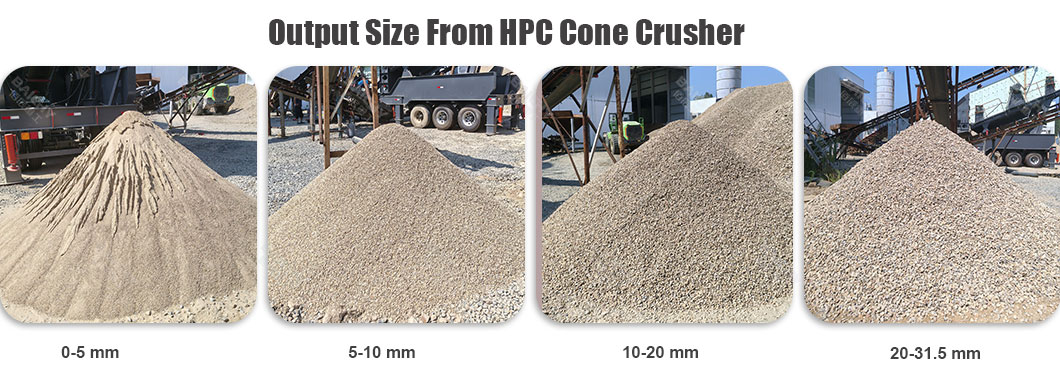
cone-crusher-HPC300-output-size.jpg

3. How to Adjust Cone Crusher Output Size

Modern technology has made adjusting the output size much simpler than in the past.

Hydraulic Adjustment: Most modern machines, such as the Single-cylinder Hydraulic Cone Crusher, allow operators to change the CSS via a PLC touch screen. The hydraulic system raises or lowers the mantle to tighten or loosen the setting instantly.
Wear Compensation: As the liners (mantle and concave) wear down, the CSS naturally increases, leading to a coarser output. Smart systems now automatically compensate for liner wear to keep the output size consistent.


4. Typical Output Size Reference Table

Note: These values are based on typical performance of secondary and tertiary cone crushers (e.g., Baichy C-Series or HP-Series).

CSS Setting (mm) 80% Passing Size (mm) Common End-Product Use
10 mm ~8 mm Fine aggregate, Manufactured sand
13 mm ~11 mm High-quality concrete aggregate
19 mm ~16 mm Road base, Asphalt aggregate
25 mm ~22 mm Sub-base, Railway ballast
38 mm ~32 mm Primary-crushed ore for milling


The cone crusher output size is not just a fixed number but a managed range governed by the CSS, cavity design, and operational speed. By precisely controlling the hydraulic settings and monitoring liner wear, operators can ensure a high-value, consistent product that meets strict engineering specifications.

Need help calculating the right CSS for your project? [Contact Baichy Machinery’s Engineers] for a free crushing circuit simulation and equipment recommendation.


FAQ About  Optimizing Your Output

1. Can a cone crusher produce 0-5mm sand?

Yes, but it requires a Fine or Short-head cavity and a very tight CSS (usually under 8mm). However, for high-volume sand production, a VSI (Vertical Shaft Impactor) is often used after the cone crusher to improve grain shape.


2. What is the crushing ratio of a cone crusher?

A standard cone crusher typically has a crushing ratio of 4:1 to 6:1. This means if the feed size is 200mm, the output size will be roughly 35mm to 50mm.


3. Why is my output size coarser than my CSS?

This usually happens due to "choke feeding" issues or worn liners. If the chamber is not consistently full, or if the mantle and concave are worn, the material can pass through the gaps without being fully crushed.


Maybe you are interested in