Walk onto any mining, construction, or cement plant site, and you will likely see a jaw crusher hard at work. Known for their incredible durability, jaw crushers are the go-to machines for breaking down medium to high-hardness rocks with a compressive strength of 250Mpa to 320Mpa. However, when you start looking to buy one, you quickly run into a confusing naming convention. Almost every manufacturer lists their models starting with the letters "PE" or "PEX".
So, what exactly is the difference between a PE jaw crusher and a PEX jaw crusher? Which one do you actually need? In this complete guide, we will break down their structural differences, applications, and how to choose the perfect machine for your rock-crushing needs.
What Do "PE" and "PEX" Actually Mean?
Before diving into the complex technical specifications, it helps to understand what these letters stand for in the global mining equipment industry. Originally derived from manufacturing naming standards, these prefixes have become universal indicators of a machine's primary function.
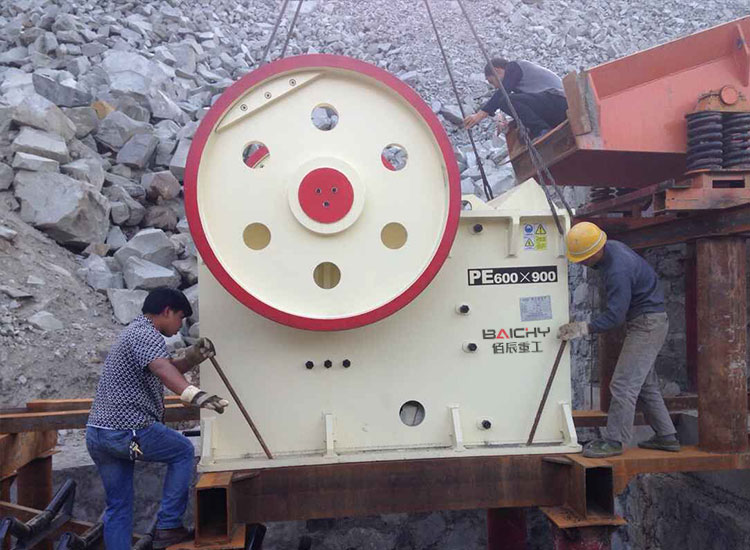
● PE Jaw Crusher (Primary Crusher): The "PE" series represents the primary coarse crusher. Think of this machine as the heavy-duty workhorse of your entire operation. It is the front-line warrior that takes the very first "bite" out of massive, raw rocks directly blasted from a mountain or excavated from a mine. Because of its stable operation, large crushing ratio and low operating cost, it can be seen in many sand and gravel crushing, sand making and other sites. The coarse jaw crusher is the PE series of jaw crushers. The commonly used models are PE200×300, PE200×350, PE250×400, PE400×600, PE500×750, PE600X900, PE750X1060 etc., and the hourly production capacity can reach 1200 tons.
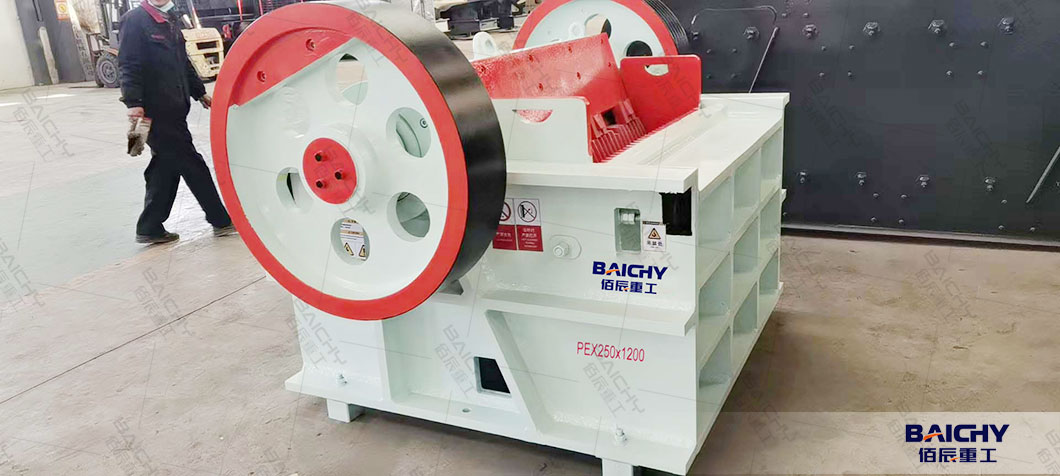
● PEX Jaw Crusher (Fine Jaw Crusher): The "PEX" series represents the secondary or fine crusher. Instead of tackling giant boulders, it takes the rough, fist-sized rocks produced by the PE crusher and grinds them down into much smaller, more uniform pieces, such as fine gravel or aggregate. Because the price is relatively cheap, many people use it instead of impact crusher or cone crusher. The commonly models of PEX series jaw crusher are PEX150×750, PEX250×750, PEX250×1000, PEX250×1200, PEX300×1300, etc. The capacity range is about 8-100 tons per hour.
5 Key Differences Between PE and PEX Jaw Crushers
While they might look almost identical from a distance—both featuring a heavy steel frame and a large flywheel—PE and PEX crushers are engineered for entirely different stages of the production line. Here are the five main differences you must know:
1. Crushing Stage and Flowsheet Placement
The most significant difference lies in where these machines sit within your production flowsheet. The PE jaw crusher is strictly used for primary crushing. It is placed at the very beginning of the crushing circuit, right after the vibrating feeder. Conversely, the PEX jaw crusher is used for secondary crushing. You will rarely, if ever, feed raw, blasted boulders directly into a PEX machine. Instead, it sits further down the line, processing materials that have already been broken down once.
2. Feed Size and Discharge Gap (CSS)
Because of their distinct roles, their physical dimensions vary greatly to accommodate different rock sizes.
A PE jaw crusher features a massive, gaping feed opening. It is explicitly designed to swallow giant boulders, with maximum feed sizes ranging from 125mm up to a staggering 1,600mm (over 5 feet!). Naturally, its discharge opening is also quite wide, allowing large chunks to pass through quickly.
On the other hand, a PEX jaw crusher has a much narrower feed opening and a much tighter discharge gap (Closed Side Setting). This restrictive design allows it to carefully control the final product size, producing fine, evenly shaped gravel that meets strict construction standards.
3. Structural Design Details and Jaw Plates
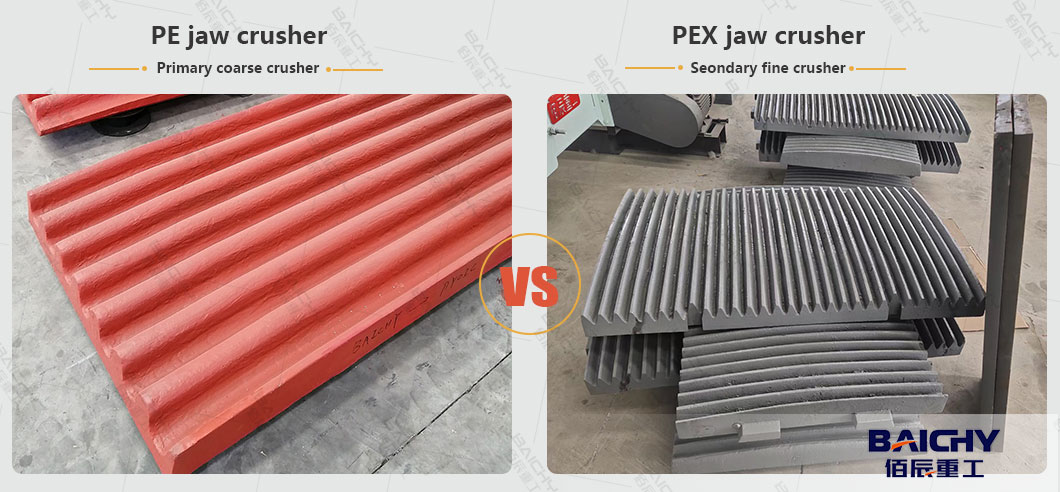
Both machines utilize a highly efficient compound pendulum (single-toggle) design. However, if you look closely at the crushing cavity, you will notice a distinct structural difference in the wear parts. The jaw plates on a PEX crusher feature denser, shorter teeth (corrugations). Because the PEX deals with smaller rocks, these tightly spaced teeth help grip, squeeze, and snap the stones much more effectively, preventing flaky or elongated shapes. Meanwhile, the PE crusher features deep, wide grooves designed to violently crack massive, smooth boulders under immense pressure.
4. Production Capacity (Throughput Volume)
If your goal is to move a mountain quickly, you rely heavily on the PE crusher. It is built for a high volume of size reduction, meaning it boasts a massive Tons Per Hour (TPH) processing capacity. Some large PE models can easily process over 1,000 tons per hour. Because the PEX crusher is tasked with grinding stones down to a much finer degree—requiring more mechanical effort and time per ton—its hourly processing capacity is naturally lower (often between 15 to 100 TPH) compared to a primary crusher.
5. Flywheel Speed and Motor Power
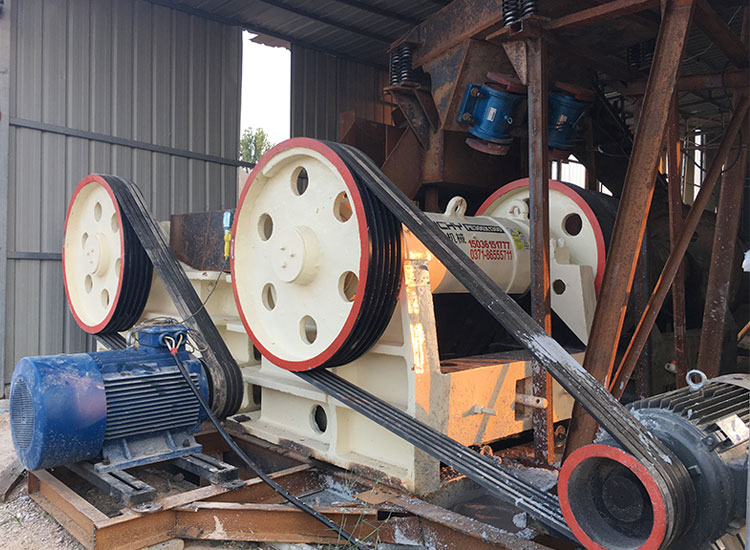
To achieve fine crushing, the kinematics of the machine must change. PEX jaw crushers typically run at a slightly higher eccentric shaft speed compared to PE crushers. This faster stroke rate ensures that smaller rocks are hit multiple times as they fall through the narrow V-shaped chamber, guaranteeing a finer output. However, because PE crushers deal with massive rocks that require immense sudden force, they are equipped with larger, heavier flywheels to store more kinetic energy, driven by incredibly powerful electric motors.
Working Principle: How Do They Crush Rocks?
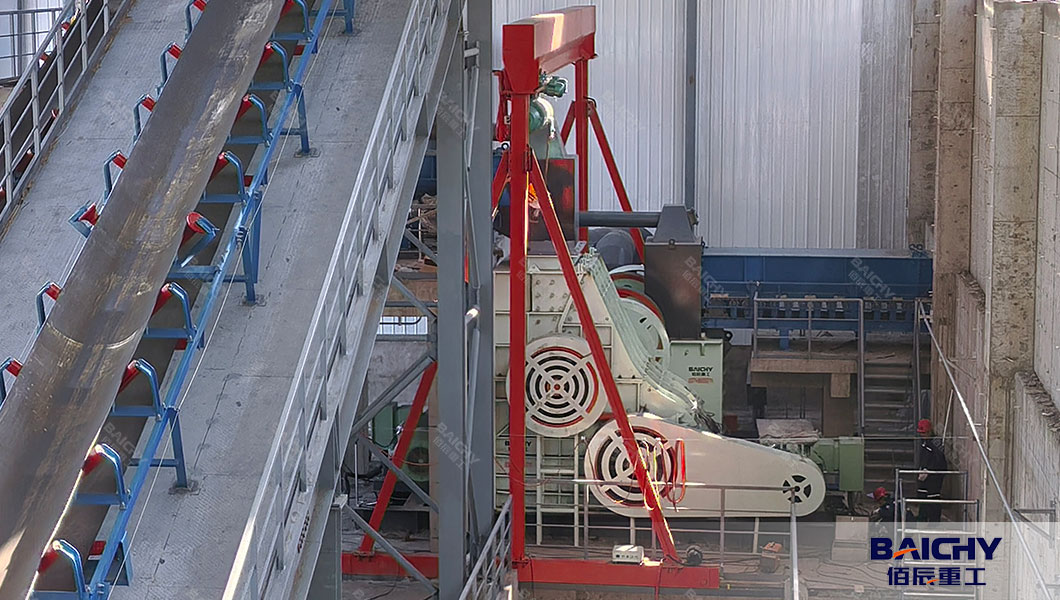
Despite their differences in size, capacity, and application, both PE and PEX jaw crushers operate using the exact same mechanical principle. They are both brilliantly simple, yet incredibly effective machines. The crushing chamber is V-shaped, consisting of a stationary jaw plate fixed to the front frame, and a movable jaw plate mounted on a pitman. An electric motor drives a heavy flywheel via V-belts, which in turn spins an eccentric shaft. This eccentric rotation forces the movable jaw plate to move back and forth in a rhythmic, elliptical motion. When a rock falls into the chamber, it is crushed via extrusion—it is simply squeezed, cracked, and snapped between the two solid, manganese-steel plates until it is small enough to fall through the adjustable bottom gap.
How to Choose Between PE and PEX Types?
Choosing the right jaw crusher doesn't have to be a complicated engineering puzzle. To make the best purchasing decision, simply ask yourself these two critical questions:
1. What is your maximum raw material feed size?
If your rocks are larger than a football or watermelon (e.g., 300mm to 1000mm), you absolutely must start with a PE jaw crusher. Attempting to force giant rocks into a PEX crusher will instantly bridge the chamber, jam the machine, or cause a catastrophic mechanical failure.
2. What is your target final product size?
If you need fine gravel for concrete aggregates (like 10mm to 20mm stones), or if you are preparing crushed material to feed into a ball mill for gold or copper extraction, you need the tight precision of a PEX jaw crusher.
3. The Perfect Match: Can PE and PEX Work Together?
Absolutely! In fact, they are engineered to be the perfect partners in a complete processing plant. In a standard stone crushing operation, the most reliable and cost-effective setup is a two-stage crushing circuit.
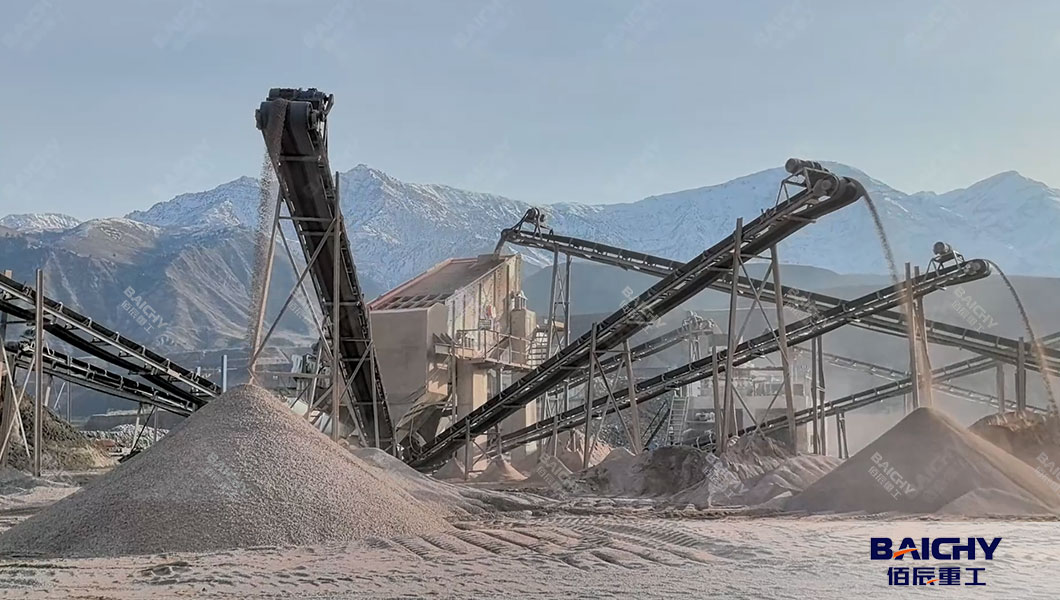
Here is how it works: The raw, oversized rocks are dumped into the PE jaw crusher (the primary stage). The coarse output from the PE crusher drops onto a conveyor belt and is carried directly into the PEX jaw crusher (the secondary stage). The PEX crusher refines the material, which is then sent to a vibrating screen. Any oversized stones are sent back to the PEX, while the perfectly sized aggregate is stockpiled for sale. They are a team, not competitors.
To sum it all up: The PE jaw crusher is the heavyweight champion built to break massive boulders into manageable chunks, while the PEX jaw crusher is the precision finishing tool designed to refine those coarse rocks into high-quality, fine aggregates. Understanding this fundamental difference is the absolute key to designing an efficient, high-yielding, and profitable crushing plant.
Don't risk making an expensive mistake that could bottleneck your entire operation. Contact our team of expert mineral processing engineers today! We provide free equipment sizing consultations, customized flowsheet designs, and highly competitive quotes for both premium PE and PEX jaw crushers. Let us help you crush your production goals—Reach out to us now for a free quote!
People Also Frequently Asked For- FAQ
1.How many types of jaw crusher are there?
There are two basic types of jaw crushers: single toggle and double toggle. Base on single toggle type jaw crusher, it has PE series, PEX series, JCE series, SKJ series to enhance efficiency of feeding and output size.
2. What is the purpose of a jaw crusher?
How Does a Jaw Crusher Work | Jaw Crusher | Kemper Equipment
All jaw crushers reduce large sized rocks, ore, or other material by a compression action. A fixed jaw, mounted in a V-shaped alignment, is the stationary breaking surface, while a movable, “swing” jaw exerts force on the feed material by pushing it against the stationary plate.
3. What is the difference between impact crusher and jaw crusher?
An impact crusher can crush hard materials while a jaw crusher can crush brittle ones. A jaw crusher is suitable to use for harder rocks such as granite, basalt, ores, and concrete. On the other hand, an impact crusher will work best with clay, limestone, coal, dolomite, and other medium-hardness materials.




 2026-09-08





 86-15093113821
 86-15093113821