How Does a Quarry Crushing Plant Work?
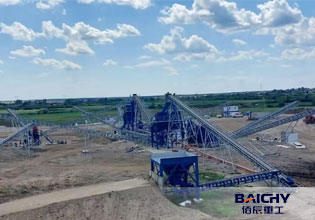
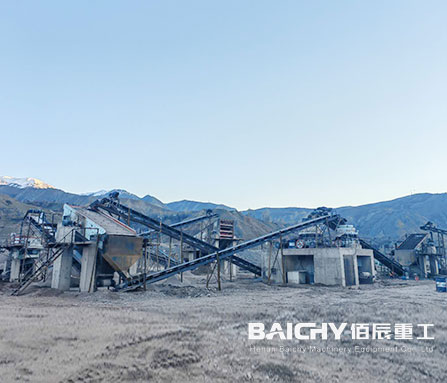
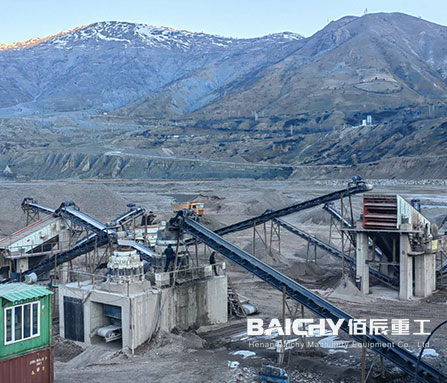
At a quarry site, the crushing process usually starts with large rocks extracted from the mountain and ends with several sizes of finished aggregates used in construction projects, highways, and concrete production. A well-designed quarry crushing plant is not simply a combination of crushers and screens. Each piece of equipment needs to work together. The feeding system controls material flow, crushers reduce rock size step by step, and screening equipment separates the final products according to customer requirements.
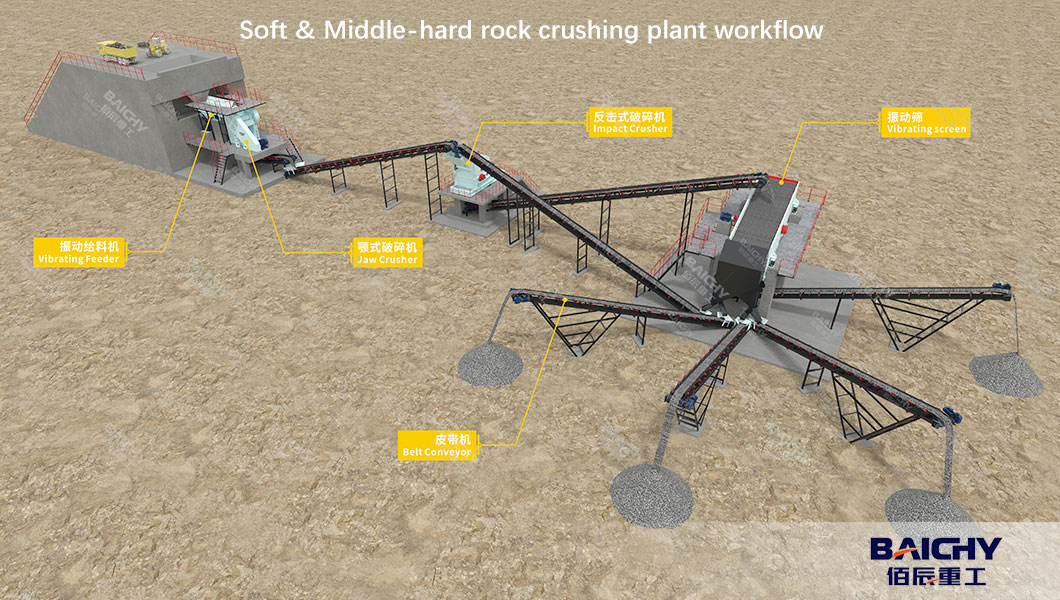
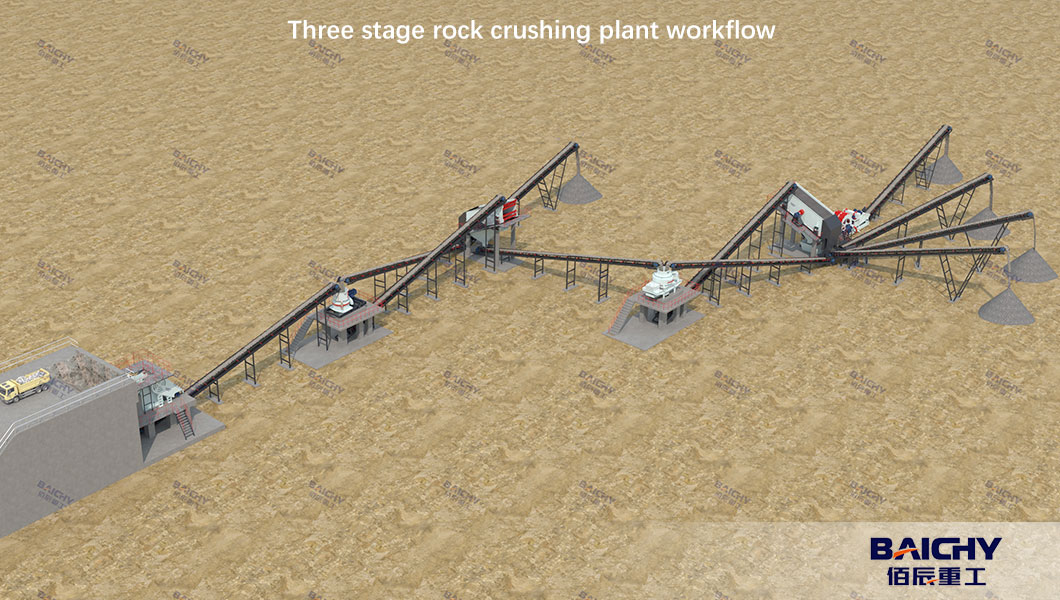
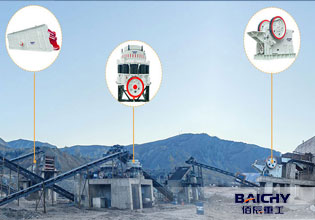
In most quarry operations, the production process includes primary crushing, secondary crushing, screening, and material handling. Some hard rock projects may require an additional tertiary crushing stage to achieve better particle shape or finer aggregate sizes. The actual plant configuration depends on several factors, including rock hardness, feed size, required output, and final product specifications.
Quick Overview: The 5 Core Stages
| Stage |
Purpose |
Primary Equipment |
| 1. Feeding |
Metered delivery of rock to crusher |
Apron feeder, vibrating grizzly feeder |
| 2. Primary Crushing |
Reduce run-of-quarry rock to intermediate size (100-300mm) |
Jaw crusher, primary impact crusher |
| 3. Secondary Crushing |
Further reduction to target sizes |
Cone crusher, impact crusher |
| 4. Screening |
Size classification and oversize recirculation |
Vibrating screens (multi-deck) |
| 5. Conveying & Stockpiling |
Transport and storage of finished products |
Belt conveyors, stackers |
1. Rock Extraction and Material Preparation
The quarry process begins with drilling and blasting. Large blocks of stone must first be broken into manageable pieces before entering the crushing plant.
Before blasting, engineers carefully design the drilling pattern, hole depth, explosive quantity, and detonation sequence. Proper blasting has a direct impact on the entire production cost.
If blasting creates too many oversized rocks, loading becomes slower and the primary crusher may struggle with the feed size. In some cases, operators need hydraulic breakers to reduce these large pieces before crushing.
After blasting, excavators load the broken rock into dump trucks and transport it to the crushing area. Large quarries often use trucks with capacities from 15 to 100 tons depending on production requirements.
For some projects, a mobile crushing plant is placed close to the mining face. The excavator can feed material directly into the crusher, reducing transportation distance and lowering operating costs.
2. Feeding System: Controlling Material Flow
The feeder is the first important part of a quarry crushing plant. Its main job is to deliver rock evenly to the crusher while preventing overload.
For large-scale operations handling heavy rocks, an apron feeder is commonly used. Its strong structure allows it to handle high-impact loads, and the feeding speed can be adjusted according to crusher capacity.
A vibrating grizzly feeder is another popular choice. It combines feeding and pre-screening functions in one machine. Small particles that do not need crushing can pass through the grizzly section, reducing crusher wear and improving efficiency.
For wet or sticky materials containing clay, a wobbler feeder can be a better option. Its self-cleaning design helps prevent material blockage during operation.
For example, in a 100 TPH stone crushing plant, a vibrating grizzly feeder with a pre-screening section can remove fine material before the jaw crusher. This helps maintain stable feeding and improves the performance of the whole system.
3. Primary Crushing: Reducing Large Rocks
The primary crusher is responsible for breaking large quarry rocks into smaller pieces that can be processed by the next stage.
The feed size at this stage can often exceed 600 mm, while the output is usually reduced to around 100-300 mm depending on the plant design.
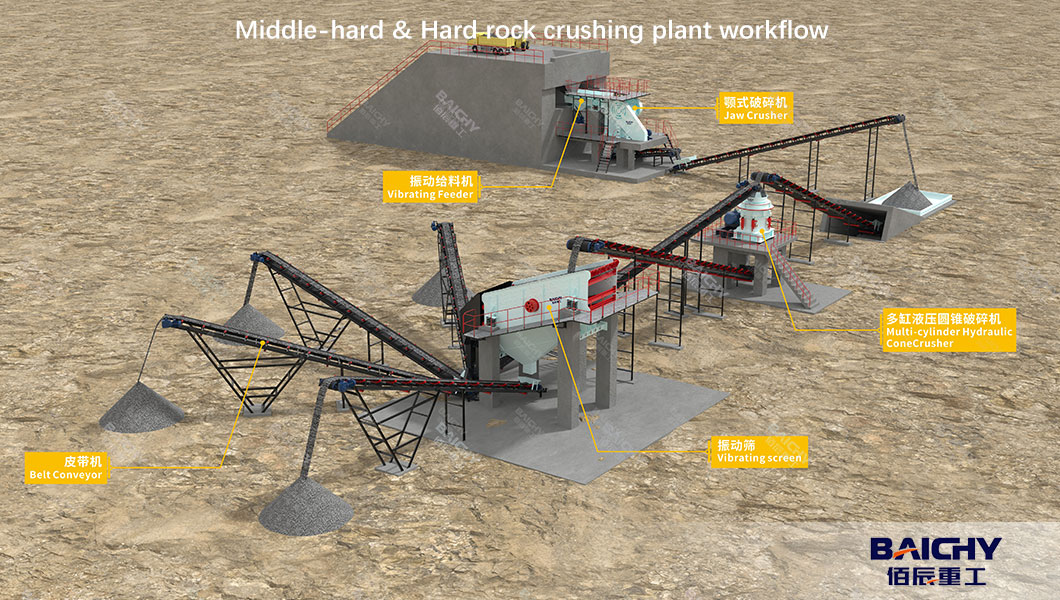
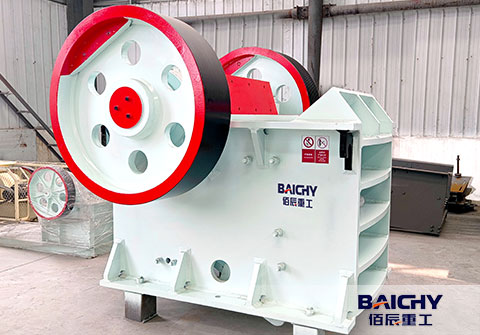
A jaw crusher is the most common choice for primary crushing. It is widely used for granite, basalt, limestone, and other hard rocks because of its simple structure, strong crushing force, and reliable operation.
Impact crushers can also be used as primary crushers, especially when the material is less abrasive and the project requires better particle shape. They provide a higher reduction ratio and can produce more cubical aggregates.
Hammer crushers are suitable for softer and less abrasive materials. They offer high reduction ratios but may have higher wear costs when processing hard stone.
During operation, adjusting the crusher closed side setting (CSS) is important. A proper CSS setting helps control the output size and improves the efficiency of the following crushing stages.
4. Secondary Crushing: Improving Product Size and Shape
After primary crushing, the material enters the secondary crushing stage. The purpose is to further reduce the size and prepare aggregates for final screening.
Cone crushers are widely used in secondary and tertiary crushing applications, especially for hard and abrasive materials. They provide excellent control over product size and generate fewer unwanted fines when operated correctly.
To achieve stable performance, cone crushers should be operated with a consistent feed and preferably under choke feeding conditions. Uneven feeding can reduce crushing efficiency and affect product quality.
Impact crushers are another option when aggregate shape is a priority. They use impact force to break stones along natural fracture lines, producing more cubic-shaped particles.
This makes impact crushers suitable for applications such as concrete aggregates and road construction materials where particle shape directly affects performance.
Proper feed distribution is essential for both cone crushers and impact crushers. Uneven material flow can cause uneven wear and inconsistent product grading.
5. Screening and Closed-Circuit Crushing
Screening is the quality control stage of a quarry crushing plant.
After crushing, vibrating screens separate materials into different sizes. Oversized particles are returned to the crusher for further processing, creating a closed-circuit crushing system.
A closed circuit helps maintain consistent product quality because only properly sized material leaves the production line.
For example, in a 250 TPH granite crushing plant, a multi-deck vibrating screen may separate the material into several grades. Larger particles return to the cone crusher, while qualified aggregates are sent to stockpiles.
When finer products are required, a tertiary crushing stage may be added. This stage further reduces material size and is often used for producing manufactured sand or high-quality aggregates.
During screening operation, problems such as screen blockage and material sticking can affect efficiency. Proper screen selection, vibration adjustment, and moisture control help reduce these issues.
6. Conveying and Finished Product Storage
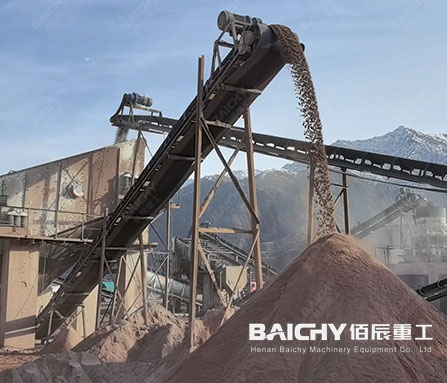
After final screening, finished aggregates are transported by belt conveyors to different stockpiles.
A well-designed conveying system reduces material handling costs and keeps the production process continuous.
In large quarry plants, magnetic separators are often installed before crushers to remove metal impurities and protect equipment from damage.
Stackers help organize different aggregate sizes into separate stockpiles, making loading and transportation more efficient.
At the dispatch area, weighbridges are used to measure truck loads, while wheel washing systems help reduce dust and mud carried onto public roads.
Choosing the Right Quarry Crushing Plant
Selecting a suitable crushing plant requires a clear understanding of the project conditions.
● The type of rock is one of the most important factors. Hard and abrasive materials such as granite and basalt usually require stronger crushing equipment, while softer limestone can be processed with different configurations.
● Production capacity is another key consideration. A small quarry may only need a 50-100 TPH crushing plant, while large mining projects may require 500 TPH or higher capacity systems.
● The final product requirements also affect equipment selection. If the customer needs high-quality cubic aggregates, impact crushers may be preferred. If reducing wear cost is more important, cone crushers are often a better solution for hard rock applications.
A professional equipment supplier will usually evaluate the material characteristics, production goals, and site conditions before recommending a complete crushing solution.
Finding the Perfect Stone Crusher Flowchart For Your Use Case
At Baichy, we are the experts in stone crusher plant. Our extensive experience allows us to help you choose the rock crusher that is perfectly suited for your project’s unique needs, budget, and materials. For more information, reach out to our team of professionals today at (86) 150-9311-3821.
Frequently Asked Questions
1. How does a quarry crushing plant work?
A quarry crushing plant processes raw rock through several stages. The material is first reduced by a primary crusher, then processed by secondary or tertiary crushers before screening. Oversized material returns for further crushing until it reaches the required size.
2. What equipment is needed for a quarry crushing plant?
A complete crushing plant usually includes a feeder, primary crusher, secondary crusher, vibrating screens, belt conveyors, and electrical control systems. Additional equipment such as dust suppression systems and magnetic separators can be added according to project needs.
3. What is the difference between two-stage and three-stage crushing?
A two-stage crushing plant normally includes primary and secondary crushing. It is suitable for many aggregate applications. A three-stage plant adds tertiary crushing to achieve smaller output sizes or stricter product specifications.
4. How do I choose a crusher for a quarry?
Crusher selection depends on rock hardness, feed size, required capacity, final product size, and aggregate shape requirements. Jaw crushers are commonly used for primary crushing, while cone and impact crushers are selected based on material properties and product goals.




 2026-10-16





 86-15093113821
 86-15093113821