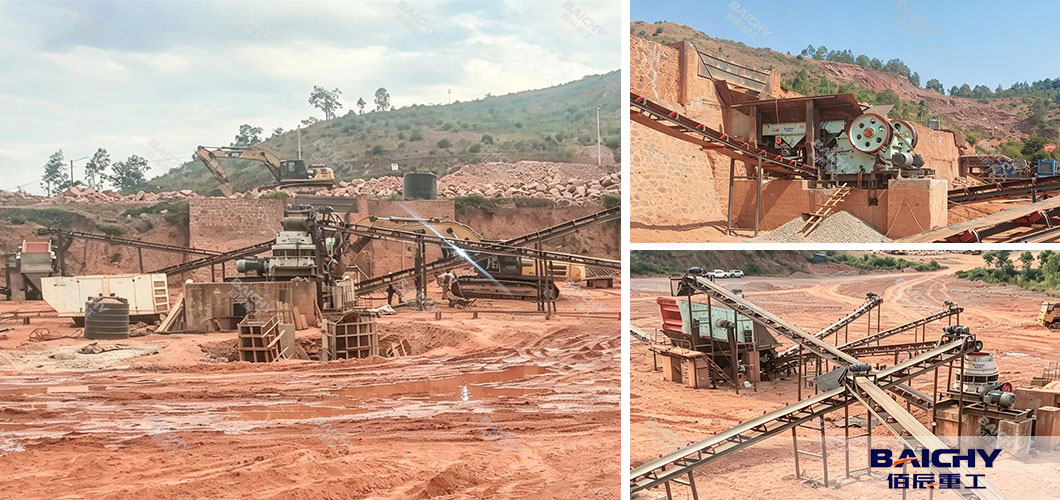
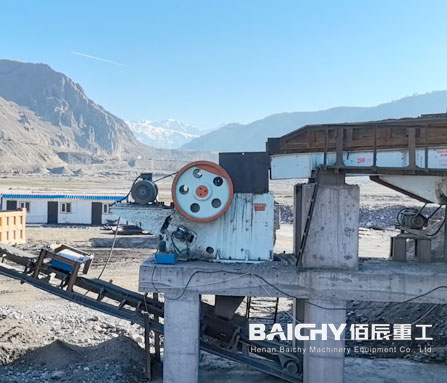
A quarry operator needed a reliable crushing solution to process hard basalt stone into multiple sizes of high-quality aggregates for construction applications. The main challenges were the high hardness and abrasiveness of basalt, strict requirements for finished aggregate shape, and the need for stable production with minimum downtime. To meet these requirements, Baichy designed a 50-70 TPH basalt crushing plant featuring a PE400×600 jaw crusher for primary crushing, CS75 cone crusher for secondary crushing, and a two-stage screening system. The production line efficiently reduces large basalt rocks into several marketable aggregate sizes while maintaining stable output and product quality.
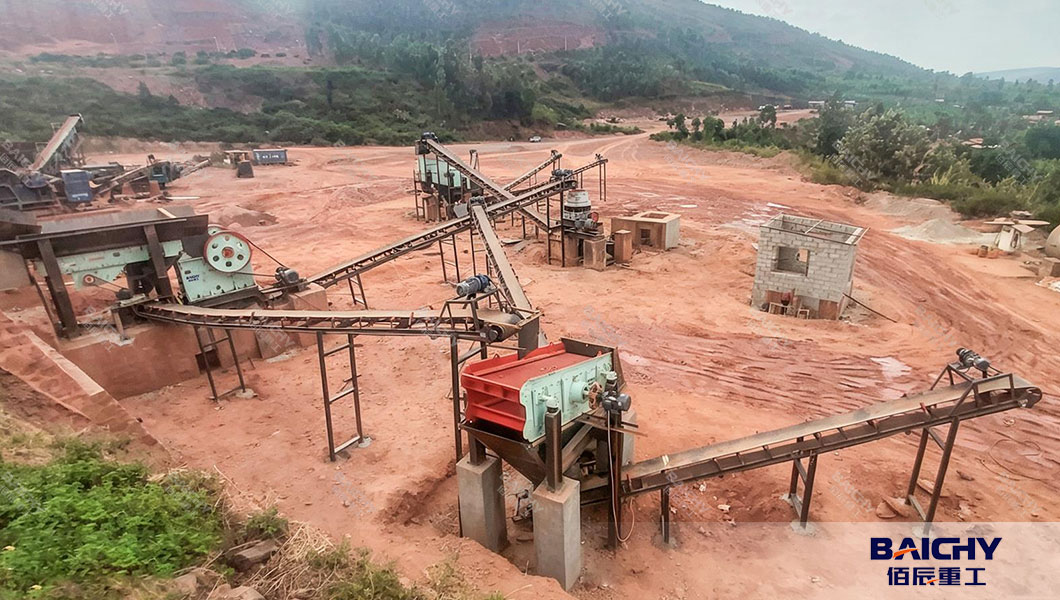
This crushing plant is suitable for quarries, road construction aggregate production, concrete plants, and infrastructure projects where consistent aggregate quality and reliable operation are required.
Production Line Configuration
| Equipment |
Model |
Quantity |
Function |
| Vibrating Feeder |
— |
1 set |
Uniformly feeds raw basalt into the crushing system and removes small-sized materials through pre-screening |
| Jaw Crusher |
PE400×600 |
1 set |
Primary crushing of large basalt rocks into smaller sizes |
| Vibrating Screen |
— |
2 sets |
Separates materials into different sizes and controls product quality |
| Cone Crusher |
CS75 |
1 set |
Secondary crushing for further size reduction and improved particle shape |
| Belt Conveyor |
Customized |
Several sets |
Transfers materials between crushing and screening stages |
Production Process & Working Principle
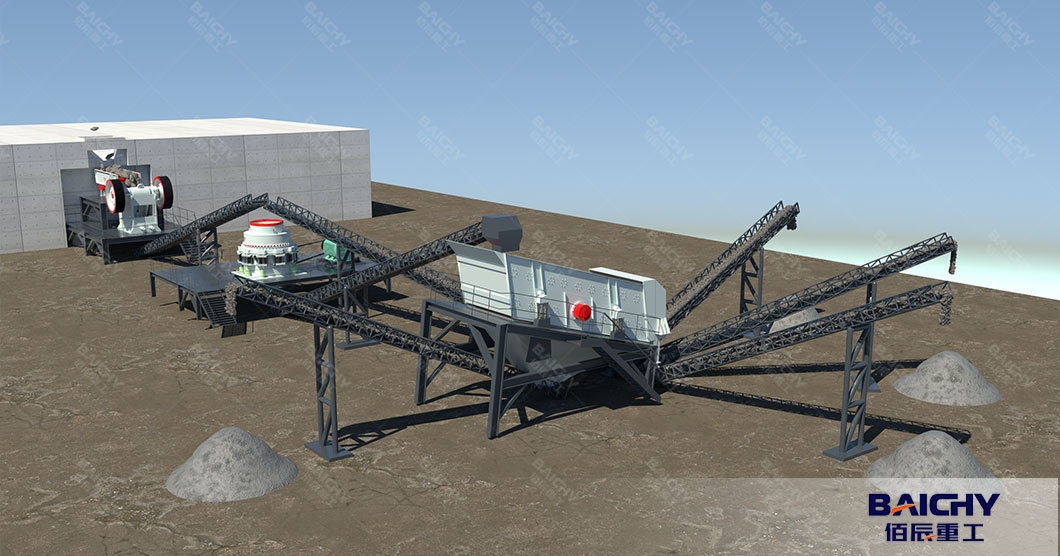
The raw basalt material is first delivered to the vibrating feeder, which provides a continuous and stable feed to the jaw crusher. During feeding, the pre-screening function removes smaller particles before entering the primary crushing stage, improving the crushing efficiency and reducing unnecessary wear.
Large basalt rocks are crushed by the PE400×600 jaw crusher through compressive force between the fixed and moving jaw plates. The crushed material then enters the first vibrating screen.
The first screening stage separates qualified aggregate sizes directly as finished products. Oversized materials are returned to the CS75 cone crusher for further crushing.
After secondary crushing, the material is sent to the second vibrating screen, where it is accurately classified into four different final aggregate sizes according to customer requirements. The closed-circuit crushing process ensures that unqualified materials are continuously processed until they meet the required specifications.
Advantages and Features of This Basalt Crushing Solution
1. Designed for Hard and Abrasive Basalt
Basalt is a highly hard volcanic rock with strong abrasiveness. The combination of the PE jaw crusher and CS cone crusher provides strong crushing force and excellent wear resistance, making the plant suitable for long-term basalt processing.
2. Efficient Closed-Circuit Crushing
The return crushing system sends oversized materials back to the cone crusher, ensuring that every particle meets the required size range. This reduces waste and improves overall production efficiency.
3. Multiple Finished Aggregate Sizes
With two vibrating screens, the plant can produce multiple specifications of aggregates to meet different applications, including: Road base materials, Concrete aggregates, Asphalt aggregates, Construction materials.
4. Stable Production with Lower Operating Costs
The optimized equipment combination reduces unnecessary crushing stages, improves energy efficiency, and helps customers achieve stable output with lower maintenance costs.
5. Flexible Application for Quarry Operations
The compact layout and reliable equipment design make this crushing plant suitable for medium-scale quarries and construction material production sites where space and investment efficiency are important.
Customer Challenges This Plant Solved
Before installing the Baichy crushing solution, basalt quarry operators often face several production challenges:
1. High Material Hardness
Ordinary crushers may experience fast wear and unstable output when processing basalt. The PE jaw crusher and CS cone crusher provide stronger crushing capability and longer service life.
2. Unstable Product Quality
Without effective screening and closed-circuit crushing, finished aggregates may contain excessive oversized particles. The two-stage screening system ensures accurate classification and consistent product sizes.
3. Low Production Efficiency
Direct feeding of large stones into crushers can increase equipment load and reduce capacity. The vibrating feeder with pre-screening improves material distribution and reduces unnecessary crushing workload.
4. Demand for Multiple Aggregate Products
Construction projects often require different aggregate specifications. This production line provides four final product sizes through efficient screening and classification.
Baichy Complete Project Support
Baichy provides complete crushing plant solutions from design to operation, helping customers build efficient and reliable aggregate production systems. Our services include:
● Customized Plant Design
Based on raw material properties, required capacity, finished product sizes, and site conditions, Baichy provides optimized equipment configuration and layout design.
● Professional Equipment Manufacturing
All major equipment is manufactured with strict quality control to ensure stable performance in demanding quarry environments.
● Installation Guidance
Baichy provides installation drawings, technical support, and operation guidance to help customers quickly start production.
● After-Sales Support
Baichy offers spare parts supply, equipment maintenance guidance, and technical assistance throughout the service life of the plant.
People Also Frequently Asked For - FAQ
Q1: What equipment is included in a complete stone crusher plant?
A: A standard plant has five core parts — feeder, crusher, screen, conveyor, and control system. Simple way to understand the flow:
Feeder → Primary crusher → Secondary crusher → Screen → Finished stockpiles, with oversize material returning to the crusher by a return conveyor. This return loop is called a "closed circuit", and it is what guarantees your finished product size stays consistent.
Q2: How do I choose the right capacity (TPH) for my plant?
A: Choose based on your target output — but always leave 20–30% margin.buy a plant rated 20–30% above your average requirement. Running a machine at 100% load every day shortens its life and leaves you no room for maintenance or a rush order. Running at 70–80% load is the sweet spot for low wear cost and long service life.
Q3: How much does a stone crusher plant cost?
A: There is no fixed price — the cost mainly depends on four things: Capacity (TPH), Crusher type, Number of crushing stages, Configuration & brand. For an accurate quotation, send suppliers your material, capacity, feed size and finished sizes — then compare quotes on the same specification.
Q4: How long does it take to install and commission a plant?
A: Manufacturing takes 15–30 days; on-site installation and commissioning usually takes 3–6 weeks. What the supplier should provide: foundation drawings, layout drawings, an installation manual, and an engineer to guide on-site installation and train your operators — training covers daily operation, lubrication, wear-part replacement and troubleshooting. Confirm these are included in the contract before you sign.




 2026-10-16





 86-15093113821
 86-15093113821