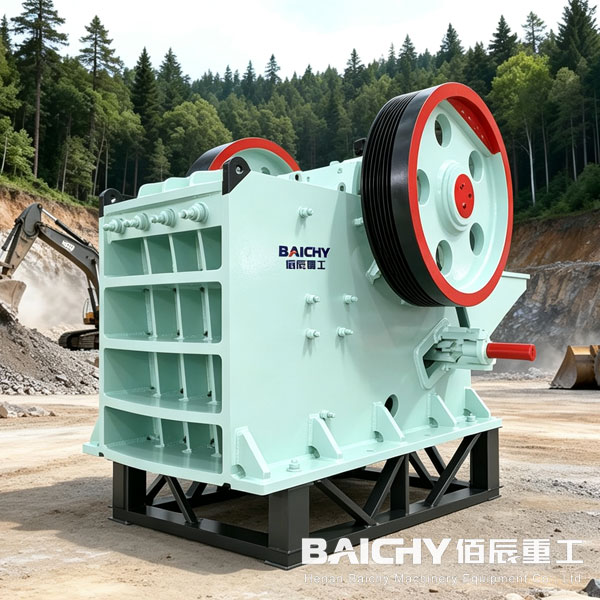
The C Series jaw crusher is built for the first, hardest job in your plant — turning oversize rock into a steady, on-spec feed for everything downstream.

If your jaw crusher is the bottleneck, the whole circuit behind it starves. Every C Series design choice below is a direct answer to a failure mode we see in quarries and mines every week.
As jaw dies wear, the nip angle and actual setting change — top size creeps up and you start closing the gap to compensate. The deep-V cavity and steep nip angle keep material moving down the chamber, so product stays consistent for longer between resets.
One end of the plate dying before the other almost always means a feed-distribution problem — and a frame that cannot absorb off-center load. Oversized bearings and a one-piece cast bearing housing spread the load evenly, so die life tracks tonnage, not luck.
A welded frame carries fatigue in every seam. The C Series frame is pinned and bolted with no welded seams, so stress is distributed through a cellular structure — and a cracked component can be replaced without scrapping the whole machine.
Excavator teeth and tramp iron are the single biggest source of sudden primary-crusher damage. Hydraulic adjustment and optional overload protection let the setting open, eject the object and close again — without a shutdown or a cracked toggle.
Jaw-die changes and bearing work should be measured in hours, not days. Lifting tools are supplied as standard, service points are limited and easy to access, and greasing and condition monitoring can be fully automated.
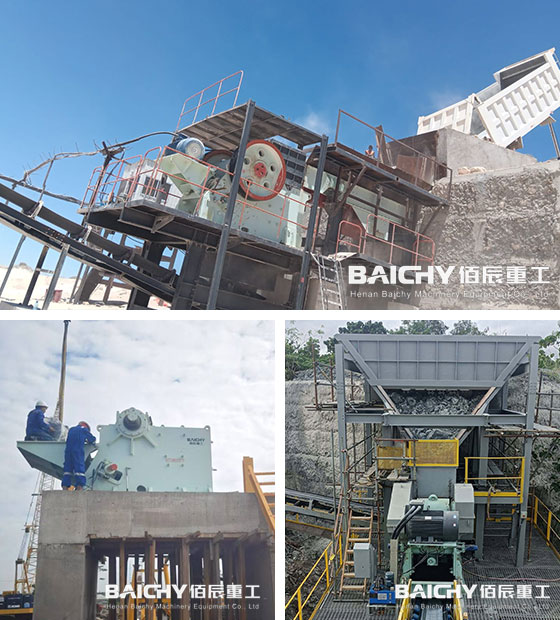
A bolt-on motor base, feed chute and guards mean less on-site fabrication. The crusher can be dismantled for transport and reassembled on site — a real advantage underground or on a brownfield retrofit where crane capacity is tight.

The feed opening sets the maximum lump you can accept; capacity is then driven by material, CSS and whether the feed is scalped. Tell us your three numbers and we will confirm the right size — and check it against the rest of your circuit.
| Model | Feed opening (W × D) | Max Feeding Size | Power | Capacity |
|---|---|---|---|---|
| C80 | 500 × 750 mm | 400 mm | 55 kW | 50 - 160 tph |
| C90 | 610 × 900 mm | 500 mm | 75 kW | 60 -180 tph |
| C100 | 760 × 1060 mm | 600 mm | 110 kW | 150 - 300tph |
| C110 | 850 × 1100 mm | 700 mm | 132 kW | 200 - 400 tph |
| C125 | 950 × 1250 mm | 800 mm | 160 kW | 300 -800 tph |
| C140 | 1070 × 1400 mm | 900 mm | 200 kW | 400 - 900 tph |
| C160 | 1200 × 1600 mm | 1000 mm | 250 kW | 500 - 1200 tph |
| C200 | 1500 × 2000 mm | 1200 mm | 400 kW | 800 - 1400 tph |
Notes: Capacities are based on defined test conditions and maximum setting; they are not a universal guarantee for every material and CSS. Actual feed-opening depth is cavity-specific. Full specifications, including speed, weight and closed-side setting range, are available on request.
The PE series jaw crusher is a sound choice for a limited budget and a medium-scale line. The C Series jaw crusher is the answer when the plant runs continuously, the rock is hard, and downtime costs more than the machine.
Rule of thumb: choose PE jaw crusher when budget is tight and the line is under ~800 tph. Choose C jaw crusher when you need high capacity, run hard abrasive material continuously, and care about cost per ton rather than purchase price alone.
We never size a primary stone crusher in isolation — the opening must match your largest lump, and the throughput must match what the secondary stage can actually absorb. Otherwise you either starve the circuit or choke it.
Determines the feed opening. Oversize that will not nip is a blockage, not a crushing job.
Hardness and abrasiveness set power and jaw-die life. We quote liner life against your rock, not a generic benchmark.
Checked against the downstream circuit so the primary neither starves nor floods the next stage.
Closed-side setting is set to hand off to the secondary — not to do all the reduction in one pass.
Most enquiries get a response within 24 hours, including model recommendation, basic flow layout and a price indication.
The C Series uses a modular, pinned-and-bolted non-welded frame, a deep-V crushing cavity and wedge or hydraulic setting adjustment. The result is higher throughput at the same opening, a higher reduction ratio, longer jaw-die life and maintenance that does not require a shutdown to change CSS. The PE series remains the better value for smaller, budget-sensitive lines.
From roughly 50 tph on the C80 up to 1400 tph on the C200, depending on model. Real output is set by feed size, closed-side setting and whether the feed is scalped — which is why we always ask for your operating conditions before quoting.
Hard, abrasive rock is where the design pays off: granite, basalt, andesite, iron ore, copper ore and similar. It also handles limestone, recycled concrete and slag. For wet, sticky or clay-rich feeds, we will spec a grizzly or scalping screen ahead of the crusher.
Yes. The modular design lets the crusher be dismantled for transport and reassembled in place, so it fits through tunnels and shafts with limited crane capacity. Installation and commissioning can be completed within a few days.
Liner life is a function of the rock, not the machine — so any honest quote gives life against your material. We stock wear parts by model and provide jaw-die and cheek-plate lifting tools as standard, so a change is a scheduled event rather than an emergency.
Standard models are typically shipped within 4–6 weeks, with engineering support through foundation design, installation, commissioning and operator training. Spare parts and remote fault diagnosis are available for the full service life of the equipment.
Save Time! Get A Detailed Quotation Quickly.