In 2026, crawler mobile crusher development is shaped by three converging forces: hybrid-electric powertrains moving from pilot to production, AI-powered predictive maintenance reducing unplanned downtime, and regulatory frameworks in major markets creating structural demand for on-site crushing. The global crawler mobile cone crusher market alone is projected to grow from US$632 million in 2025 to US$813 million by 2032, at a 3.7% CAGR . The global crawler-type mobile crushing and screening equipment market reached approximately US$1.684 billion in 2025, with a forecast CAGR of 2.5% through 2032 .
1.Hybrid-Electric and Fuel-Efficient Systems: From Option to Competitive Necessity
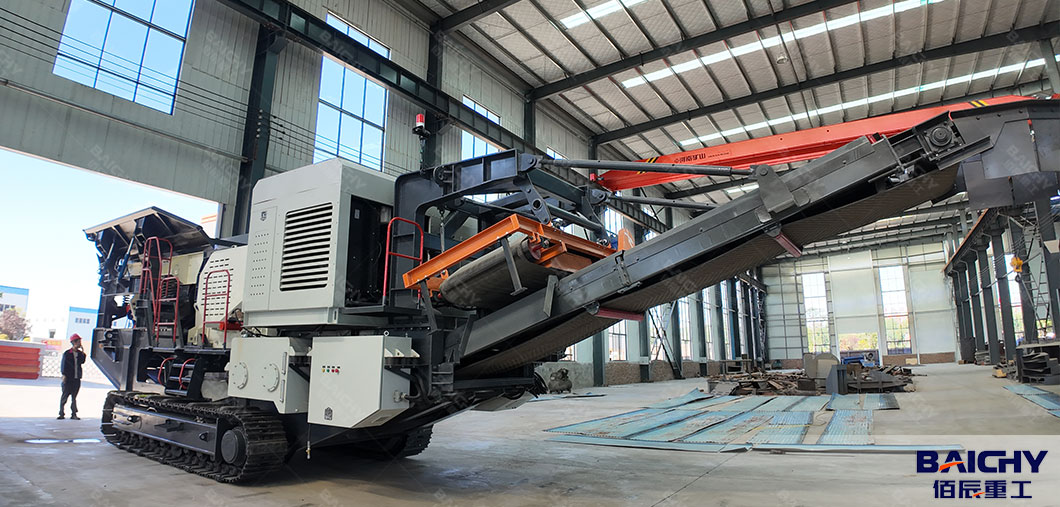
The 2026 equipment landscape shows hybrid-electric drive systems transitioning from niche offerings to mainstream configurations. Such as Baichy's crawler mobile stone crusher, weighing approximately 70 tonnes, is explicitly positioned as part of the company’s initiative to reduce fuel consumption and emissions . This reflects a broader market shift: the “focus on fuel efficient and high output crushing systems” is now identified as a major trend in the mobile crushers and screeners sector .
What this means for buyers: Fuel efficiency is no longer a premium feature—it is a baseline expectation. Operations comparing suppliers in 2026 should request specific consumption data per tonne processed under site-representative conditions. The competitive advantage now lies not in offering electric drive, but in delivering measurable fuel savings without sacrificing throughput.
2. AI-Powered Predictive Maintenance and Digital Fleet Integration
The most significant 2026 differentiator among manufacturers is not crushing force—it is the intelligence embedded in the machine. Metso’s new mobile crushers are compatible with digital tools including production performance monitoring and AI-powered predictive maintenance . Sandvik’s newly launched CH442 and CH662 cone crushers feature upgraded ACS-c 5 automation and full connectivity to SAM digital services, providing “real time and aggregated insights into performance, wear, alarms and fleet status” .
Why this matters operationally: The shift from reactive to predictive maintenance directly addresses the industry’s core cost problem—unplanned downtime. For contractors running multiple units across scattered sites, the ability to remotely diagnose a fault and dispatch the correct part before a technician arrives reduces mean time to repair. Equipment without this capability is increasingly viewed as under-specified for fleet operations
3. Regulatory-Driven Recycling Demand: The 2026 Inflection Point
Construction and demolition waste recycling has moved from a compliance obligation to a genuine equipment demand driver, accelerated by major regulatory changes in 2026.
China’s new regulatory framework: The Ecological Environment Code took effect on August 15, 2026, establishing a comprehensive legal framework for construction waste management . Key provisions include mandatory classification systems at the county level and a “manifest management” system requiring electronic or paper tracking of construction waste from generation to final disposal . The Ministry of Housing and Urban-Rural Development has explicitly stated that construction waste reduction, transportation, utilization, and disposal costs must be included in project budgets .
The practical implication for equipment demand: When disposal costs are embedded in project economics and tracking is legally enforced, on-site processing becomes financially rational rather than merely environmentally desirable. Crawler mobile crushers enable contractors to process demolition debris at the source, producing reusable aggregate and avoiding transport and disposal fees. Kunming, Yunnan province, has already established 65 disposal and utilization sites using abandoned mine restoration projects to absorb construction waste .
Global context: The EU Directive 2018/851 mandates 70% recovery of construction and demolition waste, while in North America, Infrastructure Investment and Jobs Act allocations are driving rehabilitation projects that favor mobile crushing solutions .
Decision Framework: What to Evaluate in 2026
Step 1 — Quantify your fuel and power flexibility requirement. If your operation has access to grid power at fixed or semi-fixed sites, hybrid-electric capability offers the clearest operating cost advantage. For remote or rapidly relocating operations, verify the hybrid system’s diesel-only fallback performance before committing.
Step 2 — Assess fleet management capability needs. If you operate more than two crushers, telematics and predictive maintenance are no longer optional. The ability to remotely track wear, diagnose faults, and schedule maintenance based on actual condition rather than fixed intervals reduces both downtime and parts waste.
Step 3 — Verify regulatory compliance for recycling applications. For construction waste processing, confirm that your equipment configuration supports the manifest tracking and classification requirements now mandated in jurisdictions like China . This may affect documentation workflows even if the crusher itself is compliant.
Step 4 — Validate supplier digital service commitments. Ask suppliers for specific examples of predictive maintenance alerts that prevented failures, and request references from operations using their fleet management platforms. The technology is only valuable if the service infrastructure behind it is operational.
The 2026 crawler mobile crusher market rewards buyers who evaluate total lifecycle cost and regulatory compliance alongside purchase price. Hybrid-electric systems deliver measurable fuel savings and are increasingly standard rather than premium . AI-powered predictive maintenance reduces unplanned downtime and enables condition-based scheduling . Regulatory changes in China and continued enforcement in Europe and North America create structural demand for on-site recycling capability . The crawler mobile crusher market’s projected growth to US$813 million by 2032 confirms that demand for mobile crushing capability is structural, driven by urbanization, infrastructure renewal, and the shift toward circular economy practices in construction.




 2026-10-16







 86-15093113821
 86-15093113821